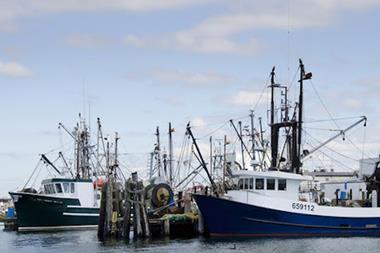
Commercial fishing is regarded as the most dangerous profession on the planet. But while Western authorities have been tightening safety regulations, flagrant risk taking with crews'' lives is still rife, writes Menakhem Ben-Yami.
When I was young and keen to catch as many fish as possible, and was about to get my first command of a 60-foot trawler, an elder skipper told me: “Now as a skipper you must always remember that first at all you must bring all your crew safely back home; secondly, you’ve got to bring your boat back to the harbour; next, try to return with all your trawl gear onboard; lastly, it would be good if you also bring fish.”
Recently, President Obama authorised a major overhaul of fishing safety laws – and not a moment too soon. Commercial fishing is considered the most dangerous profession in the United States, as it is worldwide. And, reportedly, the most dangerous fishing area in US waters is off the northeast coast, with its groundfish fisheries.
King crab fishing in the Bering Sea is dangerous business indeed, but contrary to what the ‘Deadliest Catch’ television show suggests, it is not the deadliest.
A recent government report includes data collected from 2000 through 2009, a period that saw 504 deaths throughout the US fisheries. The Bering Sea crab fishery is only the fourth most dangerous, behind the northeast groundfish sector, Atlantic scallop fishery and fishing for Dungeness crab off the US west coast.
According to Dr Jennifer Lincoln of the Centers for Disease Control and Prevention (CDC), the lead author of the report, this is because fishing vessels in the northeast sail further out, have larger crews, and their trips last longer. So when a vessel sinks, there are more lives at risk in the cold waters off New England.
There are different hazards and dangers in different fisheries, she said, which require different safety measures.
In the 1990s, measures recommended by the CDC significantly reduced accidents and fatalities in the Alaska crab fishery. Then in 2007, the agency expanded its surveillance to include the rest of the US fishing areas.
Although more people are surviving vessel losses, Lincoln said, the share of fatalities from falls overboard is unchanged at 30%.
While marine fishing is in general the most dangerous of all civilian occupations, safety in small boats ranges from unsatisfactory to miserable. Some 15-20 million small-scale and artisanal fishermen worldwide fish under conditions for which, especially in developing countries, their boats as well as safety and first-aid equipment, survival, and communication are inadequate, and search-and rescue (SAR) and early warning services are often nominal or non-existent.
There's a general lack of realistic legislation, enforcement, training of fishermen and trainers, technical support, prevention and warning systems and professional requirements.
International intervention
When, in Western countries, a sinking of a fishing vessel with several crews usually receives wide public and media attention, tens of boats with numerous fishermen missing in the West African surf, in cyclones in the Bay of Bengal, or typhoons anywhere between Indochina and Indonesia hardly earn a mention in the daily news beyond the immediate area.
Therefore, within the domain of developing nations’ small-scale and artisanal fisheries, there’s an urgent need for international and national action aimed at: (1) accident prevention; (2) reducing human and material casualties of accidents; (3) improvement of alerting capacity of the search-and-rescue systems to distress situations; and (4) improvement of such systems where they exist and establishing them where still missing.
International technical co-operation is needed for training schemes, manuals publication, design of safer fishing craft, and coastal flood and-storm shelters. Naval and air forces can and in some countries participate in weather warnings and SAR activities.
Fishing people's participation in setting up safety measures would make them better followed and more enforceable than if concocted by government experts and bureaucrats alone. The same goes for fishery management that carries safety-related ramifications that non-fishing legislators may overlook and that may involve incentives for risk taking.
On the other hand, authorities may create incentives for safer fishing, for example by not taxing safety, survival, first aid and communication equipment, and by awarding safety-related prestige and material prizes.
Safety at sea
Fisherfolk-based SAR schemes should be encouraged and supported, and rescue teams organised, trained, and equipped. Onshore and anchored at sea beacons should be set up, and small fishing boats be equipped with radar reflectors for collision preventing and for situations requiring SAR intervention.
Mechanised boat-beaching facilities should be installed where beaching through surf is dangerous. Small boats, canoes and skiffs should be made unsinkable by fitting in floatation boxes or even by fitting inside empty plastic containers, and equipped, if necessary through outside assistance, with communication means and distress signals.
In North America, Europe and some Asian and Pacific countries, where owners of fishing vessels can afford it, these are radio-communication sets and such appliances as automatic distress buoys triggered when submerged to transmit through orbiting satellites emergency call and position.
In higher attitudes, wearing survival work wear may drastically improve chances for survival in water, especially if fitted with the new, Norwegian-made wireless ‘man overboard’ system. This is capable of stopping small one-man fishing vessels if its wearer falls overboard, and to trigger an alarm and indicate the vessel’s position.
But however modern their electronic and other equipment is, small and medium-scale fishing fleets boats still capsize. A US Coast Guard analysis of 934 deaths between 1992 and 2007 assigned 55% of the fatalities to vessels flooding, capsizing or sinking.
Capsizing occurs mostly due to inadequate stability, for example, when a boat is top-heavy with a deck load of fishing gear, especially heavy pots, and fuel tanks partly empty. Stability and LWL tests, therefore, should be performed not only when the vessel is loaded optimally, but when loaded as under tough working conditions.
Any change in deck machinery and above-the-deck structures should be a subject of obligatory stability testing.
Last, but not least is the question of skippers’ certification. Unfortunately, unlike car drivers, in the US and some other countries uncertified skippers are allowed to take out boats with crews into the ocean. In view of the industry’s persistent resistance, I’m afraid that this scandal will stay put.