



Worlds first above the water-line propeller system
Marine propulsion research and development company, Contrapel Ltd, has released details of its new propulsion system for boats, which aims to make future boats more economical, manoeuvrable, safer, stronger and better for the environment.
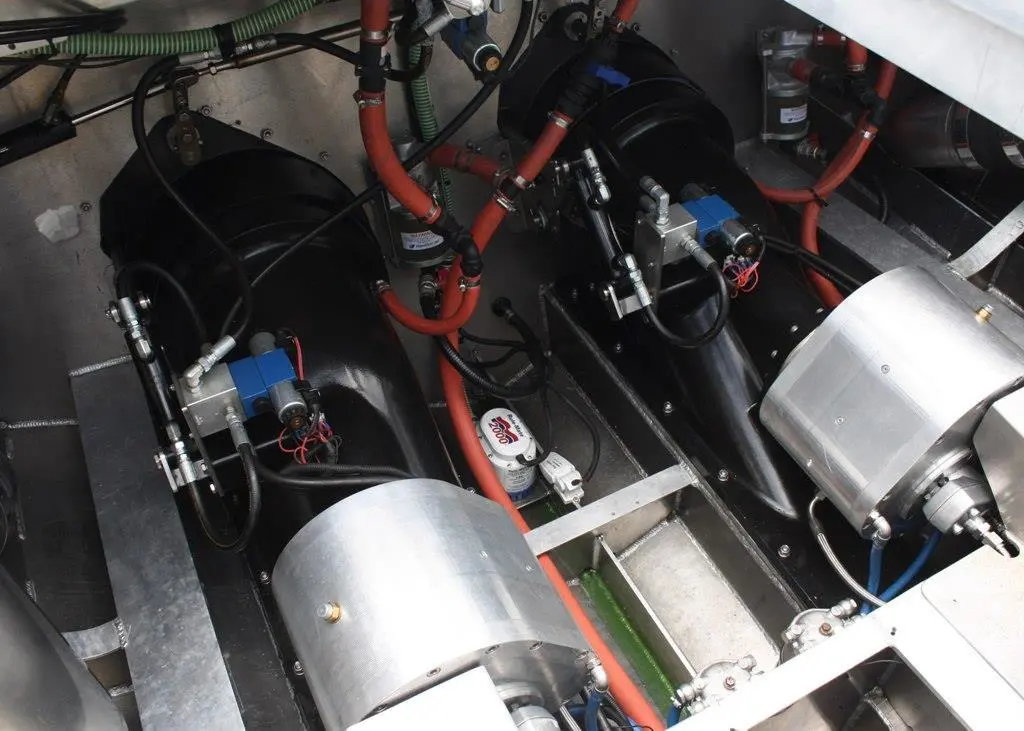
The Contrapel Hybrid Drive is a system said to be so advanced that it carries out all the functions of both propellers and water-jets with none of the drawbacks of either.
“The Contrapel technology is a propeller system working above the waterline. Externally it resembles a traditional water-jet, however internally the method for developing thrust has much more in common with conventional propeller systems,” says Contrapel founder and managing director, Barry Davies.
The Contrapel drive uses a pair of contra-rotating, fully enclosed hybrid propellers, capable of operating above the water line. The mode of operation of the hybrid propellers is to accelerate the water from out of the intake (pick-up) duct and then discharge it through the outlet, requiring only enough backpressure downstream from the propellers to keep the system primed. This contrasts with the traditional jet, which does not accelerate the water until further downstream in the nozzle section, which requires the generation of high pressure.
The Contrapel Hybrid propellers produce lift in a similar way to open water propellers, by using slippage. The use of hybrid propellers enables the mass component for each revolution be maximised and the plume velocity to be minimised. This contrasts with the low mass per impeller revolution and high-plume velocities present in conventional high-speed water-jet designs.
According to Contrapel’s own on-water tests, the higher efficiency of the new system provides several improvements compared with boats that are equipped with traditional jet drive installations:
- Vastly improved thrust at low and mid speeds
- Better fuel economy at low and mid speeds due to vastly improved control
- Highly survivable and operable in extreme conditions, including brown and black-water environments
- Will lower global marine carbon footprint
- Significantly lower noise and vibration levels
“Unlike the propeller however, it’s a complete solution for the entire global industry, since it’s scalable to all sizes and works equally well above or below the water line”, said Mr Davies.
The rotating speeds of the hybrid propellers are also very low, which generates low noise and little wake turbulence. The Contrapel Hybrid Drive boasts ‘propeller-like’ thrusts at all speeds, but unlike propellers the Contrapel Hybrid Drive propellers are enclosed in a stainless steel tube that is screened to ensure objects cannot be ingested. This means that animal life; people and fragile seascapes are protected from damage.
The system has a high tolerance to wear caused by small particles in the water, equating to minimal performance loss due to damage or wear – a benefit over high-speed water-jets.
Currently tested in 190mm, 270mm and 330mm diameter configurations, the Contrapel Hybrid Drive is able to suit a variety of marine propulsion applications, including fishing vessels.
“The Contrapel Hybrid Drive system is completely scaleable and will offer entirely new ways to solve problems encountered in just about every sphere of the marine industry,” said Mr Davies.