



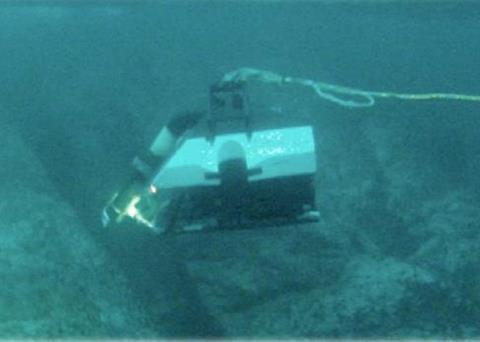
Nofima tests have shown that the remotely-operated underwater vehicle (ROV) ‘Seabed Harvester’ harvests more sea urchins than divers, and can harvest them in conditions that divers can’t.
Sea urchins are one of the world’s highest paid seafood products and several companies have attempted to establish commercial harvesting of this species along the Norwegian coast, with a couple of companies being successful.
One of the main bottlenecks for the development of a sustainable sea urchin industry is a reliable and cost efficient harvesting method.
Traditionally sea urchins have been harvested by divers, but the extreme conditions in Northern Norway make it difficult to dive for sea urchins in winter.
Scientists from Nofima have tested the ROV during the Polar Night, when the weather is at its worst.
The tests took place in January in Båtsfjord in Finnmark. Strong winds meant that the estimated temperature was as low as -40 °C. This is too cold for divers, but the ROV could still operate normally.
After four days the ROV had harvested a total of 1.88 tonnes, of which 35% was high export quality sea urchins. A full 52% of the catch was of sufficient quality to be sold. The average daily harvest using the ROV was 146kg. This is higher than what was previously harvested using divers, around 91kg per day.
“This shows that in all likelihood Seabed Harvester is the most efficient harvest method for sea urchins in demanding winter conditions in Northern Norway,” says scientist Philip James from Nofima.
“There are several factors that make it more efficient than the divers. It can be used during winter, in poor weather conditions and at greater depths, while the sea urchins are of the same quality as those harvested by the divers.”
The ROV may also be used to inspect seabed conditions and stocks over larger areas.
Estimates show there may be up to 80 billion individual sea urchins along the Norwegian coast, which constitutes 56,000 tonnes. The market value of these sea urchins has been calculated as NOK 6.2 billion by Nofima.
“In Båtsfjord, where we operate, diving is very unpredictable and 200 days a year the weather is too extreme to use divers,” says Mattis A. Tangeraas, general manager of Norway Sea Urchin AS.
“The ROV cannot operate 50 days a year so that will give us an additional 150 harvesting days per year. But in order to gain financing for such an ROV, long-term testing needs to be carried out over several months in order to confirm the potential.”
Several factors remain before the ROV may be used in an optimal manner, including the support vessel being better adapted to the ROV, as an ordinary fishing boat was used during testing.