




Rapid in line defrosting of fish and seafood
Traditional defrosting methods introduce a number of difficulties directly related to the heat transfer mechanisms, says Stalam, a developer, designer and manufacturer of radio frequency (RF) equipment.
The company says that traditional defrosting is a slow process which can take hours, sometimes days. Bacteria growth in the product is also an issue, along with high drip loss, deterioration of the product surface, and batch processing which can result in high handling costs, risk of breakage, bruising and other damages to the product due to such handling.
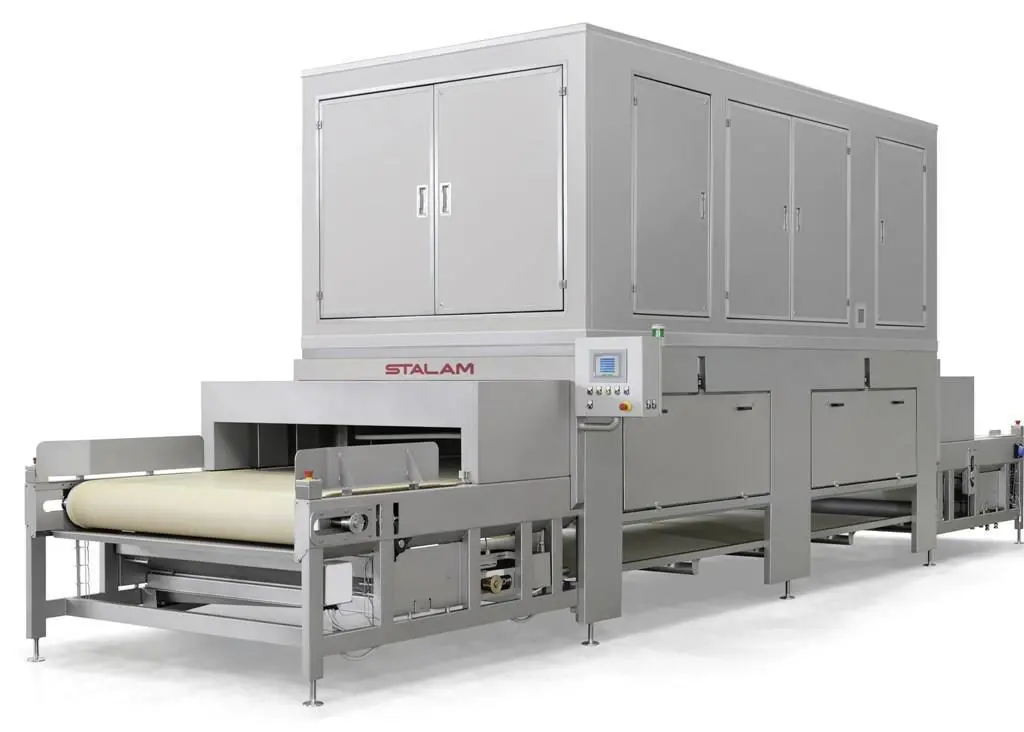
According to Stalam, the drawbacks of the conventional defrosting methods can be avoided, thanks to the ability of the Stalam RF machines to rapidly generate heat volumetrically within the product. The heating process is uniform and controlled, resulting in a significant reduction of drip losses. It also offers great flexibility in production schedules and is the ideal solution for many tempering, softening and thawing processes.
The product is placed on the machine’s conveyor belt and is transferred through the RF unit (tunnel) passing between upper and lower metallic plates (electrodes). When the RF generator applies high frequency alternating voltage between these plates, the dipolar water molecules of the frozen product will vibrate and rotate in the attempt to align themselves according to the fast changing opposite plate’s polarities. This phenomenon causes intermolecular friction, which will in turn generate heat rapidly and uniformly within the whole product mass regardless of its size, weight, shape and thermal conductivity.
The amount of heat generated inside the product and the defrosting time are accurately controlled through the voltage applied on the electrode plates and the speed of the conveyor belt.
The main benefits of the Stalam RF defrosting method are: Defrosting is achieved in minutes rather than hours/days; the processing speed and uniformity minimises product degradation; the product can be obtained at the correct temperature needed for the next stage of processing; radio frequency defrosting can be carried out continuously; and radio frequency equipment requires much less floor space compared to the traditional methods.
Stalam S.p.A.
Seafood Processing Global, 26-28 April 2016, Brussels, Belgium
Hall 4 Stand 6351