



Perkins introduces new six-cylinder engines
Perkins has expanded its marine diesel engine offering to include four new low-revving, low-stressed engines for pleasure craft and light, medium and heavy duty commercial vessels.
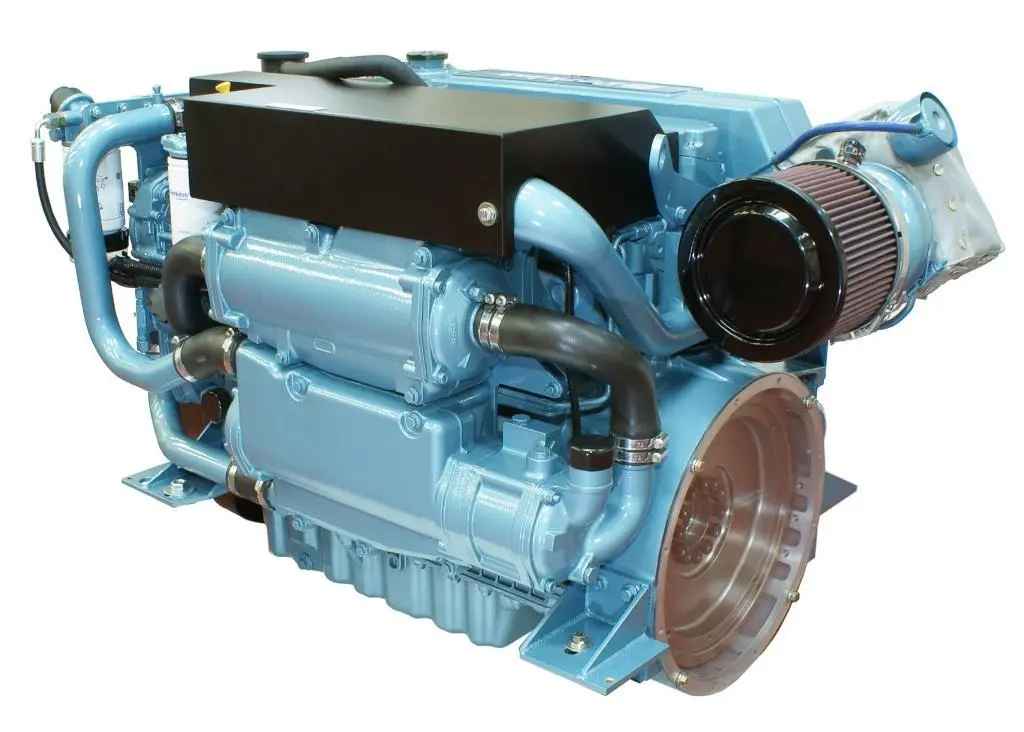
Based on a common platform – the Perkins 1106 Series engine – the four new Perkins engines have been introduced as superior replacements for previous six-cylinder marine models. They are: the 2100rpm 190hp (142kW) heavy-duty M190C; the 2400rpm 216hp (161kW) medium-duty M216C; the 2400rpm 250hp (186kW) medium-duty M250C; and the 2400rpm 300hp (225kW) light-duty M300C. All are approved EPA (Environmental Protection Agency) Tier 2, IMO2 (International Maritime Organisation), RCD (Recreational Craft Directive) and CCNR (Central Commission for the Navigation of the Rhine) stage 2 emission standards.
Assembled on a new high-technology production line, these 6.6l, turbocharged, charge air cooled engines are ultra clean, with enhanced high-build quality that provides excellent fuel economy and low heat rejection, increased delivered power, torque and noise reduction. They have been designed to ensure ease of installation, so are suitable for both newbuild and repower installations.
Range of applications
They are suitable for a wide range of applications that – depending on the particular model – includes high-speed commercial fishing boats and customs and police launches, passenger carriers and sport fishing charter boats, pleasure cruisers and blue-water sailing craft.
They share a common package size, measuring 1328mm long by 805mm wide by 828mm high. The M190C and the M216C have a dry weight of 698kg and a wet weight of 736kg, while the M250C and the M300C have a dry weight of 700kg and a wet weight of 738kg.
The new engines utilise Caterpillar ACERT technology components. New features include changes to combustion areas and turbocharger geometry, increased cylinder displacement and, significantly, the inclusion of a high-pressure, common rail fuel system. Other features include a complete fuel system with multi-shot fuel injection, air cleaner, gear-driven auxiliary and jacket water pumps, integral oil cooler, high-capacity heat exchanger with cupro-nickel charge cooler and keel cooling, isolated timing case and sump. The engines also boast electronic engine control and automatic cold start control for water temperatures as low as minus 15 degrees C.
All four models incorporate a choice of alternator and front power take-off, and are suitable for operation in sea water temperatures up to 39 degrees C. They are worldwide fuel tolerant, including kerosene, jet aviation fuel and B20 biofuel.