

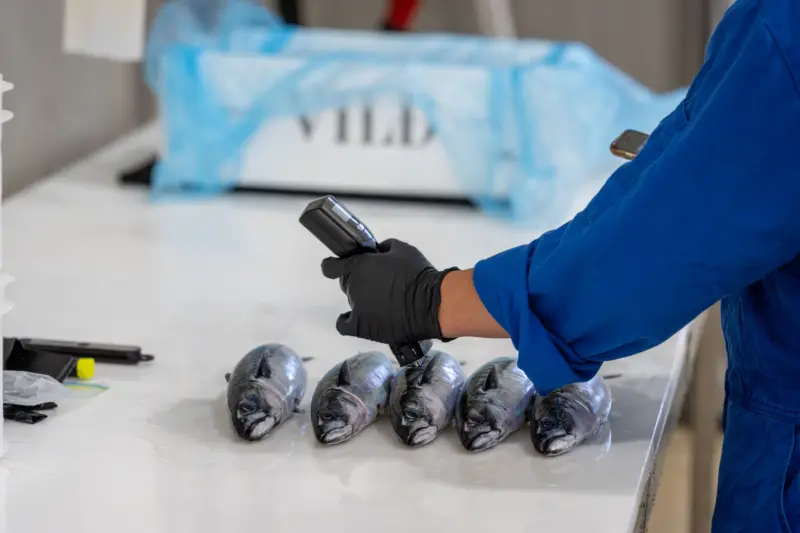
Partners in seafood quality not crime
The VMD’s random tests include local and imported fish for residues of regulated or banned products and antibiotics. Where levels are breached, VMD reports to the country of origin for action, and to Brussels which passes on the information to all EU countries’ inspectorates. Non-EU countries have to provide “equivalent guarantees” under the standards required for EU states, and imports must meet EU requirements.
The process
Steve Dean and his colleagues believe it is better not to criminalise but rather persuade producers that good practice should run from catch to table. VMD’s remit for testing trout
and salmon includes cadmium, tetracyclines, quinolones, chloramphenicol, dimetridazole, nitrofurans anthelmintics, benzimidazoles, ivermectin, mycotoxins malachite green, leucomalachite green. VMD also monitors anti-microbial resistance and suspected adverse reactions to permitted medicines. The picture is constantly improving with fewer and fewer infringements found.
I spent a day with Steve Dean, his colleagues and independent, expert advisers and he says: “All the elements of residue testing [in the UK] are coordinated by us”. Each country’s data go into a central pot with the EU Commission “so that we can [all] look at the residue studies… and for trends. For example, if we are aware that a certain country is using a certain antibiotic in prawns or chicken, will be looking for that.”
Steve Dean says the formal and informal networks work very fast and the centre knows extremely quickly if a problem has been found. In specific cases they have been able ‘almost immediately’ to stop other imports around UK and European ports.
He believes the same networking approach could also be useful across other regions such as South Asia, West Asia, Southeast Asia. He suggests that it is best to avoid the danger of double standards, where the product for export is produced to different standards than for local sale. “We had that years ago in the UK when we were killing animals to UK standards and then a totally different standard of quality for export meat. That’s been rectified. It takes time. One would hope that, by putting in place standards for the export [product], you raise standards for the local population as well.” The next step should be worldwide standards for all food production, he added.
Food scares
One of the problems for the food press is how long it takes inspectorates to find a problem and then put it into the public domain. The press does not want to cause a food panic about a problem which is months old. When can the public get good, up-to-date and also risk-balanced information on the Web etc.?
“I think we have a lot of work to do in this area. Up to now the approach of government has been to test, and thereafter reassure. The problem we have, of course, is that the modern person does not trust governments entirely. So what we have to be able to do is give people the information.
The problem we have is the system is set up on the basis that ‘I will test your product but the results are between you and me’. The modern trend, which we are looking at more and more, is that effectively you take ownership of your results, in other words ‘name and shame’. [On the Web] we have done one or two pieces of work where we have named f – where we have found both positives and negative.”
But, he says it should be called “Name and Act”. “If [a company] has had tests [carried out on their products] and they were negative you [the public] should know that, as much as knowing [other companies whose products were] positive. And by doing that, at least at the producer level, in terms of the supermarkets and the outlets, [then] people can see these [companies] are buying from reputable sources because their samples are clean, and that’s the evidence they have. We need to do more of that.”
However, he says that embarking on across-the-board testing and making sure you are publishing absolutely confirmed, detailed results carries a cost issue. He says very detailed, forensic testing costs a “huge amount” and
raises the question of whether the taxpayer or the industry pays. “And that’s the challenge for those of us doing the testing,” he said.
If a good job is being done by the
food industry (he believes it is and
that this is reflected by the fact
that residues picked up now are below one per cent of the samples tested), he says you have to ask “where’s the justification for spending yet more money to test.”
I suggested to him that, say for the 55 million people of the UK, the cost of making sure their food is safe through the work of VMD was ‘peanuts’. I asked him how many staff he had. “We’ve got less than 10 people dealing with residue work.” Total staff? “140, doing authorisation of medicines, [full time] equates to about 120.”
I said this was tiny compared to the responsibility. “Of course it is tiny!”
Crime & education
Perhaps he is too modest. I tease out of him the new thinking he has brought to the VMD. “Being true government regulators, your first response is: ‘let’s prosecute the people’. But you very rapidly find the feedback is: ‘This guy just did not know he was doing wrong’. So it comes back to an educational base. You need to get out to the people and this has been a new concept”.
And how do you spot the cheats and not criminalise those who want to produce quality at a decent price? Steve Dean knows the backyard: while he lectured for years he has also worked as
a vet in general practice and there were long spells in the pharmaceutical industry.
He says residue surveillance “…is not done to catch people out — it is a quality check. We can evaluate if it’s ignorance [on the part of the producer] or deliberate intent.”
You have to be “very understanding”, he says, about the pressures on the producer and cannot expect him to be an expert in all areas. Very often he may have bought something he should not have but he wasn’t aware. “It looks pukka material, it looks the right stuff, why shouldn’t he use such material? He gets caught out and it is then that the VMD “has an opportunity to give him advice and bring him into the community of those people who are producing quality products”. It makes much more sense to educate and therefore help people comply, and improve quality that way, than put someone out of business by taking them into court, he said.
He says that if someone is taken to court and fined, no one notices. However “The power of the type of naming and shaming exercise is huge. But, if you’ve got a list, that people can go to which says ‘Waitrose [supermarket] produce damn good fish from fish farms in Scotland, because they buy from accredited people who produce an accredited product and the chain is all complete and we know where it is going and we know what we are eating’. This is far more powerful.”
Independence
“Instead of being the usual type of civil service situation, where you keep your head below the parapet and hope no one notices you, the ambition of the VMD is to make people notice and to have [more open] meetings where people are able to stand up and voice their issues.
“The big challenge though, is how you articulate all the complexity of the work. It is very important that you end up with people who are believable, and to be believable you need to be independent.” That’s why they use government and independent laboratories that are not locked into commercial interests, he added.
The VMD is keen to keep its independent profile. There has been cost-cutting talk for months from the UK central government. This could mean VMD being squeezed into the workings of a bigger, perhaps faceless setup, in order to lower costs by giving them all the same ‘backroom functions’. Some experts who are supporters of VMD’s work and independence do not see this as a wise move.
I pointed out again that, per head of UK population, VMD’s outlay seemed to be massively cost-effective.
“You raise a very important point. The European sector has at least recognised [this] under the Lisbon agenda. If you have a foot-and-mouth outbreak (and we’ve got a potential avian flu one on our doorstep) it is not really the cost of the outbreak in terms of the animals that get slaughtered or the farm businesses that suffer. It is the wider impact, for example with foot-and-mouth on tourism, that had a much bigger impact across the country than any issue.” He said the slaughter was horrible. “But that is a small amount compared with the real impact. So the real impact of veterinary medicines legislation is huge. The tragedy is, if we do a good job we don’t get noticed. But that is perhaps where stakeholders can help”.
“The one thing I’ve learnt is … for a small organisation we have a huge range of stakeholders…we need listen to these people … They might be the litmus paper that we’ve got a bigger problem.
“I stress again. The VMD is not just dealing with the UK. We are part of the European agenda. We happen to speak good English. If there are English-speaking fishfarmers out there, wherever they are in the world, they need to know what is going on in Europe, then we are a portal for them to find out. What I am not sure of is whether we have prepared ourselves to be that portal. But that’s coming.”
Perhaps the valuable export market forced countries such as India or Vietnam to have more modern plants for processing than many EU installations. Europe may think it is superior but perhaps European has to catch up?
“You’re absolutely right. If you are building any new plant from scratch, you have the ability to put in all of the quality stuff. I don’t think we are necessarily behind [in Europe]. … the question is, what quality systems you put into that plant.”
Related Articles
 SEAFOOD
 SEAFOOD
 PROCESSING & REFRIGERATION