




Nozzle improves fishing efficiency
Built in 1988, MV “Trygvason” is a single-screw trawler originally equipped with an open-type, 2600mm-diameter CPP.
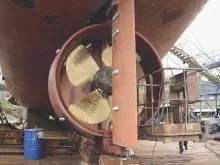
The vessel is powered by a Wärtsilä Nohab F38A with an output of 1580kW, running on marine diesel oil. According to a recent Wärtsilä report, to save fuel, the owner was seeking a propulsion retrofit with an attractive Return On Investment (ROI).
Wärtsilä’s proposal was a modern propeller design of diameter 2400mm operating in a high efficiency (HR) nozzle. Calculations indicated a bollard pull increase of 29% and a 13% improvement in free-running efficiency. Operating parameters in both sailing and fishing conditions were optimised. The ROI for this rebuilding was calculated as being less than two years.
As the original propulsion unit was not a Wärtsilä design, measurements were made on a spare propeller blade to establish the blade geometry. Both hydrodynamic and mechanical calculations were performed to define the maximum hub loading. Cavitation calculations provided reference values for noise and vibration.
Using this data and a technical specification, new geometry for the propeller blades was produced. Wärtsilä’s state-of-the-art computer techniques make it possible to not only improve bollard pull and efficiency, but also to reduce hub loading. In this case, the nozzle effect meant that the new design’s cavitation and pressure-pulse performance offered a considerable improvement over the vessel’s original equipment. Both noise and vibration levels remained well within reference limits.
The retrofit was carried out in Norway and the trawler was out of operation for about two weeks. Trials showed a bollard pull close to 30 tons – calculations had indicated 27 tons. Before the retrofit, the bollard pull had been 21 tons. The owner also reported a reduction in fuel consumption of approximately 30%.
The trawler now uses less fuel when pulling a specific net, or can trawl using a larger net.
The owner of the “Trygvason” is very pleased with the overall result. “It’s much quieter onboard now,” says Captain Støle Lønning. “In the first year, we used the boat just as it was when we bought it, but it became very expensive to run. Even though it wasn’t the cheapest option, Wärtsilä’s nozzle solution was the most effective. We can now use more efficient trawling equipment, and we haven’t suffered any loss in sailing speed, something which has happened to others.”
Wärtsilä offers propulsion improvement for both Wärtsilä and third-party installations. Following an initial assessment, deliverables are a budget price, an indication of the resulting efficiency improvement and the estimated ROI. The entire conversion process from initial discussions to sea trials of a new installation takes 6-12 months.