

Multi-storey RAS for high-value production
While working in Norway between 1998 and 2014, Dr Woo-Jai Lee, CEO and founder of genomics and precision-breeding aquaculture firm BluGen, gained a deeper insight into the South Korean fish farming industry. But he was shocked by what he saw.
“At that time, South Korea was a leading country in many industrial sectors such as cars, electronics and shipbuilding,” he told WF. “However, fish farming was far behind major leading countries with extremely segmented value chains, poor sustainability practices and high inefficiencies. And yet, I saw that there was huge potential for the industry, and that the main reason behind the lagging development was the market situation. Fish farmers didn’t need to invest in R&D and new facilities for better production because they enjoyed a still-profitable market in which demand far outweighed supply.”
Lee founded BluGen in 2013 to introduce more sophisticated genomics and breeding technology, as well as recirculating aquaculture systems (RAS), to South Korea.
Hoping to change the country’s underdeveloped fish farming industry into a more modern and efficient one, Lee, who has over 20 years’ experience in genomics and breeding projects in Norway, is developing a system that can attract sound investments and offers new opportunities for younger workers – South Korea’s first RAS for olive flounder (Paralychthys olivaceus).
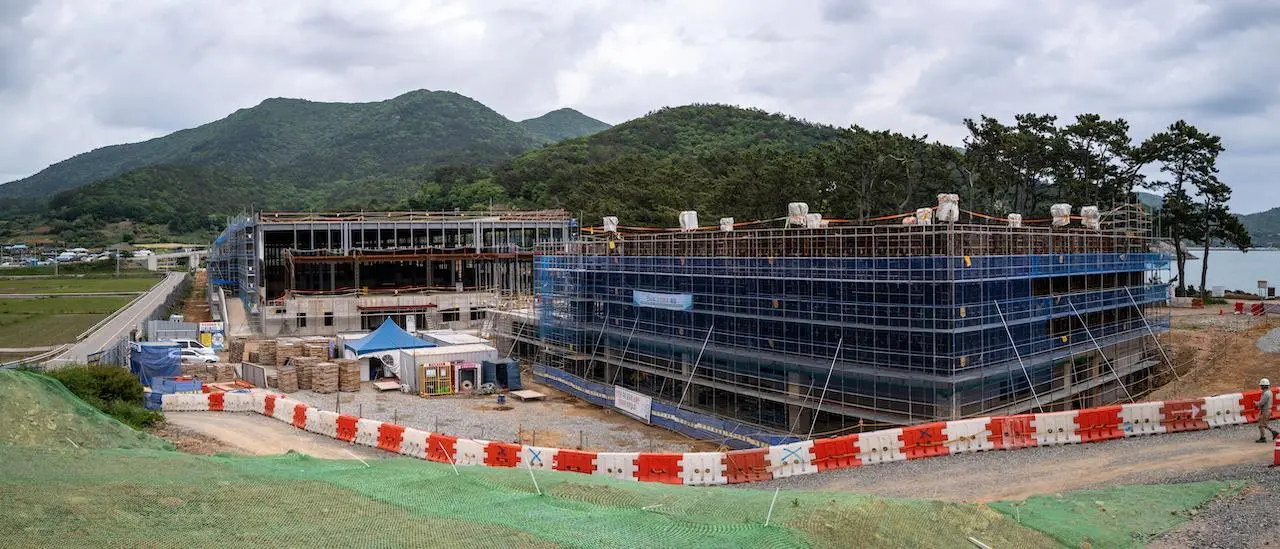
Located in Goheung, Jeollanam-do Province, one of the southernmost areas of the Korean peninsula, the 2,000-tonnes per year facility will include a hatchery of 2,000 breeder fish that are made up of 300 families. These will produce around 40 million units of juveniles each year.
There will also be shallow grow-out raceways of around 45cm in depth, built by Norwegian fish farm innovator SIFT Group (SIFT Group has developed a new concept for raceways and efficient water treatment technology, which makes an intensive farming density possible). Because the raceways can be stacked, shallow raceway designs will optimise footprint and increase production volume. For dwelling species like olive flounder, the density can be kept as high as 70kg/m2.
The aerobic and anaerobic phases have been separated and water treatment capacity and energy consumption rate both improved, while the concepts of sustainable and healthy (no antibiotics) production will be introduced for the first time. Construction is around 80% complete, and production is expected to begin by the end of 2023 pending no delays.
Industry firsts
The facility will house and vertically-integrate components of the value chain that currently do not exist in South Korea – from R&D to broodstock management to grow-out – in an environmentally sustainable way and bring a new standard and approach to aquaculture in the country.
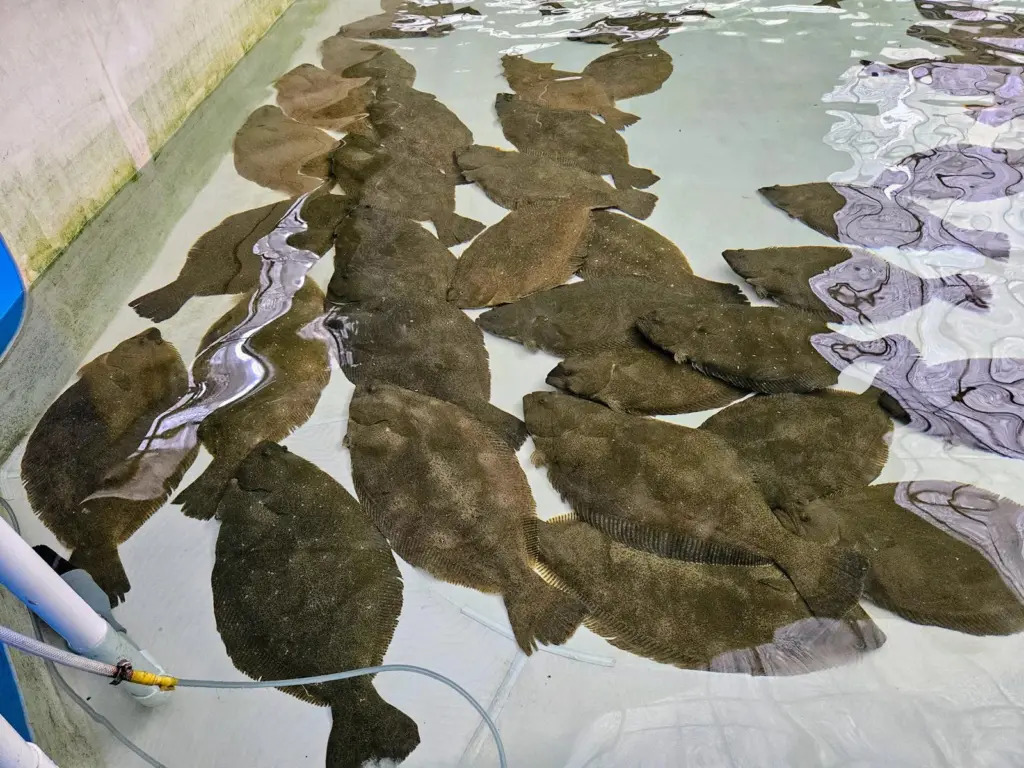
The olive flounder will be fed extruded pellets based on BluGen’s own proprietary formula (insect meal and other alternative formulations and combinations are currently being investigated) and grow at an FCR of 1.1. Although the vast majority of farmed olive flounder is around 1kg or less in size, BluGen is planning to grow the fish to the 2-3kg mark to fulfil a rarer market segment and fetch premium farm gate prices.
From stocking, it usually takes 10 months to reach 1kg, 14 months to 2kg and 18 months to 3kg.
According to Lee, olive flounder is native to South Korea and arguably the most important fish domestically in terms of consumption, seafood identity and representation. Current domestic production sits at around 45,000 tonnes per year, of which nearly the entire supply is consumed domestically.
Olive flounder is also important in Japan, and consumption is assumed to be around the same as that of South Korea. It is also widely consumed in China.
Demand for the species in South Korea, Japan and China has been on the rise, but supply has been decreasing due to production challenges from disease and climate change, while there is still a significant dependency on wild catch and flow-through systems.
Pivotal project
The average Korean flow-through farmer experiences 65-70% mortality rates between the points of stocking juveniles to harvest, said Lee, who is also aiming to demonstrate the economic viability of his new RAS facility. These types of facilities should be conceived with a strong species-market match, a biologically RAS-friendly species and excellent value chain support, he said, and these are all elements that make BluGen a compelling project from an investors’ point of view.
“BluGen may be one of the most pivotal projects in South Korea’s aquaculture history,” said Lee. “Our inception was in genomics R&D, and we have selectively bred nine generations of olive flounder to produce what we consider a genetically superior fish. We are the only company in the world that has mapped the whole flounder genome, with a proprietary selective breeding programme that integrates and implements the entire value chain from disease challenges and vaccine development programs to feed development.
“This is the first time that we’re introducing genomics-level selective breeding and other value-chain technologies to commercial-level operations, and we are building the country’s first RAS project. We have the strongest olive flounder broodstock in the world and hope to pioneer a successful RAS deployment strategy for the domestic and international aquaculture community in areas including production, sustainability and investability.”
Lee is confident BluGen’s combination of selective breeding and RAS facility means its olive flounder will have better survivability and grow to a larger, more attractive size. The species is also particularly sensitive to water quality and disease and doesn’t require deep tanks, he said, which makes it suitable for shallow raceways that offer controlled and stable growth conditions while maximising production.
Olive flounder also grow optimally within a certain temperature range, which RAS can provide, while the new facility should also be able to reduce mortality dramatically by treating the intake water and switching the feed from moisturised pellets to extruded pellets. Both steps can also block most of the pathogen introduction to the farm.
International potential
The National Institute of Fisheries Science (NIFS) and the South Korean government have recognised the commercial and symbolic importance of BluGen’s work. Both support the initiatives for implementing new technology to improve production efficiency and ultimately give farmers a strong position in the markets.
So far, BluGen has received support for actual farming practices, and for this particular project, a US$3.2 million non-dilutive grant from the South Korean government to begin construction.
“There are a lot of eyes on BluGen, since with a proof of concept, it will transform the South Korean way of farming olive flounder,” said Lee. “The domestic farming industry is waiting for BluGen to begin production. Their intent is to partner and cooperate with us throughout the whole value chain of the olive flounder farming sector. There are already several entities and regional governments within Korea that are interested in partnering with BluGen to accelerate this new way of farming.”
“We are also seeing a lot of focus on RAS projects, and we know that olive flounder is an uncommon species – at least to Western markets – that we can put on the map, with the successful implementation of RAS,” continued Lee. “Although yet to be discovered internationally, olive flounder is known for its texture and mild but delicious flavour, and we believe that it will continue to do well, for example in high-end Japanese restaurants.
“It’s an appealing and versatile species that can be successfully marketed and propagated worldwide. Right now, the current BluGen project won’t be able to supply much to export markets, so in future we plan to seek opportunities to farm the species near the export markets, together with ambitious investors.”
Related Articles
 SEAFOOD
 AQUACULTURE
 BUSINESS & FINANCE