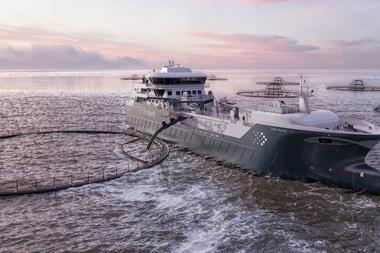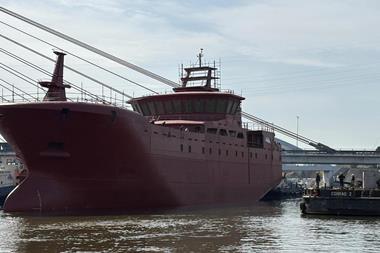





GE Transportation has introduced new V250 12- and 16-cylinder medium-speed diesel engines for marine and stationary applications which are claimed to deliver fuel savings of as much as 6.5% compared to the company’s earlier models, and offer 25% greater power density in the compact designs, while meeting US Environmental Protection Agency (EPA) Tier II emissions standards.
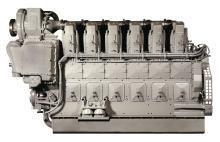
Both engines have a bore of 250mm bore and a stroke of 320mm. The 12-cylinder engine produces 3,180kW at 1,050 rpm, 3,035kW at 1,000rpm, and 2,732kW at 900rpm; the 16V250 engine produces 4,237kW at 1,050rpm, 4,038kW at 1,000rpm, and 3,632kW at 900rpm.
Background
In 1998, GE Transportation began development of its Evolution series locomotive engines to produce a unit that would meet or exceed EPA Tier II requirements without compromising fuel consumption, reliability, durability and other important customer needs. GE invested more than $250 million and seven years of research and development in the Evolution series which eventually led to the new V250 series for marine and stationary use.
In May 2006, GE shipped its 1,000 Evolution series locomotive engine, just 17 months after the company began commercial production of the engine.
Several design features of the Evolution engine are said to be beneficial. For instance, the cylinder head, water jacket, cylinder liner, piston and con-rod can be extracted from the engine as one assembly by removing a minimum number of fasteners. Both inlet and exhaust manifolds are compactly arranged between cylinder banks to allow the relatively large bore engine to be packaged in a narrow overall width. In addition, the engine's compact dimensions and high power-to-weight ratio make it ideal for marine applications.
Extensive testing
Evolution series combustion and engine systems were extensively modeled during development while critical design features were statistically evaluated against the performance and reliability requirements to ensure a high degree of robustness.
Destructive testing of critical components confirmed the design margins, with major parts of the structure – crankshaft, connecting rod, piston, cylinder head and turbocharger – fatigue cycled to failure in specially designed tests. Several test engines were built and endurance- and thermal-tested at overload and other accelerated test cycles, at GE Transportation's headquarters in Erie, Pennsylvania.
Field-testing began in 2003 and the engines operated successfully over a range of ambient temperatures and altitudes for more than a year. Since the units were equipped with GE's remote diagnostic systems, real time monitoring and diagnostics allowed for rapid identification and response to any operational issues. By 2005, when the production engines were launched, the field test engines had logged approximately 650 years of service.
Engine systems
The new V250 engine is designed for reliability and easier maintenance, with a segmented camshaft, sectional exhaust manifold, unitised power assembly and other features that simplify component removal and replacement.
• Fuel Injection System: an electronically controlled unit pump with standard configuration side entry injector is featured. This advanced Electronic Fuel Injected (EFI) system gives flexible operation in a variety of applications, as well as optimised combustion for different speeds and loads.
• Sophisticated Control: GE's PowerStar II controller drives the fuel injection system with advanced closing point detection for better fuel economy and emissions control. The system features improved diagnostics and displays all engine parameters and faults without the need for a laptop computer. Engine protection algorithms predict problems early to avoid engine damage.
• Turbocharger: GE used state-of-the-art design, analysis and test tools to develop the V250 turbocharger in partnership with GE Aviation. It is based on GE's proven turbocharger designs, but all aerodynamic features are upgraded to meet combustion design and engine efficiency requirements. The turbo has an axial turbine and centrifugal compressor, and yields a higher boost pressure while staying within the stress and speed limits of the shaft and bearing design.
Mechanical assembly
Peak firing pressure requirements as well as reliability and life cycle requirements, were key design changes for the V250 power assembly components.
• A new, three-ring, articulated piston reduces weight and exceeds peak firing pressure requirements. The skirt and the pin boss are supported by the piston pin and are optimised for excellent lubrication and superior guidance.
• The cylinder head has significantly increased safety factors, achieved with a wall that is supported by the head gasket, thicker flame deck, larger exhaust seat ring cooling bores, and smooth transition areas to avoid stress concentrations.
• The connecting rod features an increase in bearing width and a smaller oil groove in the bearing shell. The angle between the shank and big end split line maximises stiffness, while allowing disassembly through the crankcase bore.
The V250 engine shares most components with its locomotive parent such as rods, power assemblies, cams, piston, and high-pressure fuel equipment, mainframe, exhaust system, and crankcase.
However, to adapt the engine for marine and stationary use, the following parts were developed:
• Rigid and isolation mounting systems
• Dual impeller cooling water pump
• Mechanical fuel transfer pumps
• Deep lube oil sump
• Class-certifiable integrated wire harness
• Explosion relief crankcase doors
• Heat shielding on exhaust system
• Flywheel and air start system
• Seamless steel, shielded fuel lines