


X-ray inspection for frozen scallops
French seafood packer, Packopale, has installed an Ishida X-ray inspection system to monitor frozen scallops before they enter the packing process.
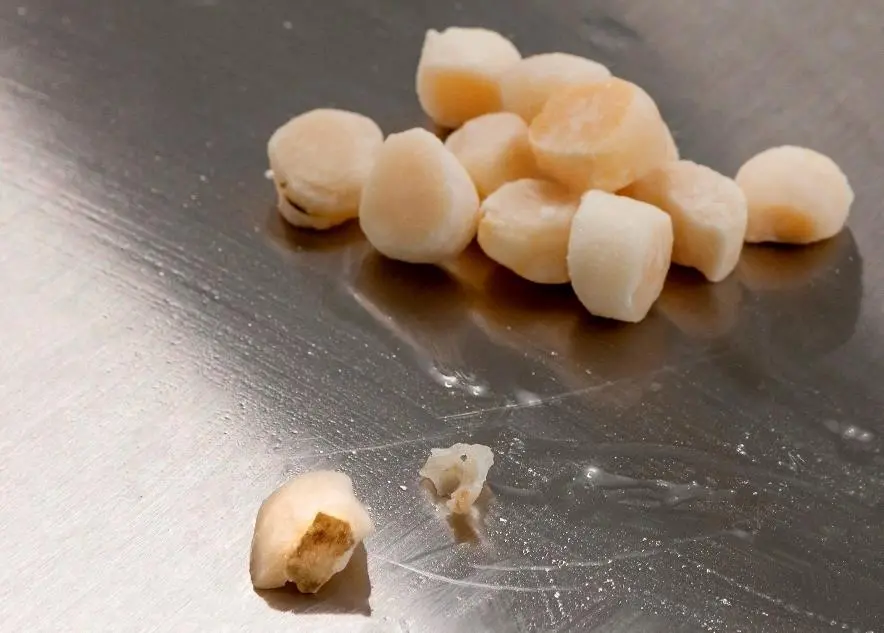
Based at Boulogne-sur-Mer, Packopale packs up to 8,000 tonnes of frozen seafood annually. Frozen scallops, which account for about one third of its production, are caught, shelled, eviscerated and washed in Canada or Argentina, then frozen for their transatlantic journey. By the time they arrive at Packopale (via a refrigerated tunnel from Norfrigo, the associated company next door) they will therefore be largely free of shell fragments and of grit from the sea floor.
The incorporation of an Ishida IX-GA-4075 high-performance X-ray inspection system into their process has now enabled Packopale to introduce a new level of certainty for its customers, who already have the reassurance of bacteriological monitoring before and after packing.
In addition to grit and shell, the IX-GA-4075 is also capable of detecting much rarer contaminants such as steel, aluminum, tin, glass, stones, hard rubber, plastic and bone, at very low levels.
The belt that passes through the IX-GA-4075 inspection chamber is divided into four 100mm-wide channels. A separate 400mm-wide belt, at a slightly higher level, brings the product to the inspection system. As the product falls off the end of this single belt, a set of funnels divides it into four streams, each feeding one of the four inspection channels.
This arrangement means that the location of any foreign matter can immediately be narrowed down to one of the four channels. The contents of the contaminated channel can then be diverted while the other three carry on, so that the volume of scallops rejected is limited and overall production is not halted.
Related Articles
 PROCESSING & REFRIGERATION
 SEAFOOD
 SEAFOOD