



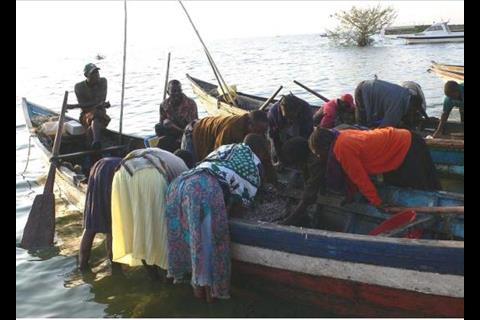
Menakhem Ben-Yami explores the plight of women and children in African fisheries.
It seems that in fishing and associated occupations women and children find themselves often in miserable situations. In most African countries the 'fish mammies', as the market women are called, finance fishermen's gear and fuel and, in general, fishermen are indebted to their own wives, sisters, or other women, who thus assume the right to be their sole catch receivers and marketers. In short, those are the women who hold the purse in fishing communities. Some of them may own one or more canoes, or even larger fishing craft. In many countries, for example Ghana, they're organised in powerful ‘market-women associations’.
So, while among the Ghanaian fisherfolk the position of women is quite robust, there are children who are victims to the practice of child-labour and who are forced into sometimes dangerous work in fishing. Fishermen on Lake Volta, which is the largest man-made lake in the world, are using many hundreds of juvenile slaves trafficked from Ghana itself or surrounding countries. This reality, notwithstanding anti-slavery and anti-trafficking laws, persists due to lack of any effective enforcement, combined with a sort of traditional acceptance of the situation, all the more that it's quite lucrative for many participants in this human trade, trafficking, and fishery.
Muro-ami
Another example of extreme exploitation of children is taking place in the Philippines, where children work in the extremely hazardous ‘muro-ami’ fishery that employs tangle nets to fish on reefs. The children, called ‘reef hunters’, dive to pick up fish or extricate snagged nets. One excuse of using children is that for them it's easier to dive and that their small fingers are better for detangling and freeing nets hooked up on a reef. Muro-ami puts children in dangerous, often fatal, situations when they get entangled in the nets or in accidents when explosives are used, and also in other risks, such as ear damage, injuries from falls, shark attacks, snake bites and drowning, and exposes them to waterborne diseases.
According to FAO, some 5% of children in the country work in fisheries, while in the Philippines, Bangladesh, El Salvador and Ghana nine out of 10 child workers are boys, forming about 10% of total fisheries labour force.
"They can develop work-related physical and mental health problems because their minds and bodies are still growing, and their lack of awareness of the risks and hazards associated with performing certain tasks often exposes them to diseases, injuries and even death," FAO says.
According to an FAO-ILO document*, there is no exact data on children working in fisheries and aquaculture, but case specific evidence suggests that they are many. Children fish, cook on boats, herd fish into nets, peel shrimp or clean fish and crabs, repair nets, sort, unload, transport, process or sell catches. They help constructing and repairing boats and nets, work onboard, prepare nets and bait. They raise, feed and harvest fish, either in the seas or inland, in aquaculture ponds, and sort, process and sell fish; all this indicates that they've got little chance for even elementary education.
Southeast Asia, where children under the age of 14 account for over a quarter of the total workforce, is considered one of the worst areas with regards to underage employment, having some of the worst working conditions for minors worldwide.
In Kerala, (south-western India) a dangerous fishing technique similar to the Muro-Ami has resulted in many deaths by drowning. Muro-Ami has been illegal in most countries for over half a century, but in Kerala a ban on employing children in this fishery has only recently started being enforced.
Observers in some Southeast Asian countries have warned that quick solutions can often force children into an even worse life in the sex industry, argued that the primary cause of child labour is parental destitution, so that a legislative ban against child labour while worsening family's poverty may also aggravate the fate of the children.
Sex-for-fish
It appears that in Kenya's western Nyanza province, the estimated 27,000 women involved, either directly or indirectly, in the fish trade in Nyanza are less fortunate than the West African ones. Along the coasts and islands of Lake Victoria a social and commercial norm makes sex-for-fish an almost inseparable part of the female fishmonger's vocation.
According to IRIN/PlusNews, the practice, known as jaboya, often is the only way for fish traders to make a living. Married women say that their husbands are aware of this part of their business. “Those who are against it do not allow their wives to be fishmongers, but others simply have got no choice, because we need food for our children”. Competition for an often meager catch forces some desperate female traders whose favours do not satisfy fishermen, to pull into their business younger, even adolescent female relatives.
The sexual obligations of these women do not always end with fishermen. When space on the bus is limited, women must have sex with the driver to get their fish fresh to the market. And when stalls are scarce, the women may need to have sex also with the vendor at the market.
People say that the main causes for jaboya, are poverty and for some - making quick money. "This together with promiscuity and prostitution on the fish landing beaches elevates the occurrence of HIV/AIDS, as well as teen pregnancy rates in the country, and it continues to be one of the greatest challenges in the prevention of HIV in Nyanza", said a local health official.
When a woman chooses to have some fun with a fisherman who's her partner in the traditional jaboya, it's nobody's business. But when a woman cannot obtain fish for trading without willy-nilly having sex…it's a dirty, disgraceful business.
*FAO-ILO Good Practice Guide For Addressing Child Labour In Fisheries And Aquaculture: Policy And Practice, 2011