



Water quality and animal welfare at the heart of sustainability going forward.
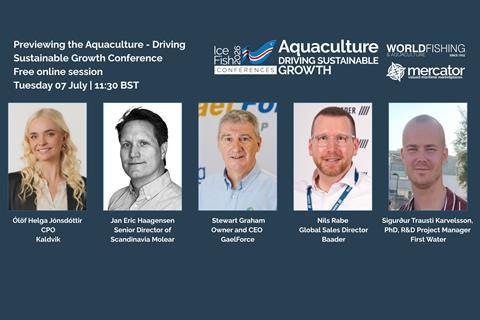
Those who joined the free webinar exploring some of the key themes at the Aquaculture – Driving Sustainable Growth Conference in September, will have come away with clear insights into the challenges – and possible solutions – within the aquaculture sector.
The conference will run alongside the IceFish Aquaculture Exhibition in Iceland on 22 September, and the webinar preview was moderated by Ólöf Helga Jónsdóttir, an Icelandic Aquaculture & Oceans Forum (IAOF) Board Member and the CPO of the Kaldvík fish farming company.
Opening the webinar she said: “Aquaculture is one of the fastest-growing food production sectors in the world. But with that growth comes responsibility. The sector is under growing scrutiny – not just in terms of environmental impact, but also around efficiency, transparency and long-term resilience.
“What we’re seeing across the industry is a clear shift: from simply scaling production, to scaling sustainably. This means improving feed efficiency, reducing waste, and enhancing fish health and welfare,” she said, adding that innovation and collaboration were also necessary for success.
Ólöf then introduced the expert panel, who all provided an outline of the exciting initiatives they will detail at IceFish 2026.
Sigurður Trausti Karvelsson, R&D Project Manager at First Water, highlighted the rapid growth of land-based salmon farming, and introduced the EU-funded Terraforming Life project, aiming to build a biogas plant to manage organic waste, reducing emissions and improving food security.
The Terraforming LIFE project, which involves five collaborating organisations and companies including First Water, plans to convert fish sludge, manure, and other organic residues into clean energy and valuable bio-fertilizer and biogas.
Nils Rabe, Global Sales Director at Baader, then spoke to emphasise the importance of animal welfare and the central role of modular processing systems in meeting increasing regulatory requirements and ethical responsibilities.
Baader, he said, had developed a sophisticated system to ensure fish were stunned before processing by adapting to their individual size, alongside customised systems that reduced cleaning time and improved food safety.
“Animal welfare means the world to us,” he added. “That’s why we are putting a lot of resources into this important topic, and we believe that animal welfare aspects in the seafood industry will be strictly enforced on a global level going forward.”
Introducing his topic as “the greatest natural technology that you’ve probably never heard of”, Jan Eric Haagensen, Senior Director of Scandinavia Molear, presented the benefits of nanobubble technology in improving water quality.
Nanobubble generators provide a highly efficient, high-density way to inject oxygen directly into water, improving its quality, improving yield and reducing disease.
Jan said: “A fish farmer once told me something that I’ll always remember, they said that fish farming, above all, is about water management, because when water quality fails, everything fails, fish stop feeding, stress rises, mortality increases, and margins can quickly disappear.
“The tension in aquaculture is we must grow more fish with less environmental impact under greater biological pressure, and with tighter margins, and we’ve innovated in feed, we’ve innovated in genetics and infrastructure, yet the fundamentals still govern success, the quality of water and the welfare of the fish.”
Stewart Graham from GaelForce, then introduced SeaQureFarm, a semi-closed containment system for efficient fish farming, which addressed environmental concerns and improved fish health.
The system incorporates multiple secure SeaQureWells, with deep water pumped through to create a circular flow within a controlled environment that separates waste, improves water quality and excludes predators.
Stewart added that after four years of development GaelForce was in the process of installing their first system: “In summary, we see SeaQureFarm as putting fish health and welfare at the heart of what we do. And why we do this? We think it can unlock the ambition I think we all have for aquaculture and growing healthy protein through farming of the seas.”
To book your delegate place click HERE.

