
Vietnam is aiming for a US$650m increase in fisheries exports this year, boosted by forecasted higher output from the country’s aquaculture sector, reports David Hayes.
Higher than expected fishery export growth from January to April has encouraged the Ministry of Agriculture and Rural Development recently to revise its fishery targets for this year.
The ministry now forecasts that fishery exports to grow by 10.6% in value to reach a record US$6.8bn in 2012 compared with its original 6% export growth projection for fishery export revenues to reach $6.5bn this year.
Overseas shipments of freshwater pangasius, also known as tra catfish, are expected to be worth over $2bn this year while shrimp exports, mostly Black Tiger prawn, are planned to reach more than $2.5bn in value.
Export revenue increase
This year’s revised export targets follow a 7% increase in fisheries export revenue in 2011 when fishery products worth $6.15bn were shipped overseas. According to government figures, shrimp exports totalling around 250,000 metric tons (mt) worth $2.4bn were delivered last year while exports of pangasius, produced mostly in the Mekong River delta region of southern Vietnam, were around 600,000mt and worth $1.8bn.
Whether the ministry’s new, higher forecast can be achieved remains to be seen. Shipping costs and overheads are higher this year.
According to Vietnam Association of Seafood Exporters and Producers, marine freight transport costs have risen about 40% while labour and electricity costs combined rose about 40% in the first half this year.
Most fishery products are processed before export. Competitive labour rates have led to the development of a large fishery export processing industry in the south of Vietnam that competes with China’s large fishery processing industry to attract export orders.
“We have around 500 fish processing plants, mostly in the south along a 500km stretch of coast line from Ca Mau up to Binh Thuen with Ho Chi Minh City lying mid-way along,” explained Truong Dinh Hoe, general secretary of the Vietnam Association of Seafood Exporters and Producers (VASEP). “Processing plant staff numbers depend on the season. Staff numbers range from about 300 to 1,000 per plant depending on the plant size. The biggest plants are the pangasius and shrimp processing units.”
Fishing is an important occupation all along Vietnam’s lengthy 3,260km coastline. According to government figures the fisheries industry is an important part of the economy employing around three million people directly and indirectly including fishermen, fish processing plant workers and others.
“Sons follow their fathers as fishermen,” Mr Hoe said. “Young men stay in the fishing villages while young women leave the fishing villages and farms to work in factories. About 80% of factory workers in Vietnam are women.”
Major markets
The United States, Europe and Japan are the three major markets for Vietnam’s seafood exports. In 2011, exports of shrimp to Japan were worth US$800m while the United States bought fishery goods worth $600m and the European Union products worth $100m.
“Europe took 40% of pangasius by tonnage,” Mr Hoe said. “South America, which is still developing as a market, took about 25%. Demand is growing there because pangasius is affordable compared with tilapia. Pangasius are exported mostly processed as frozen filets.”
Tuna is another important export with shipments from Vietnam to overseas markets worth around $300m a year in total.
Yellowfin tuna, which are caught by longline in the central coastal region of Vietnam, are exported as loins to serve as sashimi. In addition, skipjack are imported by Vietnam’s fish canning plants for export canning.
Mr Hoe noted the government’s revised fisheries export target for 2012 is 20% higher than the $5.7bn in fishery exports that was achieved in 2010. Shrimp exports that year were worth about $2bn while pangasius exports were worth around $1.5bn.
Meanwhile, the Directorate of Fisheries has set a target for total fisheries production to reach 5.37m mt in 2012 of which aquaculture output is expected to reach 3.15m mt and marine capture fisheries 2.2m mt.
Achieving the new target will mean that Vietnam has succeeded in raising fisheries output by almost 10% during the past two years. Vietnam’s total combined marine and freshwater catch in 2010 was 5m mt of which wild capture fisheries accounted for around half of total production.
Imports
Not all fishery exports are of locally caught products. Vietnam’s fish processing plants import some of their raw materials from other countries when local production is insufficient to meet domestic and export demand.
“Every year we import about $500m of fisheries products, mainly for export processing such as cuttlefish and other species,” Mr Hoe explained. “About 50% is subcontracted processing for many species including fish, cockles, cold water shrimp and snow crab.”
In addition to importing fishery products for export processing, a growing number of companies owning processing plants have begun to invest in establishing their own fish farms to avoid problems that a shortage of fishery materials for processing could create.
“Fish processors are buying or setting up their own fish farms to get control of raw materials,” Mr Hoe noted. “Processing plants have available finance while fish farms are generally family-run units. Backward integration by processing plants means good control of quality and traceability; also, better control of processing costs.
“There will be more backward integration in future. Also, more certification requirements for quality control, environmental protection and sustainability.”
In addition to backward integration, another trend to have emerged recently is for processing plants to increase the value added element in their processing to increase the value of their products.
According to VASEP’s calculations, new value added processes have added about 30% to the ex-factory value of processed fishery products in general.
“Importers request packaging displaying their own brand ready to put on supermarket shelves. For shrimp the value added options include processing into Japanese tempura style, nobashi (raw Tiger Prawn) and sushi style shrimp,” Mr Hoe said. “For pangasius value added processing includes supplying pangasius on wooden skewers or on mixed skewers with salmon and shrimp. Vacuum packing is available along with bread coating as well.”
Meanwhile, wild capture fisheries accounted for half of Vietnam’s total production of about 5m mt in 2011, the combined aquaculture output and wild freshwater fish catch also reached around 2.5m mt.
Some 3m mt of the nation’s total fisheries production was consumed by the 88m population last year while the remaining 2m mt was exported.
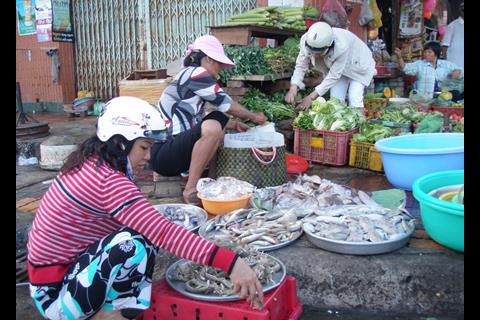
“Fish consumption is growing as people have easy access to fish. Fish is cheaper than meat. Pangasius costs about VND 30,000 (US$1.55) per kilogram in the wet market here,” said Mr Hoe. “Fish soups are popular; also grilled fish which is seasoned and eaten with rice and vegetables, usually for dinner.”
Private sector
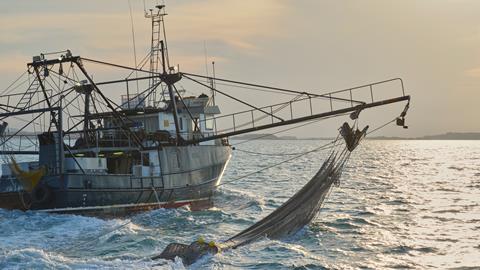
Fishing is largely a private sector activity in Vietnam. Most fishing vessels are privately owned as a majority of state-run fishing enterprises have been dissolved since the early 1990s or have diversified into pursuing other business activities.
“Vietnamese fishermen prefer to fish in national waters,” Mr Hoe said. “There is no tradition in Vietnam to fish in distant waters; also, a bigger investment would be needed.”
Most marine capture fishing occurs in waters off southern Vietnam. These waters provide over 60% of Vietnam’s marine capture fisheries totalling around 1.8m mt a year. A further 30% of the marine catch is taken in waters off central Vietnam while a small share of the catch is recorded in the Gulf of Tonkin off northern Vietnam.
According to official estimates, Vietnam’s fish stocks stand at around 4.2m mt. With inshore fisheries showing signs of overfishing in some areas, the government is looking to encourage further development of offshore fishing while inshore stocks recover.
Currently most of Vietnam’s marine catch is taken in waters less than 60 metres deep and is considered a major cause of coastal overfishing.
According to government figures the average powered fishing boat is fitted with a 50hp motor. About 25% of fishing vessels are equipped for offshore fishing operations.
To encourage fishermen to use larger fishing vessels that are better equipped for offshore fishing, the government is offering subsidies of about US$3,500 a year for fishermen buying new boats fitted with an engine larger than 90hp.
Fish resources
Other government support measures include the release of young fish and shrimp into the sea to aid restocking. Regulations are in place controlling species and fish sizes that can be caught. In addition closed seasons are enforced to protect threatened species.
“The challenge now is fish resources. Costs are getting higher. Also, climate change is having some effect on fisheries,” Mr Hoe said. “It’s not so easy to say how the future will be as fishery resources are decreasing. Fish farmers are trying new species such as tilapia.”
Supplies of freshwater farmed fish also will need to increase if Vietnam’s fishery exports are to continue growing.
Feed costs for pangasius have risen and consequently export prices for the fast growing farmed fish. The problem has been exacerbated by a shortage of juveniles which also is pushing export prices upwards.
“The government is encouraging people to raise new species; also, there is some investment in marine farms such as scallops, seaweed and grouper and other high priced items. Aquaculture will help provide food for people living in remote areas and they can sell surplus fish,” Mr Hoe remarked.
Meanwhile, Vietnam Association of Seafood Exporters and Producers (VASEP) is working with various government departments and agencies to further develop Vietnam’s fishery export industry. The association has 250 members nationwide including 170 members with processing plants while other members are associates providing services to the fisheries sector.
Established in 1998, VASEP’s main activities involve working to improve cooperation between relevant government departments and the fisheries processing industry. The association also provides members with information to support fishery marketing and export activities.
Mr Hoe noted that most fish processing plants are not VASEP members. Many are small scale family-run units operating fish dryers.
“Most big fish processing companies are our members,” Mr Hoe said. “VASEP members account for 80% of Vietnam’s fishery exports. Our success lies in making members more aware of the fishery market, production quality and how to do business. VASEP is where people can come to share information. We also connect fish processors with our country’s fish farmers.”
Traceability
One area where VASEP cooperates closely with Vietnam’s Directorate of Fisheries (D-Fish) is in the improvement of fishery product traceability and food safety along with measures to improve protection of the marine fishing environment and biodiversity.
“The government is trying to develop more regulations to control the fish supply chain including traceability,” Mr Hoe said. “We do a final random check on export cargos in Vietnam. Importing countries also do a final random inspection.
“Testing and inspection involves mainly processing plants and aquaculture farms. Local government fishery departments also have fish farm monitoring programmes.”
The government has already introduced measures to prevent the spread of disease from infected prawn brood stock while processing plants handling prawns are required to carry out systematic testing of prawns for banned antibiotic residues, in particular Chloramphenicol (CAP) and Nitrofuran.
Significant progress has been made in reducing drug residue levels and the Ministry of Fisheries continues to work with seafood exporters, the United States Food and Drug Administration and relevant agencies in the EU and Japan to solve the problem.
As traceability of foodstuff origins is an important issue in key import markets such as the EU, the United States and Japan, the government requires prawn farmers to keep records of prawn production and sales to comply with international food safety monitoring standards.