




US-Chinese co-operation nets IUU driftnetter
A fishing vessel intercepted in international waters 860 nautical miles east of Japan was found to have eighty tons of salmon and a drift net measuring more than five miles long on board.
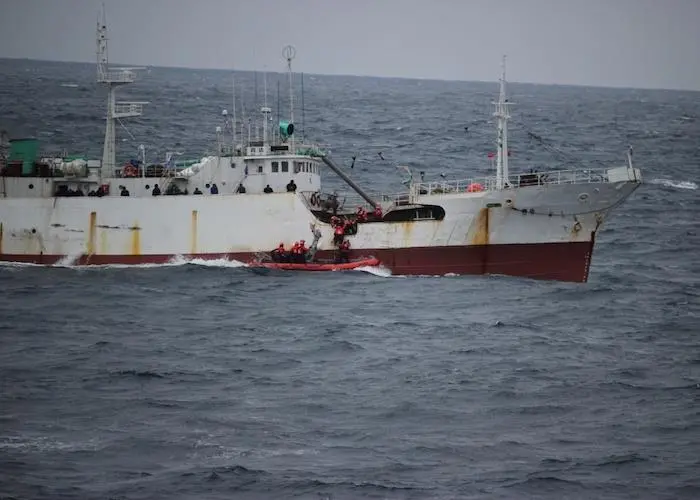
Kodiak-based US Coast Guard cutter Alex Haley was carrying a group of Coast Guard officers from the People’s Republic of China on board during a patrol and a joint boarding was carried out on Chinese-flagged fishing vessel Run Da. A USCG aircraft had already sighted Run Da while deployed on a North Pacific Coast Guard Forum multi-national fisheries enforcement patrol supported by Canada, China, Japan, Russia and the Republic of Korea.
At the scene, US and PRC Coast Guard officers conducted of pre-boarding questions over VHF-FM radio to confirm fishing activity and nationality. After questioning was complete and clearance to board was obtained from both United States and China, the Alex Haley boarding team deployed to assist the PRC Coast Guard investigation and to document the suspected illegal fishing activity.
Run Da is suspected of violating the worldwide driftnet moratorium called for by United Nations General Assembly Resolution 46/215. Run Da’s skipper admitted to fishing with drift nets and the joint boarding team discovered one ton of squid and eighty tons of chum salmon on board.
Alex Haley’s crew transferred custody of Run Da and its crew to a PRC Coast Guard vessel which is escorting it to China for prosecution.
The joint US and Chinese high seas boarding and inspection was conducted under the Memorandum of Understanding between the US and Chinese governments on Effective Cooperation and Implementation of United Nations General Assembly Resolution 46/215 of December 20, 1991.
This MOU established boarding procedures for law enforcement officials of either country to board and inspect US or Chinese-flagged vessels suspected of high seas driftnet fishing. The MOU also established a shiprider programme, which permits Chinese fisheries enforcement officials to embark on US Coast Guard vessels or aircraft.
China provided 111 enforcement officials to the US Coast Guard for joint fisheries enforcement operations since the MOU first entered into force in 1993.
‘The US Coast Guard is committed to preserving the world’s fragile marine ecosystems, not only to ensure economic prosperity today but to ensure thriving oceans for future generations,’ said Capt. Darran McLenon, chief of response for the 17th Coast Guard District.
‘This case was the first apprehension of a large-scale, high seas driftnet vessel since 2014 and highlights the successful fisheries enforcement cooperation and patrols of the US, Canada, China, Japan, Russia and the Republic of Korea, including the force multiplying value of shiprider agreements, which enables joint high seas boarding and inspections to detect and deter illegal, unreported and unregulated fishing.’
Related Articles
 FISHERIES
 FISHERIES
 WORLD FISHING EVENTS