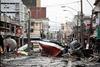
More than 70% of Chile’s central-south coastal fishing fleet was destroyed by the violent earthquake and following tsunami on 27 February, reports Peter J. Neilson.

At 03:43am on 27 February, a violent earthquake – 8.8 on the Reichter scale – hit Chile’s central coastline, destroying over 1,400 fishing vessels and leaving a trail of debris, death and destruction.
It was just as if a powerful hand had lifted fishing vessels and smashed them against the rocks surrounding fishing ports such as Talcahuano, San Vicente, Coronel, Lebu and Santa María Island.
A 550t steel fishing vessel tied up at the Talcahuano wharf was lifted by the giant 20m wave and hurled 1,200m inland, destroying hundreds of houses in it’s path.
Chilean fishermen are still asking why the tsunami alert was cancelled minutes alter the earthquake.
The United States’ NOAA (National Oceanographic and Atmospheric Agency) advised the Chilean Navy’s SHOA (Servicio Hidrográfico y Oceánico de la Armada) only 12 minutes alter the quake that there would be a tsunami off Chile’s central coastline., but unbelievably the Chilean Navy ignored the warning and instead, issued official reports indicating that there was no danger of tsunami, an act which caused many hundreds of unnecessary deaths.
Fishing industry hard hit
Chile’s fishing industry suffered great losses due to the severe earthquake and the following tsunami.
The industrial fishing sector was mostly damaged on land. In Talcahuano and San Vicente, several fish processing plants were destroyed by the quake and following tsunami.
Pesquera Alimar’s fish processing plant was completely destroyed, and will have to be completely rebuilt. The same happened to other fishing plants belonging to Pesquera Landes, Congelados del Pacífico, Industrias Maritano and others.
A Pesquera Alimar spokesman told World Fishing that he had orders not to say anything until the situation was assessed, nevertheless he said that the plant was insured. “We will not be able to process fish until the plant is built new again,” he said.
Puerto a Puerto magazine’s publisher, Sergio Villagrán, went to the devastated area searching for his brother, who was missing. He commented: “As we neared the industrial fishing area it was impossible to continue in our vehicle. Rubble and debris blocked the streets, so we continued on foot. The smell was unsupportable: Rotting mud mixed with fishmeal and destroyed sewers, rotting fish and more….everything was destroyed, nothing was standing.”
“A bit further on, as we came close to San Vicente, we encountered more fish processing plants, completely destroyed. Then we came close to the wharf and were able to see that miraculously large processing plants belonging to the “fishing giants” Pesquera San Jose Coloso and Pesquera Itata were undamaged,” he commented.
“I tried to talk to Pesquera Itata’s plant manager, but he refused to comment on the situation. Obviously, we were not allowed to take pictures, but a good zoom lens solved that problem. The same happened at the close by San José Coloso processing plant. An employee who requested his name be withheld commented:
“Our plant was very well constructed and resisted the quake and tsunami, but since the earthquake we have been without electricity or fresh water, as all piping was destroyed in the city.”
“Three of our large trawlers came into port with good catches, but as the plant is not working, the jack mackerel – all of good size – had to be sent to our fishmeal plants – before they rot – instead of being processed in our new canning plant.”
“This means a great loss for the company, but at least we have been able to use the fish for making fishmeal, which of course fetches a much lower price. We have no idea when the electric power will be restored, probably several weeks….who knows?”
Coastal fishermen suffered most
In an area which housed coastal (artisan) fishermen and their families, all their houses were on the ground, not a single wall was left standing, but many fishermen and several forklifts were removing the debris.
“Miraculously, we were not hit by that steel fishing vessel, which came up the street and did not hit our homes,” artisan fisherman Luis Alvarez commented.
“I’ve lost everything and several of my relatives are still missing. The tsunami swept away everything I had. I’m left with these clothes I’m wearing,” he confessed.
Luis Riquelme told World Fishing: “I’ve been a fisherman all my life. The sea gave me everything and later took away everything. My boat was destroyed, but at least my family is alive, so we will have to start all over again.”
Help from Argentina
The day after the news of the earthquake in Chile reached Argentina, help from the other side of the Andes began to arrive in the disaster area.
Near the devastated fishermen’s homes, a large lorry from Mendoza (over 1,000km away) was parked unloading bottles of drinking water. Other lorries distributed tents, candles, mattresses and blankets and non-perishable food.
Tsunami: an unexpected murderer
World Fishing interviewed seismologic expert Sergio Barrientos who explained the origin of earthquakes and tsunamis in Chile.
“It is impossible to predict an earthquake. One can make a map with the zones which are more ‘mature’ or probable they could happen, but definitely, earthquakes cannot be predicted,” he explained.
“If someone had asked me about the 27 February earthquake, I would have answered that it was a possibility. The only zone I would have discarded as possible or probable would have been the Valdivia to Puerto Montt area, where the 21 May 1960 occurred and was such a strong one that many more years must elapse before the seabed charges enough tension to produce a great earthquake,” he explained.
“What occurs is that the Nazca shelf forces itself violently beneath the South American shelf in a contact zone about 100km from the coast. This contact is so violent that the contact area cannot resist and all at once discharges the energy accumulated for years, causing a great earthquake,” he explained.
“The Nazca shelf generates greater tension between Puerto Montt and Panama, causing a greater number of earthquakes,” Dr Barrientos ended saying.
Chilean coastal fishermen struggling to survive
Although most of the large industrial fish processing plants in the Coronel, San Vicente and Talcahuano suffered damage and great losses, the coastal fishermen took the worst beating.
Over 1,300 coastal fishing vessels were destroyed or swept away by the Tsunami or their home ports suffered physical changes which made them unsuitable for fishing activities. Such is the case of the fishing port of Lebu, around 100 miles south of Concepción.
Lebu was once a coal mining town, but when this activity was no longer productive, the town began to depend on fishing activities. The local fleet grew and 5m fishing boats were replaced by large fishing vessels capable of sailing hundreds of miles to rich fishing grounds for their catches.
The Lebu bay is protected by hills, and the vessels used to sail up the Lebu river to their berths. But everything changed on 27 February, when the ground shook for several days.
The worst result for the fishing fleet was that the ground surrounding the bay rose 2.6m, leaving the boats stranded inland, because the river just disappeared!
The only vessels saved were those which were away fishing the night of the earthquake, which are now tied up close to the town promenade.
These must bring in their catches to neighbouring fishing ports and then send their catches to their home port by lorry.
This was especially hard on them over Easter, as the operative artisan fishing fleet was reduced by over 80%, as great part of the fleet is stranded inland. Fishermen are requesting that the government help them to get their vessels back into the water.
Salmon growers help Lebu fishermen
Chile’s Salmon Growers’ Association, SalmonChile, donated fishing vessels and outboard engines to suffering Concepción artisan fishermen who lost their vessels during the tsunami.
The first batch of seven fiberglass boats and seven outboard engines of a total of 15 boats and 13 engines valued in US$ 155 million, was handed over by SalmonChile’s general manager, Carlos Odebret, to the Lebu Artisan Fishermen´s Syndicate.
He said: “As people who also work in the sea, we want to help a very important productive sector, our coastal fishermen brothers who have been hard hit by the earthquake. They are a very productive sector for our country and we felt it our duty to help them onto their feet again.
“It is also very important for us to continue with a second stage of this helping hand, where we will not only supply them with more engines and vessels, but we will also guide them in coaching other Lebu fishermen to repair their damaged vessels.”
Artisan fisherman Rolando Huenchunao, one of the Lebu Fishermen’s Federation leaders, said: “We thank the salmon industry for this great help. They put their hands on their heart and have really helped our fellow fishermen onto their feet in this difficult moment,” he commented.
SalmonChile gives out rations
Over three days, Chile’s Salmon Growers Association gave out 15,000 salmon portions in Talcahuano.
The Association donated the portions in open air barbecues which were prepared by food preparing concern Sodexho and the Chef Association ACHIGA, and enjoyed by thousands of inhabitants who suffered the loss of their homes.
Talcahuano’s Lord Mayor Gastón Saavedra said: “These salmon portions are a great help and will also help to change eating habits here in Talcahuano.”