



Tracking year-round pollock movement
Over the past year scientists have been conducting a first of its kind study to track seasonal movements of walleye pollock across the US-Russia boundary, and predict how climate variability will affect these migrations, working with Kongsberg/Simrad to develop innovative sea floor-mounted upward-looking echo sounder technology for the project.
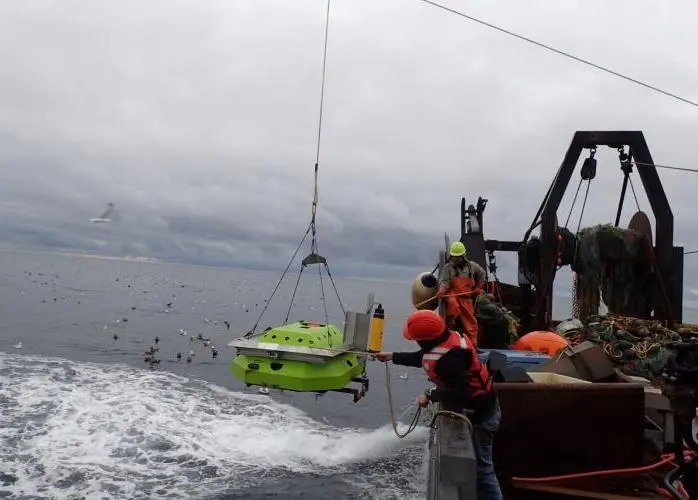
Four echo sounders were placed in the eastern Bering Sea along the US-Russian Convention line to track fish movements. Scientists believe they can quantify the direction and magnitude of pollock movement across the Convention line throughout the year. These cost-effective echo sounders were equipped with sensors to collect physical oceanographic data, which will be linked to fish migratory behaviour. Scientists had planned to retrieve data from the echo sounders during their annual acoustic survey for pollock in June.
Due to the cancelled surveys, a contingency plan to collect as much data as possible this year was developed. Among other things, a saildrone study was funded to augment midwater acoustic data for the pollock assessment. Engaging scientists on board the Oscar Dyson to collect acoustic and ecosystem mooring data for various projects was also a priority. Added to this was a plan to ask the Dyson team to also retrieve the four seafloor-mounted echo sounders.
“We’re really grateful to the Oscar Dyson’s crew and survey team for recovering our echo sounders under such challenging circumstances,” said Alex DeRobertis, fisheries biologist at Alaska Fisheries Science Center.
“There is a lot of interest in this research from scientists, resource managers, the fishing industry and local Alaska communities.”
With a small survey team and compressed timeframe for survey operations, not all research typically carried out during the summer Arctic surveys was possible. Researchers from the Alaska Fisheries Science Center are not able to collect their full complement of biological samples of zooplankton and larval fish. These data are normally collected during summer and fall surveys and are important for understanding ecosystem dynamics, predator-prey relationships, and commercial fish stock productivity.
Related Articles
 FISHERIES
 FISHERIES
 WORLD FISHING EVENTS