



Taiwan fisheries sector targets higher value production.
Taiwan’s fisheries production has fluctuated during much of the past decade as the republic’s distant waters fishing fleet has tried to increase the value of its catch while adjusting to a decrease in the fleet size under a government programme to reduce the number of deep sea fishing vessels.
Taiwan is one of several countries under pressure to scale back its tuna fishing activities which has encouraged leading local fishing companies to pursue joint ventures and other activities in cooperation with Pacific island nations.
Coastal fleet reductions
Marine capture fisheries is unlikely to grow in future as the government also is implementing measures to reduce the size of the coastal fishing fleet to ensure development of a sustainable fishing industry. Aquaculture production continues to grow, however, as fish farmers focus on high priced species for local sale and export.
“Deep sea fishing has decreased due to the fishing vessel reduction programme. Our tuna fishing fleet is too large and not commensurate with our fishery resources. From 2005 to 2007 there was compulsory vessel reduction and about 180 longline tuna vessels were scrapped,” explained a spokesman at Taiwan’s Fisheries Administration, which is part of the Council of Agriculture under the Executive Yuan (Parliament).
The three year vessel compulsory reduction programme was implemented in response to requests from various countries as well international fisheries management agencies including those responsible for different regions in the Pacific. Since then the compulsory vessel reduction programme has been replaced by a voluntary reduction scheme.
“Now we have about 460 large scale tuna longliners over 100 gross registered tons after reducing our fleet by 180 vessels and about 1,800 smaller long liners under 100 gross registered tons,” the spokesman said. “We are also doing a voluntary fishing vessel reduction programme over a long period. We give compensation to fishing companies scrapping a vessel. Not many vessels are being scrapped as large scale longliners operating in high seas are under the management of various organisations.”
Taiwan’s distant waters fishermen cover the Pacific, Indian and Atlantic Oceans. Their main area of activity is the Indian Ocean where about 250 tuna longliners currently are operating. Many longliners land their catch in foreign ports.
“Longliners land their catch in Cape Town, Port Louis (Mauritius), Singapore and Phuket in Thailand. Some vessels transship their tuna catch in the high seas and some land at ports where they transfer their catch to refrigerated containers for shipment to Japan,” the spokesman remarked.
“One group of long line fishermen target Yellow Fin and Big Eye tuna. Purse seiners supply skipjack tuna to Thailand’s canneries. We have 34 of these vessels in the western and central Pacific.
“Now is a bad time for Taiwanese tuna fishermen because of high fuel prices last year. Many came back to their home port. Now fuel costs have decreased again and they are beginning to go out."
Increasing high value fish consumption
As part of plans to promote higher value fisheries production the government has initiated several schemes to increase consumption of higher value fish in Taiwan. The programme is targeted at all groups.
“The fishing industry here says that fish consumption is stable in Taiwan. It does not grow much even though we are a big fish catcher. That’s why the government wants to promote tuna consumption,” the spokesman noted. “The government prepared a plan to build a large tuna storage warehouse in Kaohsiung fishing port to store frozen tuna as a buffer stock for the Japanese market and to consume in Taiwan.
“The warehouse capacity is 1,000 metric tons (mt). It belongs to the fishing industry under a 20 year Build, operate and Transfer (BOT) scheme, then it will be transferred to government ownership. The fishing industry owns the tuna warehouse stock so they have the right to manage it.
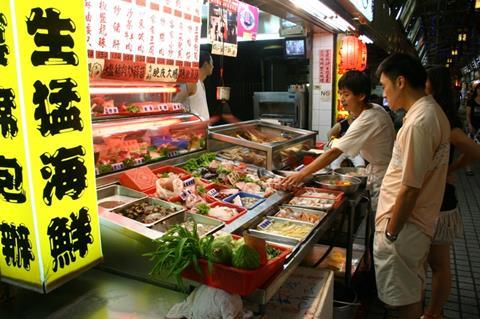
“In Taiwan we want to expand consumption of raw tuna sashimi as it is healthy; also, to show that we are not just fishermen but also fish consumers. We want sashimi to be more popular with every age group.”
The Taiwanese fleet
Taiwan’s distant waters fishing fleet is based in four ports. Kaohsiung fishing port in the south is the main deep sea fishing port with vessels based in Kaohsiung catching 412,000mt or almost 80% of the 524,000mt of fish landed at overseas ports by the Taiwanese fleet in 2007. Keelung in northern Taiwan, Suao in the northeast and Pingtung in the far south are the other ports where distant waters vessels are based.
The Kaohsiung fleet catches tuna and squid, with the fleet including 109 squid purse seiners. Keelung fishing port is a base for fishing trawlers while Suao is a tuna longliner port catching Bluefin and mackerel.
Fishing trawlers operate mostly in Taiwan’s territorial waters and in cooperation with Indonesian partners near Irian Jaya.
“For the fishing fleet operating near Taiwan, their catch is for our local market while fishing boats based in Kaohsiung supply mainly the Japanese market from the three oceans – the Pacific, Indian and Atlantic oceans,” the spokesman said. “Taiwanese people like to eat seafood. They can order a wide variety in many restaurants. Keelung, Suao on the east coast and Thang Kan near Kaohsiung are famous fishing ports and seafood restaurant centres.”
According to the Taiwan Fisheries Agency, total fishery production in 2007 was 1,499,500mt, up 18.4% compared with 1,266,000mt the previous year. The total value of fisheries production in 2007 reached NT$94,960 million, showing an 11.2% increase compared with NT$85,369 million the previous year.
Squid is the largest species caught by Taiwanese fishermen with 299,960mt caught in 2007 accounting for 20% of total fisheries output followed by skipjack tuna of which 213,980 mt was caught, representing a further 14% of total output.
Other major species include saury with 87,270mt caught in 2007 while big eye tuna production was 69,920mt, yellow fin 67,660mt and albacore 47,540mt.
Meanwhile, clam production stood at 35,650mt and oyster output 28,190mt.
Distant waters fisheries
Distant waters fisheries production accounts for 66% of Taiwan’s total fisheries production and showed the largest increase in 2007. The distant waters fleet caught 984,500mt in 2007, up 29.9% compared with 757,900mt the previous year.
Squid jigging and tuna longline fishing were the two most production activities among distant waters fishermen in 2007, followed purse seining for tuna.
The tuna longline catch reached 302,700mt in 2007, an increase of 9.7% from the previous year. Squid jigging produced 299,900mt in 2007, just over double the 148,000mt of squid caught in 2006. The sharp increase in the squid tonnage caught in 2007 accounted for around 60% of the total increase in fishery production recorded for the whole year.
Purse seining for tuna produced 232,800mt in 2007, a rise of 10.6% compared with the previous year. Among other distant waters fisheries showing an improvement was torchlight netting for saury which saw production reach 87,300mt, a 44% increase in output over 2006.
“The challenge for us in Taiwan is to keep to our fishing vessel and fisheries quotas,” the spokesman commented. “Also, we need to strengthen the monitoring of the tuna fish catch. This puts pressure on our fishermen. If they do not follow quotas they will be punished by the government. In the end many distant water fishing nations may need to reduce their fleet sizes and quotas.”
Offshore and coastal fishing
Offshore fisheries is the next largest marine capture activity with production in 2007 falling to 135,400mt, down 12.5% from 154,800mt the previous year. Dragnet fishing is the largest offshore fishing activity with a catch of 41,000mt recorded in 2007, a fall of 14.5% from the previous year.
Torchlight netting production, in contrast, rose in 2007 by 28% to reach 32,700mt while tuna longlining fell 9.3% to 22,600mt for the year.
Coastal fishing production, meanwhile, remained unchanged in 2007 with the year’s catch totaling 54,300mt.
“Coastal fishing is stable. Government policy is to protect coastal fisheries,” the spokesman said. “We made little effort in the past on coastal fisheries so there are some problems, but the policy now is to protect coastal fishing. There is a voluntary programme to reduce the number of coastal fishing boats for which the government pays some compensation.”
In 2007 the total number of fishing craft registered in Taiwan was 25,344 amounting to a total tonnage of 727,375 tons. The number of powered fishing vessels was 13,026, slightly more than half the total number of fishing craft in use.
Fishermen numbers continue to decline due older fishermen retiring while fewer young men than previously wish to become fishermen. Currently there are 336,000 fishermen in Taiwan of whom 248,000 are full time and 88,000 are part-time fishermen.
“The young generation do not want to work on fishing boats. The crews now are mostly mainland Chinese; also, Indonesian, Filipino and Vietnamese,” the spokesman said, “Government regulations state that the captain and first engineer must be Taiwanese. We have a policy of encouraging the young generation to work in fishing.”
Fish farming
Turning to fish farming, the spokesman noted that while marine culture output remained stable in 2007, inland fisheries production continued to grow. The total combined area used for marine culture, brackish water ponds and freshwater ponds presently totals 55,400 hectares.
Marine culture production remained stable at about 35,000mt in 2007.
“Marine culture is for high value fish,” the spokesman said. “Kobia is the main species produced. Most production is around the Pengu islands, west of Taiwan. Other marine culture species are grouper and sea bass.”
Aquaculture production rose almost 10% to reach 286,300mt in 2007. Production from fresh water ponds totalled 167,500mt in 2007 while brackish water pond farms supplied 118,800mt of fishery products.
Tilapia is the main aquaculture species with 76,100mt produced in 2007 followed by 53,240mt of milkfish and 24,820mt of eels.
The growth of aquaculture production is higher in terms of value than in tonnage output terms. Total aquaculture production in 2007 was worth NT$28.3 million, an increase of 17.4% in value compared with 2006 while the increase in aquaculture growth on a tonnage basis was lower at 9.8%.
“Aquaculture is growing and is 25% of Taiwan’s total annual fishery production,” the spokesman remarked. “Government policy is to promote marine culture and to control inland fisheries culture as this needs a lot of freshwater and has a negative impact on the environment. Increasing marine culture and environmentally friendly aquaculture is our policy. Eels, for example, are raised inland for export to Japan.
Meanwhile, fisheries processing appears to be growing in Taiwan with 20 new processing plants opening in 2007. This raised the total number of fish processing plants around the island to 756, of which 544 are classified as cottage industry enterprises.
Production of frozen and cold storage products, primarily processed tuna, account for a major share of fishery processing activities. Production of frozen and cold storage products reached 396,000mt in 2007 worth NT$11,732 million.
Fish processing plants are located in several fishing ports around Taiwan. The two major fish processing centres are Suao on the east coast and Pindong near Kaohsiung.
Fish canning is the second largest fish processing activity. Canned fishery products totalled 24,300mt in 2007, worth NT$657 million. Most canned fish, predominantly tuna and mackerel, is exported.
In terms of foreign trade Taiwan has increased its self sufficiency in fishery product supplies during the past decade. Since 1999 when the import and export tonnages of fishery products both totalled about 420,000 tonnes, imports of fishery products have dropped gradually to around 300,000 tonnes a year while fishery exports have risen to about 700,000 tonnes annually.
The value of fishery imports and exports also has changed during the past decade. The value of fishery imports has been stable during most of the past decade showing the trend to import higher value products as the import tonnage has declined. In contrast the value of fishery exports has fallen recently after climbing earlier in the decade, showing a recent increase in lower value fish exports compared with previously.
Meanwhile, looking ahead to future development of Taiwan’s fishing industry the spokesman noted that tuna fishing companies will need to cooperate more with Pacific island nations in future as these countries seek to develop their own fishing and processing industries to spur economic development.
“The Western and Central Pacific Fisheries Commission has passed a resolution to develop island country fisheries and to request distant water nations to transfer fishing capacity to island countries. It’s a key issue being discussed,” the spokesman noted.
“Taiwanese fishing companies already are investing in Papua New Guinea and the Marshall Islands. FCF of Kaohsiung, for example, employs 3,000 workers in a tuna loin processing plant in Papua New Guinea.”