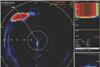
Three Norwegian, six Faroese, four Danish and four Icelandic vessels have recently installed Simrad’s latest low frequency sonar SP90 and, according to Simrad, all have the same verdict: a very good all round sonar, both in shallow water (50-200m) fishing for herring, mackerel and horse mackerel and in deepwater fishing for blue whiting.
In shallow water, the sonar has a clean picture with very few unwanted echoes from bottom. This makes it easier to determine fish from bottom and to evaluate different schools before setting the net or guiding the trawl. The standard multi frequency (20-30kHz) feature enables pair trawlers to fish without interfering with each other as well as fishing together with several vessels in the same area.
Ottar Jarle Solli, the skipper on “Teigenes”, one of the new combined vessels in Norway says, “The SP90 gave us 1,000m longer range, but what impresses me most is the clutter free picture we get under difficult conditions and in shallow water”.
The new ‘tip’ function gives the pelagic trawler a new tool to ensure correct trawl position in relation to the fish. The tip is a vertical view with a ‘reversed tilt’ function. Normally the vertical view is a vertical slice that gives valuable information about the school size and density. The new tip is a 180o fan set across ship that can be ‘tipped’ forward and backwards in a 1o step. This enables the skipper to look forward and see if the fish density is greater on one side or the other. At the same time the skipper still has the normal long range horizontal search.
“We are very satisfied with the results of the SP90 in the North Atlantic”, says Mads Dahl, Sales and Marketing Director for Simrad. “2006 became the best year in Simrad’s 60 year history and 2007 has started where 2006 left off. It seems that we have hit the right spot and made a sonar that works for all fisheries.” He adds that a high frequency sonar still detects mackerel best, especially when scattered. “But we have reports on Mackerel detection up to 1800m with the SP90”.
Simrad has also been presented with the Norwegian Design Council’s prestigious Design Award for the new interface of its fishery research multibeam echosounder, the ME70.
The interface has already been put to use in Simrad’s latest products for fishery research applications and is set to become the standard platform across all of the company’s future echosounder and sonar products.
Simrad’s Kjell Gjestad led a team of in-house engineers and designers from Norwegian design firm Formel Industrial Design. The company committed an extensive development phase to the project, to ensure that the new interface was as user friendly as possible. “It is very important to us that it is easily accessible,” says Gjestad. “We wanted a professional, suitable and functional user interface to emphasise the quality that is the backbone of all our products, but more importantly to make sure that users can gain optimum performance from the equipment when it is in everyday use. We have achieved this aim and receiving this award is a reflection of the hard work of everyone involved.”
The notification from the Norwegian Design Council’s judging panel points out that the new user interface is based on a considerable amount of technological innovation as well a novel approach to many of the challenges. Further it states that the design is intuitive, easy to use, and flexible. Five large buttons control the main functions of the ME70 and the menu system is logical. It is possible to display five different screen images simultaneously, which the user can select individually with ease. The overall expression and terminology is clear and well suited for the target users and the colours, symbols and light settings are well adapted to changes in the ambient conditions.
There are many challenges to the successful development of new and modern instruments for fish finding and fishery research. Advanced products are required to meet high demands for efficiency and functionality and when the number of possibilities is increased, the products must also provide the users with intuitive solutions to make operation easier.
The user interface is the most important factor in this challenge as within the limited confines of a computer display, fishermen and researchers have to read and process data accurately, and control the in-depth functionality of the system.
“Several Simrad customers have provided us with valuable contributions, including the Norwegian Institute of Marine Research and the French research institute Ifremer, both who use our multibeam systems already. This cooperation with customers has helped to create a highly dynamic interface, which they themselves will benefit from. We are constantly communicating with our customers to ensure our user interface and our products meet and exceed requirements,” says Torfinn Johansen who was responsible for the technical development of the new user interface.
Olav Vittersø, managing director for Simrad in Horten, Norway adds: “We are all proud that the new interface has been recognised for its ability to enhance the work of fishery research organisations by the Norwegian Design Council and we are looking forward to integrating the new interface into our future products.”