



Dalhousie student Franziska Broell is conducting a research study using a accelerometer to focus on biological oceanography and sensor development for marine animal tracking.
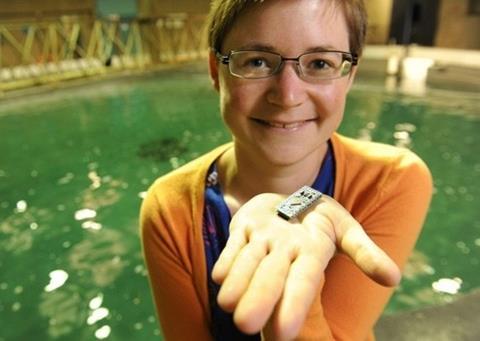
An accelerometer is the device that tells an iPhone or smartphone screen to turn depending on how the phone is being held.
Ms Broell was tasked with developing an accelerometer that could be attached to a fish to record its movements. This device would collect data that would help the team learn more about fish behaviour and growth based on the movement of the tail - invaluable information for fisheries all around the world. Currently, no one uses a reliable measurement of growth rate in the field.
Andre Bezanson, a biomedical engineering student, has helped Ms Broell to refine the technology for over a year now by adapting open source hardware developed by the Arduino electronics community. Over that time, their device has evolved into a much smaller circuit that requires less power to operate while maintaining the quality of the data.
“We’ve designed our tags so they can sample up to 500 movements per second,” explains Ms Broell. A high-definition video helps her team show that an accelerometer capable of recording such fast movements is necessary to learn more about feeding behaviours and growth rates.
In January, Ms Broell will bring her fish back to the Aquatron to fit them with the latest version of the accelerometer. By then, the fish will have grown, and she will re-do all of her previous experiments done with older models of the accelerometers to see what kind of influence the change of size has on the movement of their tails this time around.
“When I can show that the movement relates to the size of the animal, then we can put this into the field,” says Ms Broell.