



Government to launch long term fisheries development plan - Sri Lanka is due to finalise a new long term fisheries development plan early in 2007 aimed at increasing domestic fisheries production and expanding processed fish exports to major international markets. The government is keen for the fishing industry to develop more rapidly in future, aware that many Asian countries are far ahead in exploiting their marine resources.
Long term planning coincides with the Ministry of Fisheries and Aquatic Resources' decision to conduct Sri Lanka's first post-tsunami census on the state of the fisheries industry. The census has been prompted partly by rising concern that foreign non-government organisations (NGOs) have donated excessive numbers of fishing boats to some tsunami-affected fishing communities. This has increased the possibility of over-fishing in local waters in future, which the government is keen to avoid.
“We have just completed a 10 year plan to 2016. The target is to double the fisheries catch from 286,000 metric tons (mt) in 2004 to 507,000mt in 2016,” explained Amaraansa Hettiarachchi, director general of development at the Ministry of Fisheries and Aquatic Resources. “The main increases will be deep sea and inland fisheries. The strategy includes expanding the deep sea fleet; also aquaculture activities in reservoirs. The deep sea fishing catch is mostly for export, such as high value tuna. Also, we plan to build a new export-catch orientated fishing harbour north of Colombo.”
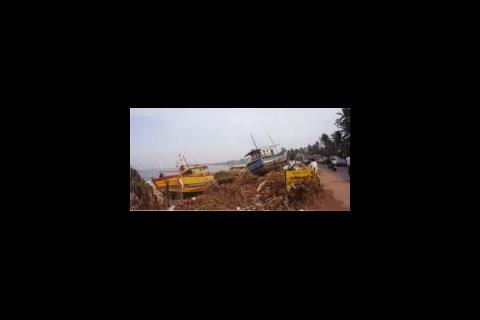
Sri Lanka's fishery development strategy is being launched as the government begins to survey the state of the fisheries industry in full for the first time since the tsunami struck late in December 2004. Overseas-funded charities have donated motorised fishing boats to communities that lost fishing boats when the tsunami struck, Hettiarachchi noted. However, the Ministry of Fisheries estimates that fishing boat numbers now exceed planned development levels and need to be strictly controlled to prevent the likelihood of over-fishing occurring in Sri Lankan waters.
“We are controlling our coastal fisheries. There are no over-fishing signs so far. But we are monitoring the situation now as a lot of boats have been donated by NGOs after the tsunami,” Hettiarachchi said. “There are three times the previous number of fishing boats in some areas. These are 17 to 23 foot long boats fitted with 15hp to 25hp engines. We are doing a census now.
“About 17,000 fishing boats were damaged by the tsunami. At a rough estimate NGOs donated one and a half times to double that number. A lot of NGOs are involved. We are definitely worried about the fishing impact. That's why we are doing a census. We stopped issuing fishing boat licenses in August 2006, so some new fishing boats are unregistered. Also, there were some fishermen who did not register their boats before.”
Most of the NGOs donating fishing boats have been European, along with local NGOs linked to European NGOs. Fishing tackle has been donated by NGOs and the UN Food & Agricultural Organisation.
Coastal fishermen have been the main recipients of the donated fishing boats. These catch small fish, mainly for the domestic market; though lobster, sea cucumber, chank shells, conch shells for bangles, and prawns are caught for export.
Most prawns are caught off the north and northeast of Sri Lanka, Hettiarachchi noted, where prawns are increasingly being caught by Indian fishing vessels.
Sri Lanka's total fisheries production averaged about 280,000mt annually in the years immediately preceding the tsunami, of which marine fisheries represented about 250,000mt. In 2005, the year following the tsunami marine fisheries production dropped 48% to 130,500mt as many coastal fishing boats had been damaged by the tsunami. Although figures are not yet available for 2006, the government is hoping the fishing catch will show a strong recovery.
“Our deep sea fleet numbered about 1,700 vessels and was not affected so badly. Just 10% of the deep sea vessels were lost as most were out at sea fishing or in protected harbours at the time the tsunami struck,” Hettiarachchi explained. “There are 14 deep sea fishing harbours in the south and west of Sri Lanka, and just two in the east (which are not functioning at present). There are none in the north because of the shallow draft there.”
Repair work is underway on a number of harbours that were damaged by the tsunami with work scheduled for completion in 2007 and 2008. As most of the harbours were built to serve small vessels, the government has decided to upgrade facilities as part of general repair work to serve deep sea fishing vessels in the future. In addition, new ice production and cold storage facilities are planned for installation in various fishing ports to support overall fisheries expansion.
Fish prices went up after the tsunami and fish imports increased as a result. Sri Lanka imports 75,000mt of seafood annually on average. This volume slightly increased as traders sought to take advantage of lower domestic fish supplies.
Some 40,000mt of dry fish were imported from India, Thailand and Pakistan in 2005, along with 25,000mt of canned sardines, mainly from Chile; also some from Thailand and the Philippines. In addition, 5,000mt of smoked skipjack was imported from the Maldives. Considered a delicacy, smoked skipjack is used to improve the food flavour of other dishes in Sri Lanka.
In spite of the damage that the tsunami caused to fishing villages, fishermen's boats and tackle, and fishing communities, Sri Lanka's fisheries resources seem to have been spared long term severe damage.
“Our fisheries catch recovered very quickly. There is no sign that there are less fish living in coastal waters; no sign that the debris affected fish life; but fishermen had to remove debris from the coast and beaches to regain access to the sea,” Hettiarachchi remarked.
“Now we do not feel that there was a tsunami – physically you cannot see that there was a calamity. In fact, 7,000 fishermen died. But fishermen have returned to the sea. The people who died were on land. Those who were out fishing had their lives saved.”
Fisheries are of major importance to Sri Lanka where seafood contributes about 70% of all animal protein consumed in the country. Most fish consumed is caught by the local fishing industry which in 2004 caught 286,000mt of fish accounting for 84% of all fish consumed in Sri Lanka. The per capita fish supply has ranged from 17.5kg to 18.5kg annually in the recent past.
Fisheries are an important employer with about 150,000 people directly employed in fishing while another 100,000 are employed in related activities. A further 400,000 people are employed in the fish trade and related activities. All told, an estimated 2.4 million people in households throughout the country are reliant on fisheries.
These numbers are expected to rise in the future. The government's long term fisheries plan projects that almost 800,000 people will be employed in fishing, fish processing and the general fisheries trade in 2016, compared with 655,000 in 2004.
In addition to providing a significant portion of domestic food protein, fisheries have developed into an important export industry in recent years. During the past five years fisheries have earned from US$83 million to $101 million annually in foreign exchange. The tsunami did not greatly affect fisheries exports as most are fish caught by the deep sea fleet and shrimp farm production.
Chilled and frozen tuna account for 42% of export earnings, and shrimp 38%. Lobsters, shark fin and sea cucumber are other important export items.
According to Ministry projections, fishery exports in tonnage terms will grow from 13,680mt in 2004 to about 26,880mt in 2015. The ratio of high value fishery products is expected to grow as the catch of skipjack, yellow fin and big eye tuna, and other species rises each year.
Fish consumption also is expected to increase as fisheries production grows, producing an overall improvement in the local everyday diet.
“Now per capita fish consumption is 17kg including fish imports. We want to increase it to 22kg per capita from local fisheries production. Exports will increase from $100 million to $500 million in value during our plan,” Hettiarachchi said.
“There will be a new wholesale fish market at Peliyagoda, built with a $10 million investment, which will have an export section. The new Colombo fish harbour will be close by. This will be part-government funded and partly by the Asian Development Bank.”
The government is keen to see Sri Lanka's deep sea fishing fleet expand to increase the marine fish catch. The current deep sea fleet numbers 1,740 vessels, though few are believed to be large fishing boats. Some foreign vessels fish in the nation's waters. However, the government does not plan to encourage foreign fishing activities.
“Foreign vessels come into our waters and there are foreign vessels landing their catch from international waters here, but we have not given foreign vessels licenses as we want to develop our own deep sea fleet. We also encourage our fishermen to fish in other waters. Our international waters stretch 200 miles to the south and east,” Hettiarachchi said.
Government plans call for the deep sea fishery catch to grow with the introduction of 100 units of a new class of fishing boat of over 24 metres in length equipped with line haulers, refrigerated storage, advanced safety, communications and navigation equipment, and crew accommodation and other facilities in line with international regulations.
Further planning is required as the government has not decided whether the new deep sea vessels will be introduced under a phased programme involving a public-private partnership scheme or under private ownership. The first batch of three new class fishing vessels are due to become operational in 2008 and are expected to catch about 250mt of high value fish, mostly tuna, each year.
Hettiarachchi pointed out that a fleet development plan needs to be submitted to the Indian Ocean Tuna Commission seeking inclusion of the planned vessels in the Commission's vessel registry to ensure that Sri Lanka does not get left behind in the race for tuna fishing quotas.
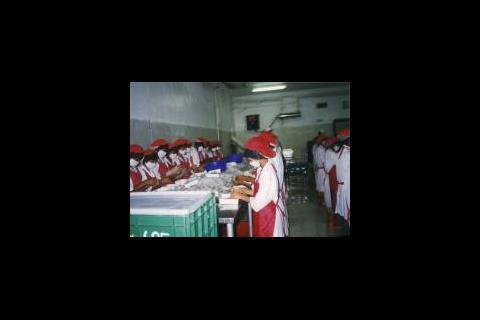
Sri Lanka has 24 modern fish processing plants of which 12 are approved to EEC standards. Four of the 12 plants are involved in marine and cultured prawn processing while the eight other plants are engaged primarily in tuna loining for export to Japan and Europe. Yellow fin tuna is the most common species processed, though marlin and sail fish also are caught for processing as well.
“One Russia-owned tuna canning plant is being set up in Colombo for tuna to export to Germany. Also, a New Zealand owned tuna canning plant will be set up in Galle. Both of these plants will have their own fishing vessels, but these will operate outside of Sri Lanka's EEZ waters,” Hettiarachchi explained.
Although, Sri Lanka's fisheries development potential is considerable when compared with other Asian countries such as Thailand which boasts fisheries production 10 times higher, the government is keen that future development should be sustainable and that the country's 1,600km coastline should not suffer environmental damage.
As a result, the government's Coast Conservation department will be charged with overseeing the operation of an integrated coastal zone management programme as an integral component of the overall long term fisheries development plan. The issue is important as in addition to major fishing harbours, coastal fishermen use a further 35 anchorages and about 600 minor fishing centres along the coastline, where fishing activities and impact also need to be monitored and controlled.
Ensuring sustainable coastal fisheries development will also require the control of shrimp farm development to avoid problems affecting coastal regions that have occurred in other countries where shrimp farming has developed without adequate controls.