
South Korea
South Korea faces challenges as fish imports grow – South Korea’s fishing industry faces numerous challenges over the next decade as the fisheries sector evolves to play a new role in the country’s fast developing economy.

Traditionally a major employer of labour and a core sector in the economy, the fishing industry is under pressure to reduce its marine capture capacity to ensure sustainable production and will rely increasingly on aquaculture for future growth in output.
Fisheries production in South Korea has fluctuated most years since the late 1990s though the overall trend has been upward due to strong growth in marine aquaculture output and better fish stock management. Coastal and offshore fisheries production remains stable while aquaculture production has doubled in size during the past decade.
South Korea’s fishery production totalled 3,032,000 metric tons (mt) including seaweed in 2006 according to the Korea Fisheries Association (KFA), registering an 11% increase compared with 2,714,000mt the previous year. Total fisheries production has risen 20% compared with 2,514,000mt in 2000, including seaweed.
Coastal and offshore fisheries production is stable, partly due to the decline in fishing boat numbers under the government’s fishing vessel decommissioning programme. According to KFA figures, the coastal and offshore fishing fleet caught 1,109,000mt in 2006 compared with 1,189,000mt in 2000, the annual variation being less than 20,000mt in most of the intervening years.
The three major species caught are anchovy, squid and mackerel which account for more than half the combined coastal and offshore fisheries catch. Other important species are yellow croaker and swordfish.
South Korea’s deep sea fishing fleet experiences the most fluctuation in output with the total deep sea catch varying by plus or minus 10% to 15% most years. In 2006, deep seas fisheries production reached 639,000mt, an increase of 15% from 552,000mt the previous year but below the 2000 deep sea catch totalling 651,000mt at the start of the decade.
The deep sea fishing fleet operates mainly in the North and South Pacific and the Indian Ocean, catching mostly tuna and Alaska Pollack. Most of the Alaska Pollack catch is brought back to South Korea for domestic consumption while about 50% of the tuna catch is landed in foreign ports. The deep sea fleet also fishes for squid near the Falklands Islands.
Tuna is the major fish type in the deep sea catch of which skipjack is about 65% by weight. Tuna accounts for almost half of the total deep sea catch.
Alaska Pollack is normally the second largest species caught by the deep sea fleet followed by squid. Saury and croaker are the other important species for South Korea’s deep sea fishermen.
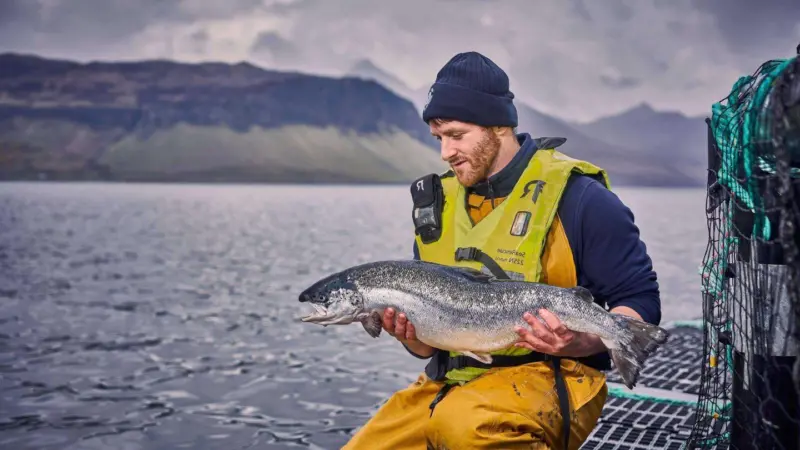
Aquaculture (predominantly marine aquaculture) in recent years has become the largest source of fisheries production, with output reaching 1,259,000mt in 2006, a 21% increase compared with 1,041,000mt the previous year. Aquaculture output has almost doubled this decade as production has risen almost each year after aquaculture output of 653,000mt was recorded in 2000.
Cage farmed fish production is believed to exceed 450,000mt a year. Important species raised in marine cage farms include sea bream and flounder.
“Aquaculture is popular in South Korea; but many fishermen want to start up in aquaculture and this has caused problems due to dense aquaculture practice, so the government is reducing the number of fish farming licenses,” explained Hoon-Chong Yi, chief of the Korea Fisheries Association free trade countermeasures team. “Traceability is one way to control aquaculture production. We attach a label to fish on the farms and track them using the labels to see if there is disease on the farms or any bad conditions.”
South Korea’s recently introduced traceability system for fish and fishery products provides information on the entire process – from the fish farm or fishing vessel to the consumer’s home. The traceability system has been introduced to support the country’s important fisheries export sector and to increase local consumer confidence in domestic fishery products.
The basic plan for the introduction of the fisheries traceability system was formulated in 2004. The government then launched a trial operation of the system the following year for oysters, seaweed laver and flatfish. The traceability system was expanded to 10 further items in 2006 and eventually was extended to 30 fish and fishery products in 2008.
Inland fisheries is the other sector of the fishing industry. However, production remains small in mountainous South Korea, with production of just 25,000mt of inland freshwater fisheries products reported in 2006.
Since the late 1990s consumption of imported fish and fishery products has grown dramatically in South Korea and imports are forecasted to continue rising in future.
“The gap between fishery imports and exports is getting bigger,” Mr Yi said. “This trend is consistent as consumers want more fishery products so we need to import more. This will be the trend for the next 10 years.”
The value of fishery products being imported each year has more than doubled during the past decade while the value of fisheries exports has fallen by almost one third during the same period.
South Korea’s trade deficit in fishery products started in 2001 and has risen each year since then.
Between 1987 and 2000, South Korea exported fishery products worth more than US$1.5 million a year. However, fishery exports fell below $1.5 billion in value for the first time in 2001 and have declined since then, falling to $1.01 billion in 2006 due to stagnated domestic production and rising local consumption of fisheries products.
While exports have decreased, imports of fishery products have risen from $1.4 billion in 2000 to $2.77 billion in 2006. As a result South Korea’s trade imbalance in fishery products reached $1.7 billion in 2006 and is believed to have grown further since then.
Fish imports have risen due partly to rising income levels and growing demand for products that local fishermen do not catch in sufficient quantity. The major fish species imported are tuna, Pollack, sole and croakers; also, low priced fish species from China.
“Some fishermen are very concerned about South Korean fish imports from China but the government is reluctant to start a South Korea-China free trade agreement (FTA) because many fishermen are concerned about FTA requirements, especially with China,” Mr Yi noted. “The government concluded FTA talks with the United States last year.”
Fish are an important part of the South Korean diet. Per capita consumption of fishery products averages about 40kg annually. Most fish are eaten in the home though many restaurants offer fish dishes. Fish generally is eaten cooked though some species are eaten raw including sea bream, halibut and tuna; also, occasionally mackerel and hair tail.
“Fish is popular to eat cooked or raw like sashimi. The most popular raw fish are flat fish for sashimi,” Mr Yi said. “Flat fish sushi is very popular in South Korea. Tuna sashimi is popular but the price is higher, so some people resist eating it.
“Fish consumption is going up but fishery resources are depleting. Older and middle aged people eat fish but young people are not eating fish as they prefer fast food to fish. So we are planning to promote fish to young people.”
Fish consumption is smaller than meat consumption as fish is more expensive to buy. However, fish consumption growth is higher than the growth of beef and pork consumption as more people become aware of fish being a healthy food choice.
The Korea Fisheries Association is an umbrella organisation for fishermen, seaweed cultivators, fish processors and the fishing industry. KFA has around 200 members including big fisheries companies. Promoting consumption of fish and seafood is part of KFA’s wide scope of activities.
“We do promotional events and publish consumer reports for young people about lifestyle and long life. We invite scholars and famous people to address young people,” Mr Yi remarked. “We recommend steamed mackerel for healthy eating; also, boiled mackerel, served with rice and vegetables. This is a typical Korean dish. The price of mackerel is low so a lot of people like eating it.”
Meanwhile, South Korea’s fishing industry is in transition as the government continues to support efforts to reduce the number of fishing boats and prevent overfishing while encouraging better management of fish stocks.
Currently about 83,000 fishing vessels are registered in South Korea of which 95% are under 10t. The number of non-motorised boats is below 5,000 today, less than one third of the number in the mid-1990s.
The number of fishing vessels continues to decline. Under the government’s vessel buy back programme, about 6,300 coastal fishing vessels were taken out of service from 2005 to 2008.
The government currently is operating a fishing vessel buy back plan aimed at decommissioning more than 1,000 fishing vessels to reduce the number of off-shore fishing vessels in operation by 30% over the period 2007 to 2010.
The fishing vessel reduction target is based on the government’s calculation that the current volume of fish caught by offshore fishing vessels is 30% more than coastal and offshore fishery resources can produce on a sustainable basis, given the impact of high fuel prices and trade agreements with other countries on local fishermen.
Fishermen numbers also are declining, though many of those leaving the industry are believed to be part time fishermen and older fishermen who are retiring. Fewer than 200,000 fishermen are believed to work in the industry today compared with about 500,000 fishermen in 1990.
“Most fishermen are South Korean but Chinese crew members are replacing Koreans as they get old,” Mr Yi noted. “Young generation coastal Koreans go to work in cities so we need more fishermen; but some South Korean fishermen do not want foreign workers here as they may lose their business. Only older Koreans are fishermen.”
Meanwhile, government subsidies for the fishing and agricultural industries are among various items that due to come under international scrutiny when negotiations for the final round of the World Trade Organisation (WTO) agreement begin on 1 December 1 2009.
Fishing subsidies are of particular concern to South Korea along with Japan and Taiwan; all of which have large fishing fleets. The South Korean government subsidises the fishing industry in various ways including the provision of fuel subsidies and cheap loans which are used for fishing village improvement, IT training, studying and disaster prevention.
The subsidies are paid to low income coastal and offshore fishermen rather than to the larger, more profitable deep water fishing boat operators. Japan and Taiwan also provide their fishermen with a similar range of subsidies. The three governments are keen to maintain fishing industry subsidies and cooperate in defending fishing subsidy payments when the issue is discussed at WTO meetings.
“Many countries want to finish the WTO round this year or next. WTO is seven sectors of which fisheries is one. This affects South Korea as we have many subsidies. The WTO wants to ban subsidies and we are very worried about this,” Mr Yi explained. “The South Korean government gives many subsidies. The fuel subsidy is the most important as it covers 50% of total fisheries subsidies.
“Some countries say subsidies encourage resource depletion but we at Korea Fisheries Association do not agree. We attach importance to good fisheries management like aquaculture and using fish hatcheries.”
South Korea’s involvement in bilateral negotiations for the conclusion of Free Trade Agreements (FTAs) also affects the fishing industry as fishery products are among the various tradable items that bilateral FTAs cover.
The first FTA that South Korea ratified was with Chile in February 2004. Since then FTA agreements have become active with Singapore in March 2006 and with the European Free Trade Association (EFTA) in December 2005 and the Association of Southeast Asian Nations (ASEAN) in May 2006. The South Korea-United States FTA was signed in June 2007.
Talks are continuing with other countries including China and Japan for FTA agreements which will improve market access for fisheries and other products of each side in the FTA agreements.