


Solar powered cold storage for remote communities
PT Contained Energy Indonesia has developed and successfully deployed stand-alone, off-grid, 100% solar-powered cold storage facilities, designed for use in remote communities.
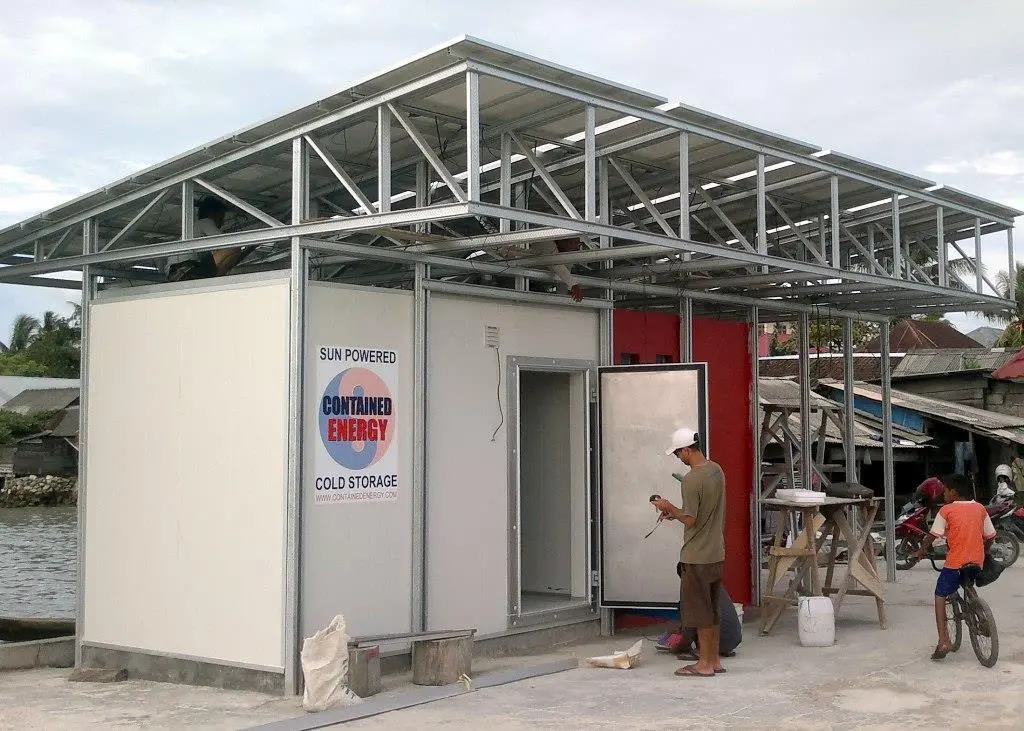
The system operates without external power source and thus has zero energy costs.
The company realised that in remote communities where no grid power is available, the conventional solution of powering refrigeration with diesel gensets often fails because of significant operating costs and logistical challenges. Even where grid-power is available, frequent power outages pose a problem and can result in substantial losses.
The first two units of 20m3 have been installed – one on a remote island in Wakatobi and another in Pacitan, Indonesia. They have been designed to keep 1000kg of fish at -2oC, in ambient temperatures of up to 40 C, with the capacity of adding and cooling 200kg of ‘un-iced’ fish per day (for a total cooling load of 30kWh per day). The system can also be used for ice-making.
It is energized by a 6.4kWp solar array through a three-phase Outback inverter system, backed up by a relatively small 10kWh VRLA battery bank. One of the unique features of the system is that it incorporates a large volume of Phase Change Material (PCM) in the ceiling, capable of storing 15kWh of cooling capacity at -4oC. This thermal energy storage technology allows the compressor package to do most of its ‘work’ during the day, when the solar power is available. This saves a substantial quantity of battery storage that would otherwise be required.
The unit features walls, ceiling and floors constructed from 15cm insulated modular panels, stainless steel door with heating element, aluminium chequered floor plates, lighting and a programmable digital control system.
The high-quality solar array, the largest cost component of the system, comes with 25 years performance warranty and an expected productive life of 30+ years, whereas the economic life of inverters, compressor and housing is designed for 10-15 years. The industrial VRLA deep-cycle gel batteries only need replacement every six-to-seven years. Cost of ownership over its design life is thus extremely low and in many locations, ROI for the system, compared to ‘conventional’ fuel- or grid-powered units, can be as low as two-to-three years.
This particular system can be built into a 20’ shipping container. Other sizes and capacities, such as walk-in freezers, down to -30oC are also possible.
Related Articles
 PROCESSING & REFRIGERATION
 SEAFOOD
 SEAFOOD