




Shrimp from New Mexico?
Commercial shrimp farming in New Mexico seems unlikely, but a study into its viability is being carried out that might result in a new, inland shrimp market.
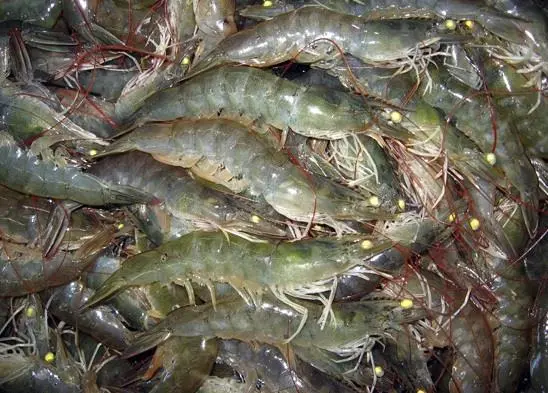
The New Mexico State University (NMSU) study is comparing shrimp being raised on a new feed incorporating glandless cottonseed meal with shrimp raised on a commercial feed.
The NMSU shrimp are being raised in local Rio Grande Basin water, with salt and minerals added to replicate normal shrimp conditions, and in a closed system that could be replicated relatively inexpensively and installed almost anywhere.
Directing the NMSU study is Colleen Caldwell, an adjunct associate professor in NMSU’s Department of Fish, Wildlife and Conservation Ecology and the New Mexico unit leader for the US Geological Survey’s Biological Resources Division.
“Aquaculture is agriculture,” Ms Caldwell said. “Pacific shrimp, Litopenaeus vannamei, is an easy species to rear, and it has been commonly demonstrated that it is easily reared in an aquaculture environment.”
For the past month the shrimp have been fed daily with a measured ration. Shrimp in five control tanks are being fed the commercial feed product, while the ones in the five experimental tanks are being raised on the glandless cottonseed feed.
Researchers at Texas A&M University originally developed the cottonseed in a separate project supported by Cotton Incorporated. The Alcala cotton variety lacks the glands that produce gossypol, a substance that acts as a natural pesticide but also makes the seed, including its oil and meal, inedible by humans and most animals.
Behind the NMSU-Cotton Incorporated research is the idea that the oil and the protein from glandless cottonseed could be obtained at a relatively low cost and incorporated into a variety of products, including feed for aquaculture crops.
“What we’re doing here is raising shrimp in very controlled conditions,” Ms Caldwell said of her project. “We’re in a desert, and water is very precious.” She explains that researchers developed a recirculating system that gives 100% water reuse, and adds that because the temperature and salinity are also both very important for the shrimp, water is kept at about 30 degrees Celsius while mimicking the salinity of the ocean, roughly 35 parts per thousand.
“If we can demonstrate …that you can rear shrimp, especially on a fairly inexpensive feed such as the cottonseed meal feed, I really think that this project could be picked up by average families in New Mexico who could then rear these animals in a greenhouse.”
If a market can be developed for shrimp grown far from the ocean, then the low transportation costs might make this an attractive option for local buyers.
Related Articles
 FISHERIES
 FISHERIES
 WORLD FISHING EVENTS