





Rabobank: China could soon become a $29bn seafood import market
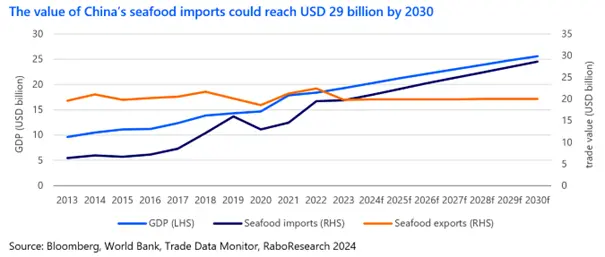
China is poised to drive 40% of the global growth in seafood consumption to 2030, and this tremendous growth, fuelled by the country’s economic prosperity, large population, and high seafood demand, could transform it into a US$ 29 billion market for seafood imports, according to new analysis from Rabobank.

According to the RaboResearch report, higher-value seafood should benefit from this trend, thanks to China’s growing upper-middle class and e-commerce expansion.
“China’s economic prosperity, coupled with its population of 1.4 billion consumers and a high affinity for seafood, positions it as the most promising growth market for seafood this decade,” RaboResearch Seafood Analyst Novel Sharma said.
The report also highlights that Chinese seafood consumption is expected to grow by 5.5 million tonnes through 2030, outstripping local supply.
“We expect China to seek resources beyond its borders to ensure adequate supply and close the widening gap between demand and supply by the decade’s end.”
The RaboResearch forecast for China’s seafood demand for the remainder of the decade is a combination of volume- and value-driven growth.
“We anticipate that urbanisation, the growth of upper-middle-class consumer groups, and the expansion of e-commerce channels will drive a trend toward demand for higher-value seafood in the long term,” Sharma said.
“If this pivots to higher-value seafood continues, value-driven consumption growth will likely outpace volume-driven growth, with China potentially emerging as a $29 billion seafood import market by 2030, creating ample opportunities for global seafood exporters.”
RaboResearch also advises that volume-based opportunities will still be significant, and that domestic producers should benefit, as they typically focus on lower-value species and the mass market is likely to remain price-sensitive.
The expectation is that China’s demand for seafood imports will grow $10 billion by 2030.
“This anticipated import growth could reshape the global seafood industry,” Sharma said. “High-value species such as salmon, lobster, crabs and wild shrimp, of which China has limited to no domestic production, may see the largest gains. High-value species like farmed shrimp, for which China’s demand surpasses its production, also stand to benefit.”
The research suggests opportunities for seafood exports to China are ripe for Southeast Asian countries and India, particularly for shrimp, crabs and marine fish. Also, Central and Latin America, known for their competitive seafood exports, could unlock further growth, especially for high-value species like shrimp and salmon.
Ecuador has already capitalised on China’s farmed shrimp demand in recent years, notes the report.
“As China transitions to being the major global seafood buyer and price setter, the decisions it makes regarding seafood consumption and sourcing will have a global impact,” Sharma said. “It will be important for global exporters to monitor China’s evolving demand dynamics closely to identity potential untapped opportunities.”
Related Articles
 SEAFOOD
 SEAFOOD
 PROCESSING & REFRIGERATION