






Nomad commits to cutting carbon emission
European frozen food company Nomad Foods, the company behind brands such as Birds Eye, Findus, Iglo, Ledo and Frikom, has announced the results of an 18-month study exploring if frozen food storage temperatures can be increased, thereby leading to significant carbon emission reductions and cost savings, without impacting product safety or quality.
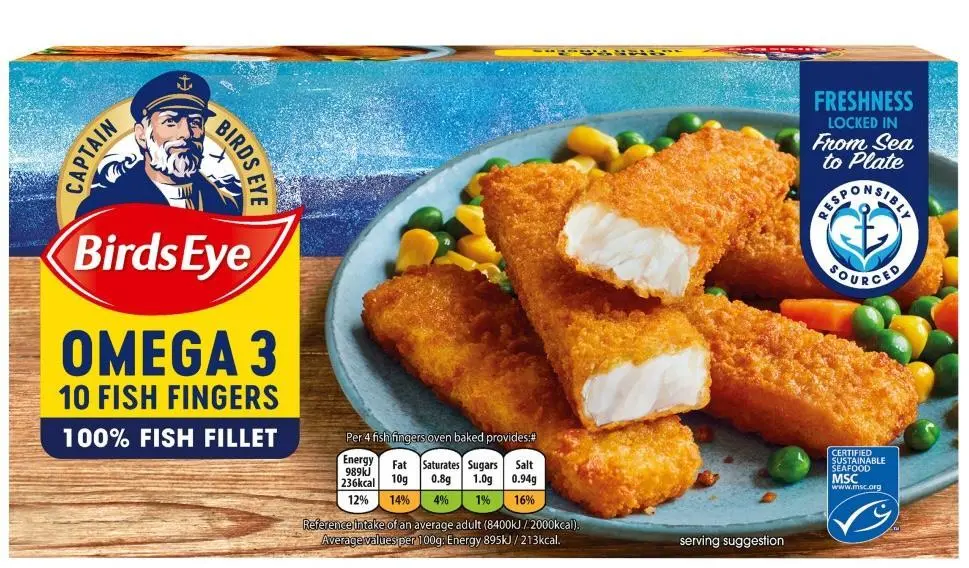
The results, with food science and technology organisation Campden BRI, build upon the previously announced 12-month results and add further weight to the suggestion that storing frozen food at -15oC, instead of the industry standard -18oC (zero degrees Fahrenheit), can reduce freezer energy consumption by 10-11%, without any noticeable impact on the safety, texture, taste or nutritional value of a product.
Nine savoury frozen products are included in the study; poultry, coated fish, natural fish, vegetables, plant-based foods and pizza. Four temperatures (ranging from -18oC up to -9oC) and eight key areas including food safety, texture, nutrition, energy use and packaging impact were tested. Results after 18 months showed no significant change to the products at -15oC versus -18oC, unless those products had passed their Best Before Date, where a drop in Vitamin C for some vegetable products could then be seen.
Options for the study to be peer reviewed are now being explored.
Nomad Foods is also the first food manufacturer to sign up to Move to -15oC, an industry coalition launched at COP28 and dedicated to cutting carbon emissions in the frozen food supply chain. Recognising that a shift in frozen storage temperatures requires industry-wide collaboration, Nomad Foods’ Chief Executive Officer Stéfan Descheemaeker is now calling on other frozen manufacturers to join the movement.
Descheemaeker said: “We already know that frozen food compares very well against alternative preservation methods in terms of carbon footprint. The latest results of our study with Campden BRI underlines the critical role frozen food has in reducing the impact of the wider food industry on climate change.
“However, we can’t do this alone, which is why we are calling on other frozen food manufacturers to join us and the Move to -15oC coalition to ensure the full breadth of products within the frozen category are tested at higher temperatures.
“As we celebrate 100 years since flash freezing was invented by Clarence Birdseye, I think he would be very proud to see the innovations being driven in the frozen food category to tackle the world’s greatest challenge of climate change.”
Move to -15°C was founded following the launch of the Three Degrees of Change report, an academic paper supported by global logistics firm, DP World, and delivered by experts from the Paris-based International Institute of Refrigeration, the University of Birmingham, and London South Bank University among others. The report found that a move from -18°C to -15°C could make a significant environmental impact with no compromise on food safety. Its findings found that this small change in temperature could:
- Save 17.7 million tonnes of carbon dioxide per year, the equivalent annual emissions of 3.8 million cars annually
- Create energy savings of around 25 terawatt-hours (TW/h) – equivalent to 8.63% of the UK’s annual energy consumption
- Cut costs in the supply chain by at least 5% and in some areas by up to 12%
Recognising that a change in global temperature standards requires a collective effort, the coalition intends to bring together key players within the global food supply chain to collaborate and explore viable options for a move to -15°C.
Nomad Foods published a life cycle analysis of its leading frozen food products in 2022 which showed frozen food performs very well against alternatives in terms of carbon footprint, partly due to much lower levels of food waste.
Related Articles
 SEAFOOD
 SEAFOOD
 PROCESSING & REFRIGERATION