



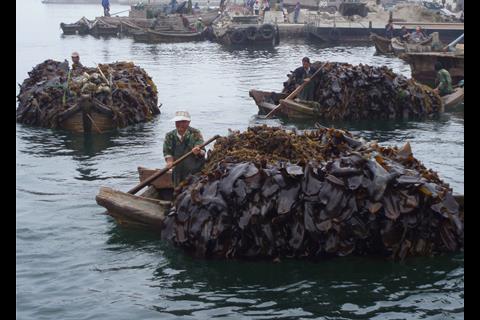
Dr Keri Wallace and Dr Adam Hughes from SAMS Research Services Ltd (SRSL) explain Integrated Multi-Trophic Aquaculture (IMTA) and its benefits.
What is IMTA?
Feed is a core operational cost for most finfish aquaculture operations. However, approximately 70% of the nitrogen and 80% of the phosphorus in this costly fish feed is lost to the environment through excretion and faeces. But with the application of newly emerging technologies, some of this unused food, nutrients and energy can be recaptured and converted into crops of commercial value for the producer, while going some way towards mitigating environmental impacts of intensive mono-culture.
Integrated Multi-Trophic Aquaculture (IMTA) is a practice in which the by-products (wastes) from one species are recycled to become inputs (fertilizers, food and energy) for another. When implemented correctly, fed aquaculture species (e.g. finfish/shrimps) are grown alongside selected organic extractive species (e.g. suspension feeders/deposit feeders/herbivorous fish) and inorganic extractive species (e.g. seaweeds).
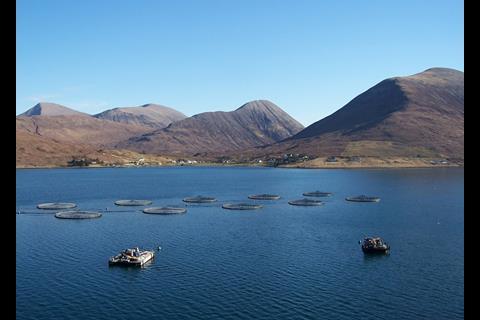
For example, the wastes emitted from the cage culture of salmon would be assimilated by shellfish and seaweed, which are also of commercial value. This kind of recycling (bioremediation) is made possible in IMTA by the fact that it is ‘Multi-Trophic’, meaning that the co-cultured species represent different trophic levels, so that it resembles the way a natural ecosystem works.
While the secondary co-cultured species (usually shellfish and/or seaweeds) are typically premium ‘cash crops’ of some kind, novel alternatives may be considered for extraction of natural products (e.g. pharmaceuticals, nutraceuticals, functional foods, cosmeceuticals, botanicals, pigments, agrichemicals and biostimulants). The driver behind a growing interest in IMTA is more than just profits however. The rapid growth and expansion of mariculture over the last decade has resulted in intensified cultures, decreased space available for cage sites or aquaculture leases and, potentially increased environmental stress on the immediate ecosystem. When you throw in the rising cost of energy and aquafeeds, and a developing environmental regulatory landscape, there is a very real demand for more sustainable practices.
Why IMTA?
The major benefit of IMTA is theability to use wastes to produce new crops. However, the bioremediation effects are also of interest, and may also have positive social and economic implications for aquaculture operators, alongside some environmental benefits. Another consideration is the reduction of business risk. Farming multiple species means a diversified product portfolio, which can deliver operational stability in the face of changing market prices or the catastrophic destruction of a crop (e.g. due to disease or climate change).
In this respect, species selected for co-culture should represent an investment portfolio, with short-term, long-term, high risk and low-risk components built-in to allow for sustainable business growth. IMTA does have some risks of its own however, and it is important for producers to implement adequate management and monitoring practices to reduce the likelihood of disease transmission between aquaculture facilities or to natural flora and fauna.
Because IMTA represents an environmentally friendly and sustainable approach to mariculture, one of the major benefits is an opportunity for producers to demonstrate a company ethos of environmental responsibility; a branding strategy which would work particularly well if supported by suitable eco-labelling or a system of Nitrogen credits.
At the current time, commercial IMTA implementation worldwide is minimal. This is because the business case for this approach has only recently begun to gain recognition. The most advanced of the commercial systems have just three components (fish, shellfish, and seaweeds), but these are relatively simple systems. IMTA is a flexible technology, and far more advanced systems could be constructed with multiple other components and concomitant benefits for farmers.
The real potential of IMTA is most clearly being demonstrated in Canada at present, where multiple projects have now sprung up on both the Atlantic and Pacific coasts. However, Chile, China, South Africa, United States of America and the United Kingdom also have IMTA systems at or near commercial scale.
Those in the UK exist only in Ireland and Scotland. But in Scotland, unlike several other countries, there is no legal barrier to licensing of integrated aquaculture operations, and several licences have already been granted. The Scottish Government is supporting the country’s aquaculture industry to achieve ambitious growth targets of 210,000 tonnes of finfish and 13,000 tonnes of mussels by 2020. Despite these ambitions, none of the integrated aquaculture systems in Scotland are at commercial scale. It would seem therefore; that Scotland, like much of Europe, is ripe to benefit from wide-scale uptake of new approaches to sustainable growth practices, like IMTA.
There are a number of small operations running pilot scale IMTA developments in Scotland at present (e.g. Loch Duart Ltd, and West Minch Salmon Ltd). However, the most extensive IMTA set-up is in Loch Fyne, and run by the Scottish Salmon Company Ltd (SSC) as a result of collaboration with the Scottish Association for marine Science (SAMS).
Cutting-edge research
The Scottish Association for Marine Science (SAMS) in Scotland is one of the oldest oceanographic institutions in the world and has a long track record in pioneering aquaculture research. Over the last few years SAMS has set the pace for IMTA progress in Europe, through a number of high profile research projects. Recent examples include the multi-million Euro IDREEM project (Increasing Industrial Resource Efficiency in European Mariculture); 2012-16. Funded by the European Commission, this project is co-ordinated by SAMS and brings together 15 industrial and research partners to help the European aquaculture industry adopt more environmentally and economically efficient practices by using IMTA on a commercial scale. The four-year project aims to demonstrate the costs and benefits of IMTA through pilot commercial-scale testing, field research and modelling.
Interdisciplinary research within IDREEM examines the obstacles and risks to the use of IMTA systems and is developing new tools to overcome these constraints, whether they are economic, environmental, technical, social or regulatory. IDREEM project outputs will deliver the evidence required to support the adoption of IMTA across the aquaculture industry; helping create employment and widening a market niche for IMTA-grown seafood products.
SAMS is also hosting a Sustainable Knowledge Exchange (KE) Fellowship in Aquatic Food Supply, funded by the Natural Environment Research Council (NERC), 2014-2016. This fellowship involves staff dedicated to mapping UK academic expertise in aquaculture science against priority areas outlined by key players in the aquaculture industry, with an emphasis on selected key species and IMTA practices. Through this fellowship, SAMS is able to identify future research needs and technology challenges facing the aquaculture sector with respect to IMTA practices.
It is important for research organisations to work closely with industry, and since 2006, SAMS’ scientists have developed collaborations with salmon companies Loch Duart Ltd, Scottish Salmon Company (SSC) and West Minch Salmon, as well as with the mussel producer Loch Beag, to initiate pilot projects investigating the potential for IMTA along Scotland’s west coast. Trialled practices included the integration of Atlantic salmon with several species of sea urchins and seaweeds. Other research has focused on the integration of organically farmed salmon with oyster and king scallop, and the co-cultivation of sea urchin species with the blue mussel.
Much progress has been made in understanding these systems and SAMS has now accumulated a knowledge-base in IMTA sufficient to allow trading subsidiary SAMS Research Services Ltd (SRSL) to supply cutting-edge consultancy to innovative fish farmers, advising on the application and optimisation of IMTA in European waters. These new services are underpinned by a decade of robust scientific research.
Seaweed culture and IMTA
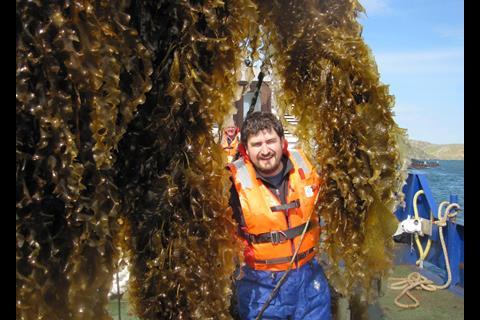
A great deal of the IMTA research at SAMS has focused on the role of seaweeds as an ‘extractive’ species which can deliver bioremediation benefits. Genera of particular interest and those with high potential for development in IMTA include Laminaria, Saccharina, Palmaria and Ulva. Species selection is paramount. For example, a hectare of Palmaria palmata may absorb as much as 12-30% of the nitrogen output from a 500 tonne salmon farm, while Saccharina latissima might absorb only 5-10 % from the same operation. But whichever species are used, be assured that large quantities of seaweed would have to be grown to make significant impacts on dissolved nutrients.
Seaweed cultivation can deliver uptake and removal of nutrients (by harvest of the seaweed) at a co-culture farm scale but could also play a greater role in the management of wider-scale coastal nitrogen budgets if planted on a bay-wide scale, rather than being planted in direct-proximity to the farm only – farming the system rather than the site. This practice is already commonplace in China.
The culturing of seaweeds depends greatly on available sunlight and other physical parameters, particularly current speed and depth (on account of light attenuation), to the extent that these parameters can outweigh any measurable advantage of additional nitrogen. Growth rates in summer for P. palmata and S. latissima can be enhanced by up to 48% and 61%, respectively when grown next to a fish farm, and biomass yields over a growth season can be enhanced by 63% and 27%, respectively.
Experiments at SAMS have shown that seaweed grows better at control sites further afield, rather than too near the farm, where they can get coated in a fine film of waste particles. The condition of the cultured seaweed fronds is obviously more relevant where the purpose is to achieve a viable crop for resale, rather than for those sites where culture is purely for bioremediation purposes. For all these reasons, it is wise to seek specialist advice on how to optimise IMTA practices by tailoring them to complement the local ecosystem.
The global seaweed farming industry already produces tens of millions of tonnes every year across 44 countries and is worth billions of dollars. Scotland however, has one of the longest histories of seaweed harvesting, dating back to the late 17th century; with uses ranging from a natural fertiliser to natural products like alginate in the 20th century, where it was used as a common thickener in ice cream and other food. Today the main uses of kelp are as a luxury food item and for vitamins, cosmetics, plastics, hydrocolloids and animal feed. It is only in the last few years however, that cultivation and harvesting of seaweeds as a source of biofuel has captured the hearts and minds of scientists and industry alike.
Seaweed can be fermented to produce ethanol, which can be mixed with petrol. Alternatively, seaweed can be decomposed in an anaerobic digester to produce methane. So-called ‘marifuels’ are of interest because kelp grows more quickly than land plants, converting sunlight into chemical energy five times more efficiently. Farming kelp also avoids several of the issues facing conventional biofuels produced from terrestrial crops, such as land-competition and freshwater availability. When combined with the potential to offset the environmental impacts of another global growth industry, aquaculture, it seems likely that the practice of cultivating seaweed through IMTA practices is an ideal approach to delivering a more sustainable future.
SAMS has recently been awarded NERC funding for a project called Global Seaweed (Global Initiative in Tackling Emerging Issues in Seaweed Aquaculture); April 2014 to 2017. The project is centred on addressing the issues and bottlenecks that hamper the seaweed industry in Europe. Outputs will then focus on importing know-how in seaweed cultivation into the UK, and on developing tools to ensure a smooth transfer of research results to the industry and to policy makers on a global scale. This international project will firmly place SAMS at the forefront of seaweed cultivation science.
Further reading
Integrated Multi-Trophic Aquaculture, Adam D Hughes, Maeve S. Kelly, Scottish Association for Marine Science for the Scottish Aquaculture Research Forum (SARF); www.sarf.org.uk/downloads
Integrated mariculture: a global review. FAO Fisheries and Aquaculture Technical Paper. No. 529. Rome, FAO. 2009. 183p. Soto, D. (ed.)