


Rolls Royce’s new hybrid shaft generator
The new Hybrid Shaft Generator (HSG), developed by Rolls Royce, is an advanced power electric system that will allow for flexible use of speed, enabling better efficiency of both propeller and engines.
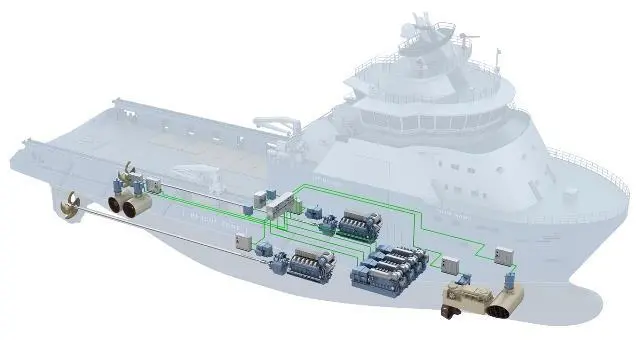
This HSG concept means that if applied in the right circumstances, this technology could give remarkable fuel reductions for diesel mechanical installations. The technology could be applied to a range of marine craft, with varying results for different vessel types.
Efficiency is achieved by conditioning the power from the coming form the shaft generator so that a switchboard can provide a constant voltage and frequency and the correct phase angle to match other generator sets running parallel.
Previously when the shaft generator was used the engine speed had to be constant in order to match the frequency of the electrical system on board the ship. Other methods of doing this have involved systems for holding the generator speed constant despite variation in engine speed.
The HSG concept is a system that conditions the power from the speed generator, allowing for variations in speed. The immediate advantages are flexible use if engines and propellers. The reduction in RPM will gives owners greater control over their equipment and fuel efficiency, as well as potentially reducing their CO2 and NOx emissions.
An example would be a 6,500kW CP propeller with a loss of around 900kw. This has a fixed nominal RPM and zero pitch. The HSG concept reduces RPM, in turn reducing the shaft line RPM, down to idling speed but still with fixed nominal frequency and voltage on the electrical network.
The zero pitch loss is reduced by 800kW. With the reduction of engine RPM, up to 8% fuel saving is a distinct possibility.
Vessels that would benefit the most are those with medium speed engines driving CP propellers or main thrusters through reduction gears. Without the HSG the engine can run the propeller at full speed and low pitch, with a high loss.
The HSG would allow the engine and shaft speed to run at the best suited speed, while converting the power to feed the switchboard and electrical needs. This would eliminate the need to run auxiliary generator sets.
The HGS concept is a two step conversion process, involving the power electronics and active front end (AFE) technology to avoid transformers. At first the current is changed from variable frequency alternating current (AC) to direct current (DC). Next the change from direct current to fixed frequency alternating current. This is supplemented with a ‘speed droop’ feature which appears to the switchboard as if it was a standard generator set running in parallel and sharing load in a stable way.
Merchant ships, refrigerated cargo vessels and offshore vessels would also benefit from the HSG concept, as it would tailor itself to the individual problems each type faces from their conventional systems.
Rolls Royce points out that this new system is not limited to new vessels, but can in some instances easily installed in older ships. The HSG concept handles both synchronous and asynchronous electrical machines, adding to its versatility and ease of use.
The potential from the HSG concept involves saving fuel, time and sees a potential for less noise and vibration, not mention the efficiency from propellers and engines. The system is modernised to the point where running the HSG has been simplified for crew and captain to easily use on a day to day basis.