
Hard working propellers are normally "out of sight and out of mind", or certainly they should be, according to Teignbridge Propellers, but this means that this vital part of a boats propulsion system is often neglected.
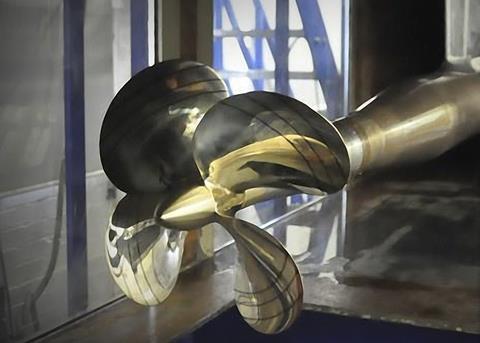
The company says that an "off the shelf" propeller will not be designed or made for the vessel and it will be inefficient. It says that in no time, any cost saved in the purchase price will be swallowed up with extra fuel costs. A custom designed propeller is made to give the optimum performance and fuel economy for the particular vessel application and it will save its cost in fuel savings in a very short time.
Custom designed propellers
Several years ago the team at Teignbridge Propellers decided to improve the performance and economy of marine propellers. They introduced two new developments into the propeller market. The first was a new radical propeller design called the C-Foil (custom foil). The second development was the introduction of a new computerised, pattern-less, rapid design, and rapid manufacturing process, that enables the company to quickly produce custom designed propellers for the best performance.
The C-Foil propeller has been out-performing its rivals in open water vessel trials for several years. Recently the company decided to have this verified by independent organisations.
Plymouth University was one of the institutions and it carried out a fluid dynamics exercise and found that the design provided “12% more thrust and was 10% more efficient”.
At Newcastle University the team at the Marine Science and Technology department tank-tested a four bladed version of the C-Foil propeller and a ducted propeller and nozzle.
In their report the team stated the following:
"The maximum efficiency for the propeller was 80%”…“Modern propellers, depending upon their application, can commonly expect efficiencies between 60% and 75%, the C-Foil is therefore above the upper bounds of this range”.
Their conclusion was that “The Teignbridge C-Foil propeller appears to be a well designed and efficient propeller. In the Emerson Cavitation Tunnel It achieved a maximum efficiency of 80%”…“Cavitation observations were encouraging for a propeller of this type under heavy loading.”
Stand P38