

QFC newbuild to feature cutting-edge Carsoe factory
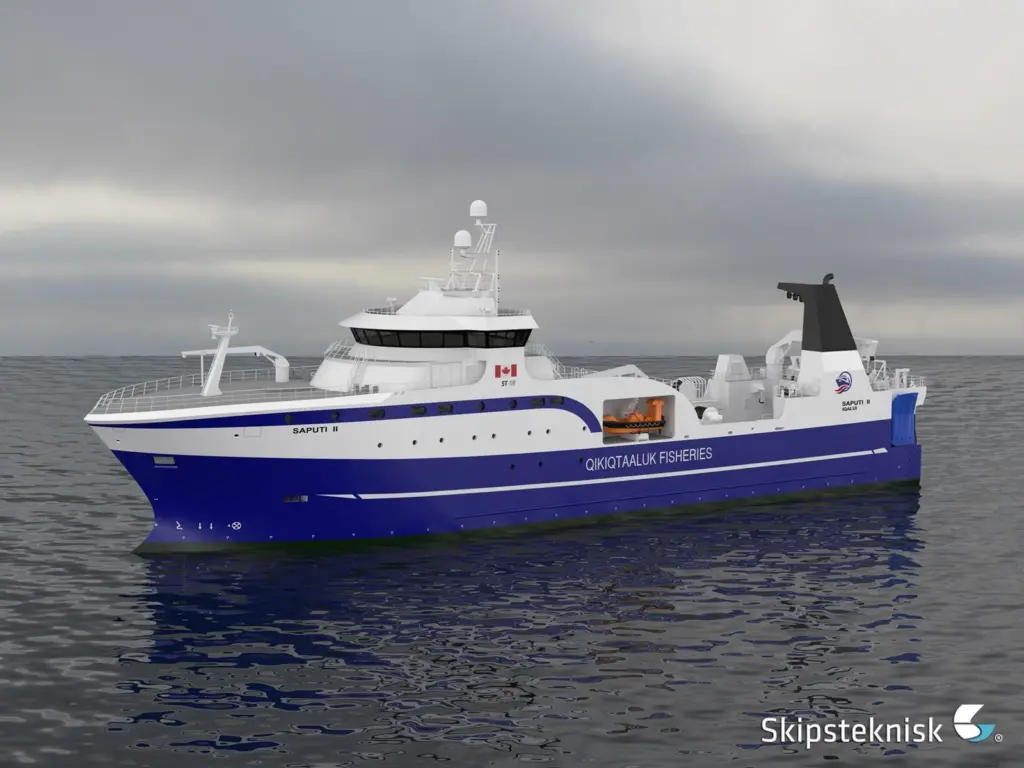
Qikiqtaaluk Fisheries Corporation (QFC) has confirmed its largest factory fishing trawler to date, Saputi II, will have an advanced Carsoe processing facility onboard.
As a trusted partner, seafood processing equipment manufacturer and supplier Carsoe was a natural choice for the dual-species processing factory, said Jerry Ward, Director of Fisheries with Qikiqtaaluk Corporation, owner of QFC.
“We have benefited greatly from Carsoe’s service over the past several years as a partner on the first Saputi vessel. Carsoe has delivered a superior processing solution, efficient implementation, experienced technicians – followed up with a great spare part and maintenance service, ensuring reliable and uninterrupted operations,” Ward said.
Commissioned in October last year, Saputi II will be 79 metres in length and 17 metres in width. The vessel will have an efficient, low-emission engine and will aim to utilise its catch to the fullest. It will have a handling capacity of 750 tonnes of shrimp and 1,100 tonnes of halibut.
Carsoe said it is thrilled at being contracted to deliver the newbuild’s processing plant.
“The Saputi II is a state-of-the-art Arctic vessel, and we are very happy to be chosen as processing partner on the build. Our factories are designed for efficiency, using automated processes to maximize yields and ensure easy handling for the crew,” Carsoe CEO Hugo Dissing said. “So, it is a great fit with what we do best.”
Seamless switching
Carsoe said its processing factory aboard Saputi II will guarantee unparalleled product quality through cutting-edge onboard processing and freezing techniques, preserving the freshness of the product.
The factory will be equipped with automated by-catch separators, a shrimp grader, and a batch cooking line. Additionally, it will feature a complete halibut production line, granting the vessel the flexibility to seamlessly switch between different production types.
Processed products will be rapidly frozen using one of the three IQF tunnel freezers or the two automatic horizontal freezers, with the freezing process being entirely automated to ensure efficient and continuous processing.
With an automatic, continuous freezing process, manual handling is eliminated, resulting in increased production rates, Carsoe explained, adding that the infeed and outfeed of the freezer are automated, which maximises capacity and simplifies maintenance procedures.
Advanced palletising
At the end of the freezing line, the factory’s packing section will feature a robotic hotel for sorting products.
Frozen products will be sent for automatic palletising with an integrated stretch wrapper, and then automatically transported to the cargo hold.
According to Carsoe, this type of palletising system is ideal for factory trawlers because the stretch film is added during palletising, allowing for quick and efficient storage preparation. The layered wrapping also provides additional stability and protection for the catch, ensuring safe storage during bad weather and heavy seas.
Carsoe also highlighted that the automated workflow in the processing plant eliminates several manual processes and heavy lifting and creates an improved working environment for the crew.
Saputi II will be constructed in the Freire Shipyard (Construcciones Navales P Freire), a family-owned company established in 1895 by Paulino Freire in Vigo, Spain.
QFC an Inuit birthright development corporation created by the Qikiqtani Inuit Association. With a history spanning 40 years in the Qikiqtani Region, QFC’s mission is to provide employment and financial opportunities for Inuit in the region.
The company also owns and operates the multi-species factory freezer vessel Saputi. Both Saputi and Saputi II will operate in the Qikiqtani Region, harvesting offshore shrimp and turbot/halibut.
Related Articles
 PROCESSING & REFRIGERATION
 SEAFOOD
 SEAFOOD