



Offshore aquaculture project gets green light
The Norwegian Ministry of Trade and Fisheries has given the green light for Norway’s first development concession enabling Ocean Farming AS, supported by Kongsberg Maritime AS, to build the world’s first automated exposed aquaculture facility.
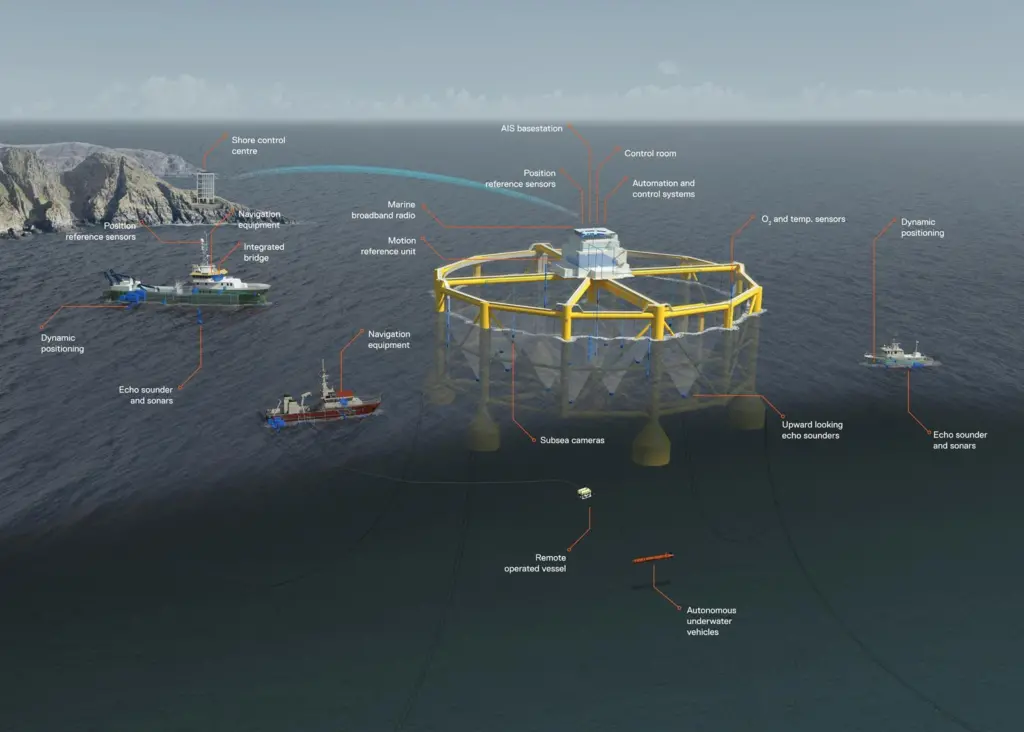
Situated outside of Trondheim, this innovative new facility is said to be a significant step in Norway’s efforts to deliver technical solutions to address the impending global food gap challenge.
“The Ocean Farming facility introduces a paradigm shift in salmon farming now, and other fish types in the future. With greater focus on biology and nurturing healthier fish, the concept delivers significantly improved yields that will prove important in the decades to come as part of Norway’s strategy to leverage its aquaculture and offshore expertise,” said Egil Haugsdal, President, Kongsberg Maritime.
The submerged, anchored fixed structure is suitable for water depths of 100 to 300m, where the aqua biological conditions are ideal for aquaculture. It is fully automated with normal operation requiring a crew of just three to four people and can also be remotely operated.
This project combines the best of existing technology and solutions from the Norwegian fish farming industry and the offshore oil and gas sector, with Kongsberg playing a key role by leveraging its position as a turnkey supplier of technology and engineering services.
In addition to technology integration, Kongsberg is providing EIT engineering services, including delivery and installation of the gensets and aqualight systems.
The Kongsberg Maritime technology scope of supply for the fish farm itself includes the K-Chief 600 automation system controlling a large number of different systems. It is also providing an extensive telecoms and positioning package to include products such as the Maritime Broadband Radio (MBR) for communication between offshore sites and to shore and precise Motion Reference Units (MRU).
In addition, Kongsberg is responsible for the AIS requirements of the project, through delivery of the AISBS610 system and associated AIS infrastructure.
It will also supply the high-tech Simrad EK80 scientific echo sounder, a range of underwater cameras and an Acoustic Doppler Current Profiler (ADCP), velocimeter and O2 sensors.
These products are designed to accurately detect where the fish are in the vast water volume of the cage and how they move in order to ensure effective feeding. In addition, they will display advanced 3D display of the fish and relevant environmental parameters.
Related Articles
 FISHERIES
 FISHERIES
 WORLD FISHING EVENTS