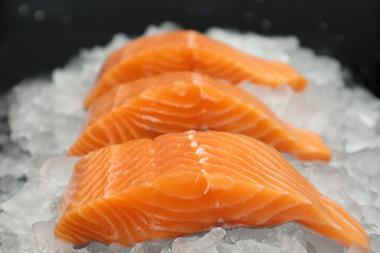



Jutland peninsula is the holiday haunt for the Danes but the locals face dark summer clouds as they find that their salmon processing industry is caught between the devil and the deep dark fjords of Norway. In May, Pan Fish had to temporarily close its salmon processing plant in Hirtshals as the EU regulations on Norway's farmed product began to bite and in the process made the Danish salmon industry suffer. By July Pan Fish management had logged the value of its Danish subsidiary at zero.
The irony is that Pan Fish Denmark, at the top of Jutland, has been one of the largest and most modern processing plants for salmon in Denmark. In 2004 the turnover amounted to 280 million Norwegian Krone (NOK) (€37.5 million) and it was based mainly on processing Norwegian salmon. Indeed using Norwegian salmon has been the rule in Denmark. Norwegian company ownership as in the case of Pan Fish Denmark, is also quite common. There is a twist in that Pan Fish Hirtshals, until 2004, was majority-owned by the Faroese company Vestsalmon. The complex history of the Hirtshals' plant also makes it difficult to fully understand why things went wrong.
Capital Esbjerg
Pan Fish Denmark is one of the largest of some 80 Danish companies handling salmon. Some focus on smoking others on filleting/portioning. Pan Fish Denmark and JP Salmon i Esbjerg have been important players in both sectors. A third Danish smokery is Norlax in Outrup and the company is the result of four mergers between five Danish smoked-food companies. The capital of Danish-smoked salmon is probably Esbjerg on Jutland's west coast and it is also home to KB Røgeri, which buys in 2,000 to 2,500 tonnes of salmon each year.
OH Fiskeeksport AS at Skagen buys in 12-15,000t and most of it is resold whole with the rest made into red and fine fillet. Thorfisk AS in Grenå and Hesselholt Fish Export AS in Skagen are also big producers of salmon fillets and portion packs. They are both big nationally and handle a lot of different fish and seafood.
It is not accident that Norway has been exporting a massive amount of its salmon through Denmark. It is not clear which came first, the Dane or the Norwegian smolt, but we have already pointed out that a number of the processing plants are owned by Norwegians.
In a recent study, the Trondheim-based The Foundation for Scientific and Industrial Research at the Norwegian Institute of Technology (SINTEF) and the Fafo Institute for Labour and Social Research examined European employment based on Norwegian salmon. It found the direct effects in the EU processing industry was estimated to have produced 8,100 full time workers in 2003 of which Danish jobs amounted to 1,370 -- many bedrock companies in coastal communities. World Fishing's reports from Denmark in the post would put an even higher figures of Danish workers dependent on salmon.
April's punitive duty by the EU Commission on the Norwegian salmon certainly forced the price of salmon up for the Danes. One Norwegian-owned smokery, A-Fish AS in Skagen decided to make a temporary move to Poland.
The Scottish connection
The Norwegian finger is usually pointed at Scotland's fish farmers for Brussels' action against Norwegian salmon on dumping grounds. The Scots are in the EU club of course. But there seems to be some haze over the lochs and fjords because Norway's Stolt Sea Farm and Pan Fish (and other 'foreign' interests from outside the EU), also own salmon-farming operations in Scotland.
Norway has never accepted the dumping accusations and began negotiating with EU and in June the Commission decided to drop the punitive salmon duty and replace it with a minimum price for salmon. Both Norwegian farmers and Danish processors were relieved, but for the Danes the troubles were definitively not over. The first problem was --- who was going to get the refund of (now) withdrawn salmon duty. The Norwegians who handed over the cash duty or the Danes, who 'paid the price' for being dependent on Norwegian salmon in the market?
Death by duty?
There is no answer book for the maths, but Danish and Norwegian organisations have worked to find an agreement. According to Ole Hatlebakk, the director and owner of O.H. Fiskeeksport AS, the new minimum price regulation is the worst they could get.
"The problem is that the minimum prices for whole salmon and for salmon fillet don't harmonise. The Norwegian negotiators know the industry much better than the EU bureaucrats, giving the Norwegian processing industry a clear advantage. If they don't manage to change this, the European salmon industry will die", claims Hatlebakk.
Even more worrying for them is the fact that the salmon price has continued to rise even after the duty was taken off. Processing companies dependent on long term agreements with supermarkets chains are getting squeezed. By the middle of July the average price was 28.50 NOK (€3.2) and still climbing. The value-adding industry in Denmark has reacted in different ways. Pan Fish actually has retreated. A-fish AS still has production in Poland, using cheap labour to lower the total costs. Another way to lower the costs, is switching to frozen salmon from Chile. Generally the Danish industry wants to avoid this, but in recent months there is evidence that Chilean product is being bought. Buying Chilean salmon is also more widespread among Denmark's Polish competitors, and some suggest that the fish from Chile may often end up under the same label in the same shelf packet as the Norwegian salmon. Denmark has modern facilities, skilled workers, keen traders and a long tradition in this sector.
Patient owners are hanging on for the rollercoaster to come out of its climb and head into a dive --- part of the normal ride in the industry. When the salmon price drops, the brave Danes should be able to make money again. However, since no one can tell when that will be, the survivors will be those with more diversified activities or a cashpile at the bank to help them weather the trough.