


Nor-Fishing 2006, held in Trondheim from 8 to 11 August, was blessed with good weather, a large number of visitors and a mood of optimism generated by another successful year for the industry.
Opened by HM King Harald V, the king highlighted the challenges the communities along the Norwegian coast have in terms of preserving the environment and the fish stocks in a sensible co-operation with the oil industry.
Technology and innovation
The theme of the Technology Conference focused on the problems of overexploitation, poor fishing gear selectivity, large post harvest losses and poor utilisation of by-products. In addition, the working conditions onboard fishing vessels are often poor and fishermen are, in general, highly exposed to fatalities. Harvesting, processing and distribution of sea food products are also energy-intensive activities, and the energy issue needs urgent addressing.
As part of the exhibition, the organisers run a competition for the most innovative product and, this year, NerPro AS was awarded the Nor-Fishing Foundation Innovation Prize 2006 of NOK 100,000. The jury stated that the company has a clear strategy for its work on product and market development. NerPro won the prize for having developed a machine (NetCutter 4) for clean-cutting of nets which permits top and bottom lines to be quickly used again. It is claimed that no other machine in the world is able to undertake this particular task which, when done manually, takes time and is an extremely heavy operation to carry out.
NetCutter 4 has a potential market in the 100 net mending businesses in Norway alone, and in Norway there are currently some 1,500 net fishing vessels, all of which have their nets clean-cut and re-fitted at least once a year. NC4 has a capacity of 15 nets per hour compared to manual cutting which can only cope with three to four nets per hour. Product developer Geir Ketil Nerland started the development project three years ago, and he has received financial support from Innovation Norway and technical advice from SINTEF.
The other two candidates for the Innovation Prize were Peter Taboada, Spain, for the product Petfrost, and Statoil Norway for its method of reducing spills of environmentally harmful oil. Both companies were awarded a diploma and NOK 10,000.
Cutting edge technology
Much of the cutting edge technology for improving the efficiency of fishing vessels is based on sensor technology and a number of companies, including Scantrol and Simrad, featured their latest product ranges at the exhibition.
Simrad unveiled the latest development of its PI44 net monitoring system with the introduction of two new, sophisticated sensors, designed to provide unique, but vital information to improve trawl and purse seine safety and performance. The PI44 is an echosounder and net sensor receiver in one unit, and is active on two frequencies in addition to receiving signals from the sensors on the trawl, purse seine or Danish seine. The screen can display information from up to six sensors and if more data is required, another screen can be networked with ease. The sensors already available are Bottom Contact, Catch, Depth, Height, Rip, Spread, Twin Spread, Temperature, and the two new additions, the SeineSounder and Geometry Sensor.
Scantrol exhibited its iSYM autotrawl system and iSPOOL electronic wire spooling system. These are flexible winch monitoring and control systems which make fishing vessels run more economically.
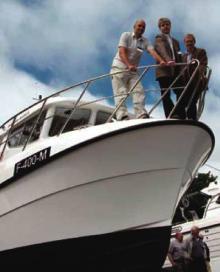
In the outdoor area visitors had the opportunity of examining the new 30 foot fishing vessel designed and built by Trondheim-based Selfa Arctic AS (see picture). This is a new kind of coastal fishing boat with a 25 knot cruising speed, net and longline fishing facilities, 3.42 metre beam giving good stability, and a high quality interior standard ideal for passenger traffic and tourist fishing.
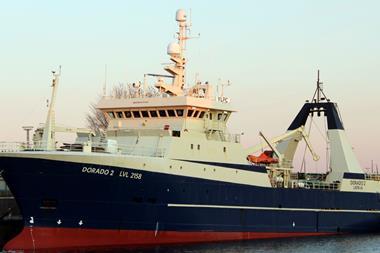
On the order side, the Norwegian shipbuilder, Solstrand AS in Tomrefjord, signed a NOK 400 million contract to build two arctic factory freezer trawlers for the Icelandic shipping company Thormodur Rammi-Saeberg Ltd. Designed by Skipteknisk, the 70 metre long vessels have a freezer cargo capacity of 1,500 m3 and will be delivered in November 2008 and April 2009.
As a complete contrast, there was a fascinating outdoor demonstration of traditional boat building skills involving the construction of a six metre long Viking style wooden boat which was started and completed during the four days of the exhibition.
Nor-Fishing attracted some 400 exhibitors from 14 countries and all represent the very latest in fish technology. Optimism is back in the fishing industry and Nor-Fishing 2006 reflected this mood and lived up to most peoples’ expectations.