



South Korea’s fishing industry is navigating a challenging period as the government seeks a further reduction in fishing boat numbers along with further expansion of aquaculture production to ensure the long term sustainability of the fisheries sector, reports David Hayes.
According to the Ministry of Agriculture, Forestry and Fisheries, South Korea’s total fishery production reached 3.1 million tonnes in 2010, accounting for 2.1% of total world production. This positions South Korea as the world’s 12th largest fishery producer after Russia.
Marine capture fisheries amounted to 1.84 million tonnes, accounting for 58% of the country’s total fisheries output.
Coastal and offshore fisheries production total 1.23 million tonnes annually, representing two thirds of marine capture fisheries production and 40% of South Korea’s total fisheries production.
The major species caught are mackerel, hairtail, anchovy, squid, croaker, blue crab and clams.
Distant water fisheries production is 612,000 tonnes representing one third of marine capture fisheries production and 20% of South Korea’s total fisheries output.
The main species caught are tuna, saury, Alaska Pollack, squid and krill.
Aquaculture output, meanwhile, was 1.31 million tonnes in 2010 representing 42% of total fisheries production. The main species are flounder, rockfish, oysters, laver, kelp and abalone.
Changes
South Korea’s fisheries industry has seen a number of major changes during the past three decades according to the Ministry of Agriculture, Forestry and Fisheries figures, with marine fisheries declining in output while aquaculture production has doubled as a proportion of total fishery production from about 20% in 1980 to over 40% today.
Marine capture fisheries has declined from about 57% of total production in 1980 to account for around 37% of output at present after the share remained stable at almost 50% of total fisheries output during most of the 1990s.
Distant water fisheries have declined as a proportion of total fisheries production during the past two decades and represents around 20% of fisheries output today.
Distant water fisheries decline in importance has followed earlier growth in the 1980s as a result of which the share of distant waters fishery catch rose to around 30% of the nation’s total fishery production in 1990. This resulted from South Korean fishing fleet owners expanding their distant waters fishing activities to offset the concurrent decline in marine capture fisheries in the country’s own territorial waters.
Located in the south of the Korean peninsular with the Yellow Sea to the west and the East Sea to the east of the country, South Korea has a 11,540km coastline and relies on the fisheries sector for a growing share of its animal protein consumption needs.
Inshore waters off South Korea’s west coast average 44m in depth and are characterised by mudflats at low tide with low salinity, high nutrient seawater.
Croaker, flounder, prawn, hairtail and blue crab are the main species found in these waters.
South Korea’s east coast waters are deep, by contrast, averaging 1,700m in depth. Warm water lies near the surface and cold water near the sea floor.
The main species found in these waters are squid, saury, Alaska Pollack, yellow tail and red crab.
The south coast, meanwhile, forms the centre of the country’s aquaculture industry and is the region where many of the country’s 3,153 offshore islands are located.
Wild capture fisheries nearby are mainly for anchovy, mackerel, eel, sea bream, file fish and tuna.
Targets
To meet long term targets of developing a sustainable fisheries industry, government fisheries policy involves reducing the number of fishing boats in operation while encouraging further growth in aquaculture production.
Although South Korea is the world’s sixth largest producer of aquaculture products, the country boasts the greatest aquaculture productivity per square kilometre of land area compared with other countries.
Agriculture, Forestry and Fisheries Ministry figures detail that South Korea’s aquaculture industry produces 14.2 tons of fishery products per square kilometre compared with eight tons per square kilometre for second placed Philippines and 7.6 tons per square kilometre for third placed Vietnam.
China, the world’s largest aquaculture producer, records aquaculture output equivalent to 4.4t/km2, while Japan produces 3.1t/km2, Norway 2.6t/km2 and India 1t/km2.
South Korea’s aquaculture output has risen due to improved husbandry skills and the growth in the number of aquaculture schemes in operation most of which are run as small businesses.
Decommissioning
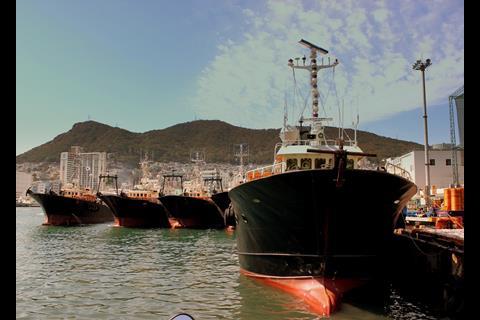
Aquaculture production has grown during the past decade while the number of fishing vessels in operation fell by 24% over the same period due to the government running fishing boat decommissioning schemes that involve compensating fishermen for scrapping their fishing boats in a bid to reduce overfishing in territorial waters.
At the start of 2011, some 47,520 fishing boats were in operation in South Korea after 16,640 fishing boats were taken out of service and scrapped during the period running from 1994 to 2010 under the government’s fishing boat reduction scheme.
Compensation payments worth 1.55 billion were made to fishermen agreeing to scrap their vessels during the 15 year period.
The government’s fishing boat reduction programme still continues. The Agriculture, Forestry and Fisheries Ministry has announced an eventual target of reducing the nation’s total fishing fleet to 39,900 fishing boats which is considered to be the number at which South Korean marine fisheries will operate at a sustainable level.
Reaching the government’s eventual target figure involves scrapping a further 7,620 fishing vessels. In addition to simply reducing the number of fishing boats in operation, the government’s decommissioning scheme is aimed at reducing the number of vessels using certain types of fishing gear such as trawl nets which have been identified as a major cause of overfishing.
Decline in fisher folk
Meanwhile, South Korea’s fisher folk population is in long term decline due to a number of factors including the wide range of career opportunities that young people have today.
According to government statistics, the number of fishermen has fallen by almost half during the past 30 years due to reduced numbers of young men entering commercial fishing as an occupation. At the same time, older fishermen have been retiring in greater numbers, some encouraged by government subsidies paid to scrap fishing boats.
Government figures show that about 69,000 households were employed in commercial fishing at the start of 2010, almost half the number compared with about 130,000 fisher folk households that existed in 1981.
The biggest decline in fishermen numbers occurred during the 1990s when about 50,000 fisher folk households left the industry.
South Korea’s fishing industry has faced similar challenges to the country’s farming industry with farmers’ children preferring to migrate to cities in search of careers in manufacturing or the expanding service sector rather than stay on the farm.
Many fishermen today are over 50 years old with the average age of fishermen in South Korea far older than for people working in most other industries.
According to official forecasts, South Korea’s fishermen population will continue to age and face a further decline in numbers in future.
In 2010, around 36% of the country’s estimated 171,000 remaining fishermen were 60 years old or older in age compared with the situation in 1995 when about 25% of the nation’s 370,000 fishermen were aged 60 years and over.
By contrast, between 1980 and 2010, only 18,750 new recruits entered the fishing industry, according to government statistics.
Further changes are expected in the fishermen population. By 2020 fishermen numbers will have fallen to about 130,000, according to government manpower projections, while the proportion of fishermen aged 60 years and over will have risen to 60% as fishing increasingly becomes an older person’s occupation.
One result of the decline in South Korean fishermen numbers is that many local fishing boat owners are forced to employ foreign fishermen from China and other Asian countries, particularly distant waters fishing boat operators.
Consumption
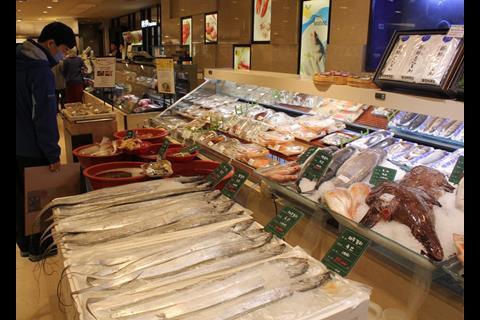
Meanwhile, rising fisheries production has been matched by increased consumption of fishery products, particularly among young and middle aged people.
Although rising meat consumption has resulted in fishery products occupying a smaller share of total per capita protein intake in some other Asian countries during the past decade, consumption of fishery products in South Korea continues to rise and seems to be more popular than ever.
Government figures show that annual per capita fish consumption grew by 57% in weight from 1998 to 2008 in South Korea and now accounts for 40% of animal protein intake.
Consumption of fishery products grew from 35kg per capita a year in 1998 to 55kg per capita in 2008 while yearly per capita consumption of meat, which was also 35kg in 1998, rose by about 16% to 41kg per capita during the same period.
Rising fish and meat consumption reflects rising family incomes and household expenditure due to South Korea’s rapid economic development since the 1990s.
Consumption of rice, considered the staple food in South Korea, by contrast fell 16.5% from 103kg per capita a year in 1998 to 86kg per capita in 2008, as consumers ate more protein and less rice.
Illegal fishing
Meanwhile, South Korea continues to rely on wider government controls on fishing activities than other East Asian countries in an attempt to control illegal fishing and the use of unregulated non-sustainable fishing practices.
Fishing boats need to be licensed to fish in defined areas. Regulations also are in place governing the type and size of fishing gear used as part of efforts to reduce overfishing through the use of certain gear such as trawl nets.
The government operates a total allowable catch (TAC) system to protect fishery stocks and marine resources. Fishing gear mesh size is regulated to prevent under age fish being caught while closed seasons are operated to protect vulnerable fish stocks in specified areas.
Government-backed resource enhancement measures include the construction of artificial reefs and the release of fish fry to increase fish stocks. The government also encourages marine aquaculture to increase sustainable fisheries production and funds the release of salmon and cod to promote these two fisheries.
Other controls used to promote and protect fisheries include restrictions on locations where fish catches can be landed along with restrictions on fish transhipments and the places of sale for fishery products.
Limiting fish landings to authorised fishing ports forms part of government efforts to prevent illegally caught fish from being landed and entering the domestic fishery supply chain.
Further restrictions are in place to prevent the sale of illegal catches while other government policies encourage the co-management of fishery resources and the conservation of seawater quality as part of measures to protect South Korea’s marine fisheries.
Aquaculture controls
Controls also are in place to regulate aquaculture activities and encourage sustainable development of this important sector. Around 13,400 aquaculture licenses have been issued by Fishery Department offices covering 266,000 hectares of marine fisheries.
In a bid to support coastal fishing communities and encourage fishing households to continue with fishery related occupations, restrictions limit the size of enterprises permitted to undertake aquaculture activities with the aim of encouraging small scale businesses to develop.
Other controls on aquaculture are aimed at ensuring the safety of cultivated fishery products for human consumption. Restrictions are in place on antibiotics usage in aquaculture production while controls are used to ensure drain water quality conservation.
Further government support is being given to develop sustainable fisheries production in the future. Government funding, for example, is being provided to assist with fishing village infrastructure development so that fishermen can continue in their occupation supported by more modern infrastructure and other facilities to promote fisheries activities
In addition, a national port management scheme has been set up to ensure proper control of fishing port operations and their future development.
Processing
Meanwhile, South Korea’s fisheries processing industry is worth about US$6.2 billion a year, according to government figures. As part of official efforts to support the processing sector, the government is encouraging seafood processors to increase traceability of their products and is backing the introduction of a fisheries eco-labelling system to expand local sales and exports.
Fishery exports in 2012 are believed to be worth around $1.7 billion according to government data. Major export markets include Japan, China and the United States.
South Korea also is an important market for processed seafood imports as consumers demand a wider range of reasonably priced foods.
New government food safety regulations mean that South Korea’s Animal, Plant and Fisheries Quarantine Agency will test Vietnamese shrimp imports for ethoxyquin from January 1 to December 31, 2013, to ensure shrimp imports are safe for human consumption.
South Korea is Vietnam’s fifth largest shrimp import market buying frozen shrimp worth $171 million in 2012.