




Watch: Oceanus – the world’s first long-range autonomous researcher
Oceanus, the world’s first long-range, autonomous research vessel, is the subject of a new CGI video, with developer Plymouth Marine Laboratory (PML) saying it’s set to usher in a new era for net-zero oceanography and advanced international marine research.
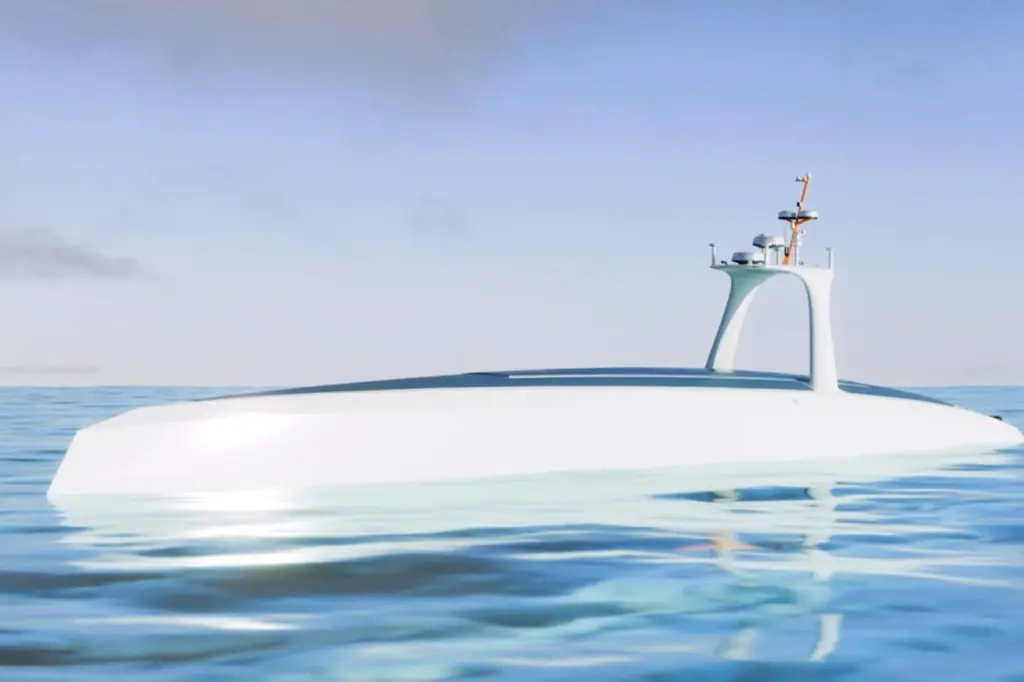
Supported by seed funding from the Natural Environment Research Council (NERC), the sleek, futuristic-looking and fully uncrewed Oceanus has been designed as a self-righting, light-weight, mono-hulled autonomous vessel capable of carrying an array of monitoring sensors to collect data in remote and challenging areas of the ocean, for research into critical areas such as climate change, biodiversity, fisheries and biogeochemistry.
Spanning 24 metres, the vessel will be able to reach remote areas of the ocean that are difficult or impossible to sample through traditional research vessels, whether due to remote locations or due to extreme weather conditions.
PML Chief Executive Professor Icarus Allen commented: “A statistic I find quite shocking is that, to date, humans have explored less than 5% of the world’s oceans. And yet, the ocean does so much for us. It’s absorbed at least 25% of carbon emissions that we have emitted. It also absorbs over 90% of the excess heat resulting from greenhouse gases… and, most importantly we humans, get between 50% and 80% of the oxygen we breathe from the ocean.
“It is vital now, more than ever, to improve our understanding of the ocean and the changes taking place within it – the ocean is facing huge challenges and it’s vital we have as much evidence as possible to support decisions on how to protect and manage it sustainably,” he said.
PML has partnered with MSubs and ProMare to build Oceanus, with both organisations having extensive experience in marine autonomous technology. It has also partnered with Marine AI Ltd, a software engineering firm specialising in edge-based sensor-driven cognitive artificial intelligence to deliver safety-critical marine autonomy, who will support with the autonomous control system.
It’s expected the build phase will take around two years to complete.
Related Articles
 VESSELS & SHIPYARDS
 VESSELS & SHIPYARDS
 NEW VESSELS