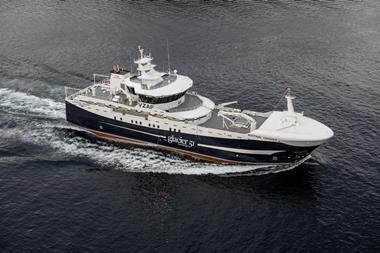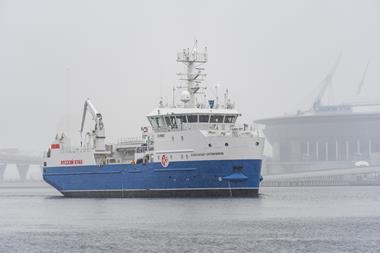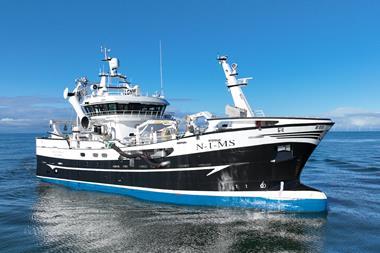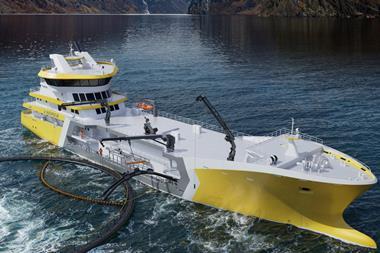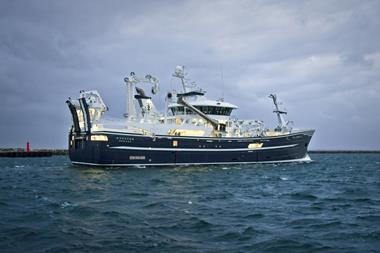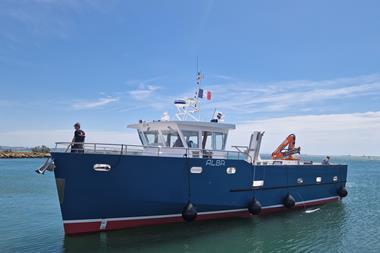




A new 30-metre mussel harvesting vessel purpose-built by McMullen & Wing to withstand the most challenging sea conditions encountered in New Zealand’s Bay of Plenty has entered service.
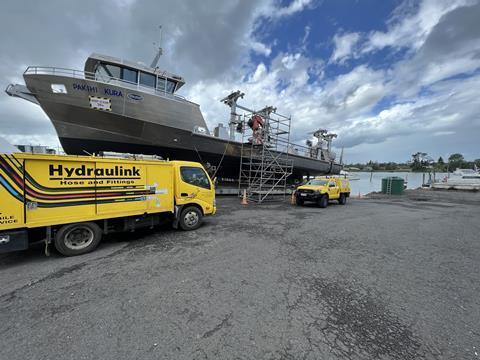
It has been equipped with Hydraulink hose and fitting kits for optimum safety and reliability.
Aquaculture vessel Pakihi Kura was built for Whakatōhea Mussels by McMullen & Wing drawing on the boatyard’s 55+ years’ experience building and servicing commercial vessels and yachts for both the domestic and international markets. The vessel design was a collaborative effort between Oceantech Design, who provided the preliminary design including styling, naval architecture, geometry, structural, stability and performance calculations, and McMullen & Wing, who took the preliminary design and developed the workshop drawings required to execute the build.
The single-screw vessel, constructed from marine grade aluminium, has the capacity to carry up to 105 tonnes of product on deck, whilst maintaining a service speed of 10-12 knots thanks to the 969kW Caterpillar C32 main engine. Additionally, a 280kW Caterpillar C9.3 auxiliary engine powers the extensive hydraulic systems.
“One of the key factors in choosing McMullen & Wing was the ability to design our vessel with features to meet the unique and challenging operating conditions experienced in our region,” Whakatōhea Mussels Chief Executive Peter Vitasovich said. “This was critical to ensuring a strong partnership in both the design and build of our new vessel.”
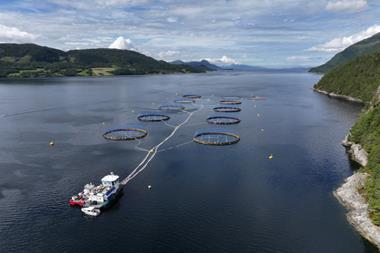
The company’s 3,800-hectare offshore farm lies 5km off the coast of Opōtiki and is capable of producing 20,000 tonnes of mussels annually – one fifth of the current total New Zealand industry production. During storm conditions, the richly productive area has measured peak wave heights of over 15 metres, with average wave heights over 9 metres for extended periods.
“So the safety and comfort of the crew were a priority consideration for McMullen & Wing, who were ideally equipped to answer the challenge with their history of building seagoing super yachts and extremely hardy work boats,” Hydraulink Area Manager Craig Jenkins said.
McMullen & Wing’s marine expertise was complemented by its partner Hydraulink’s own expertise as the supplier of hydraulic hoses and fittings for the ultra-fast 2021 America’s Cup challenge in which all competitors, including the winning Emirates Team New Zealand, used a hydraulically actuated foil cant system to raise boats clear of the waves as the 6-7 tonne AC75 yachts hit top speeds between 40 and 50 knots depending on conditions in the Hauraki Gulf.
“A top-class hydraulic system is critical to the operation and safety of any mussel farming vessel – and McMullen & Wing’s hydraulic fitout for Pakihi Kura is a masterpiece,” Jenkins said. “They mapped out the working spaces beautifully to provide easy and swift access for hydraulic installations and service to ensure optimum safety and reliability for the many hydraulic systems on which the vessel depends. Their forethought will pay dividends in terms of system uptime, reliability and safety over years and years to come.”
McMullen & Wing Technical Manager Jeff Porter said the collaborative hydraulic system design by Dana Brevini and McMullen & Wing builds on the successful features of another vessel in Whakatōhea Mussels’ fleet, Kukutai, and results in functionality tailor-made for a challenging environment.
“It is a unique design with features that are particularly suited to work boats in many marine environments, including marine transportation, fishing, energy exploration, and other tasks where seaworthiness, manoeuvrability and lifting, loading, and unloading capability are at a premium.”
The vessel’s main deck features a large crane mounted on a fabricated aluminium plinth along with four davits used for handling the mussel lines, plus a line tensioning winch and the mussel harvesting equipment.
A Palfinger PK33002 (M) E folding crane has a maximum outreach of 16 metres, enabling it to reach anywhere on the vessel. It has a lift capacity of 2,000kg at 9.5m, enabling the crew to offload two 1-cubic-metre bulk bags of mussels at a time on to the dock.
The crane features continuous slewing, without any blind spots, so it can be centrally located, adding flexibility to crane operations. It is fitted with Palfinger’s electric control system (ECS) featuring electrically operated emergency cut-off and electro-hydraulic overload.
The vessel’s davits were engineered using McMullen & Wing’s experience with mussel industry vessels, this being the sixth set they have built since developing the first set for Kukutai in 2018. The single-post davits are fitted with double sliding arms and winches, each combination rated at 1500kg SWL.
Dana Brevini supplied the braked planetary winch drives and directional control valves for the davits whilst custom marinised hydraulic cylinders are supplied by Victor Hydraulics. Hydraulink hose and fitting kits are used throughout, with all details maintained on file for easy replacement as needed to optimise safety and in-service reliability.
A mussel harvesting equipment package from Ansco Engineering includes a powered walking wheel and two idler wheel assemblies mounted on the davits, a powered infeed conveyor recessed flush with the hull side to help bring the mussels aboard, a rope washer, a declumper/washer unit, a size grader along with a series of conveyors that link the equipment together. A standalone mussel seeding machine is also stored on deck and can be shifted in and out of position at the forward end of the main deck using the Palfinger crane. Hydraulink quick-release hydraulic couplings as well as waterproof electrical connectors are located conveniently nearby.
The auxiliary engine pump drive powers five hydraulic pumps supplying four circuits – the deck gear, the deck crane, the bow thruster and windlass, and the seawater pumps. Load-sensing technology is used on two of the circuits to maximise energy efficiency. The vessel’s hydraulic tank stores 2,250 litres, while the circuit volume is close to 3,000 litres once keel-cooling and pipe circuits are included.
To minimise structure-borne noise and vibration, all piping and tubing is supported in rubber-lined split clamps with secondary isolation on dual-compression mobile isolators. Bulkhead penetrations also avoid direct contact between piping and structure.
“Everything about the Pakihi Kura displays quality, durability and outstanding design for trouble-free service,” Jenkins said. “She is pure class.”