




New-generation Altaire joins Shetland fleet
There’s been a long series of pelagic vessels sailing from Shetland under the Altaire name, with the last few built at Norwegian yards. However, this time around, the Altaire Fishing Company opted to build at Karstensens in Skagen, with the new vessel built to the yard’s own design. According to Kent Damgaard at Karstensens Skibsværft, there has been a longstanding working relationship between the yard and the owners of Altaire, which has been a regular caller at the Skagen yard for repairs and maintenance.
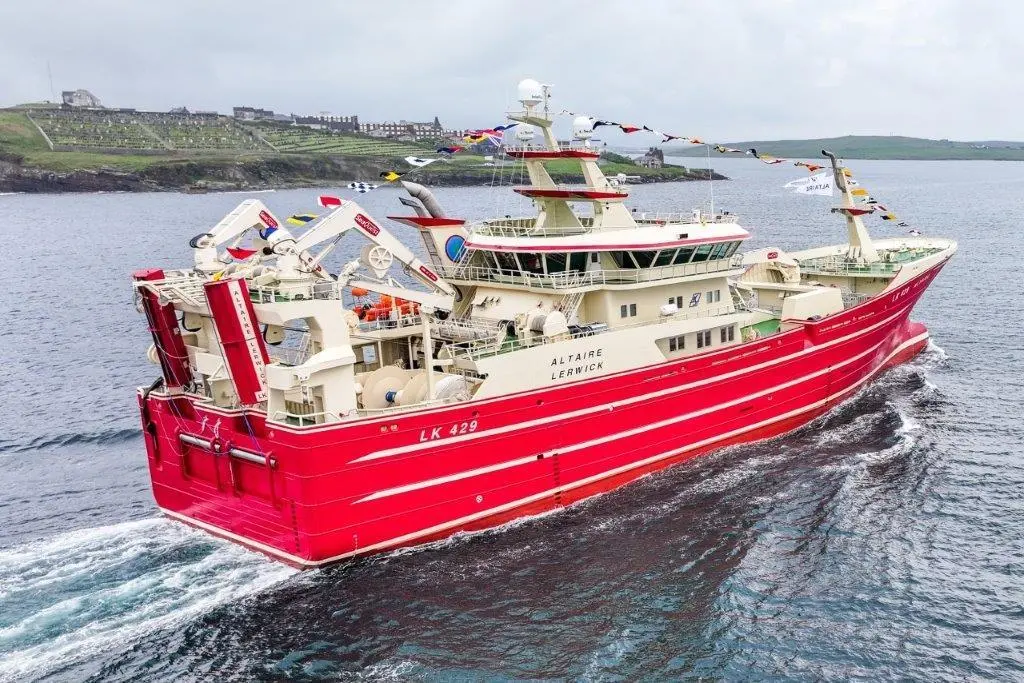
Altaire Fishing Company is owned by Interfish, headed by Jan Colam, in partnership with skipper Chris Duncan and chief engineer Ivan Reid.
New Altaire is a major step forward in terms of operational efficiency compared to the previous vessel, which has fished with great success over the years, and which is now with new owners in the Faroe Islands. The new vessel will operate on herring, mackerel and blue whiting on an established pattern, with catches delivered fresh in RSW.
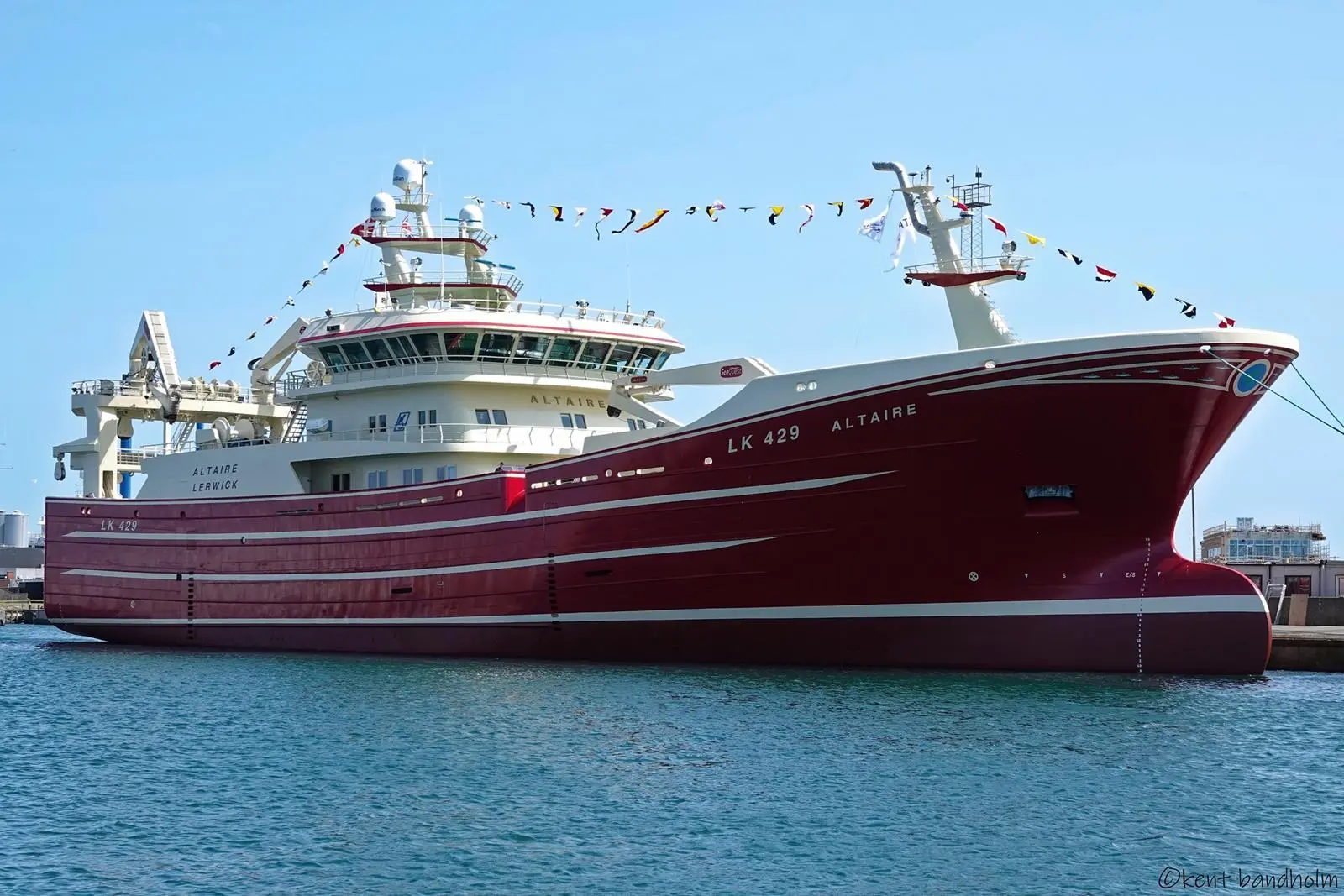
Handed over to its owners at the end of June, Altaire’s steelwork was completed at the Karstensen Shipyard Poland in Gdynia and the partly outfitted hull arrived at the yard in Skagen in November last year. The spec and arrangements are the result of close co-operation between the owners and the yard’s design team with the focus on optimal working and living conditions for the crew, maximising catch value through the best possible handling and storage and ensuring that fuel consumption and energy usage are as efficient as possible.
High-spec
The 79.95-metre LOA, 17.5-metre moulded breadth Altaire’s 14 RSW tanks provide a 2,935 cubic metre carrying capacity. Catches are pumped at the stern and routed to the selected tanks via the separator, and the tanks are chilled by a double Johnson Controls system, each of which has a 1506kW/1.295.000kCal/h cooling capacity to bring temperatures down rapidly. The RSW circulation system operates with remote operated valves through Johnson Controls control system.
C-Flow supplied the vacuum system with four 87kW compressor units and twin 4,200-litre tanks.
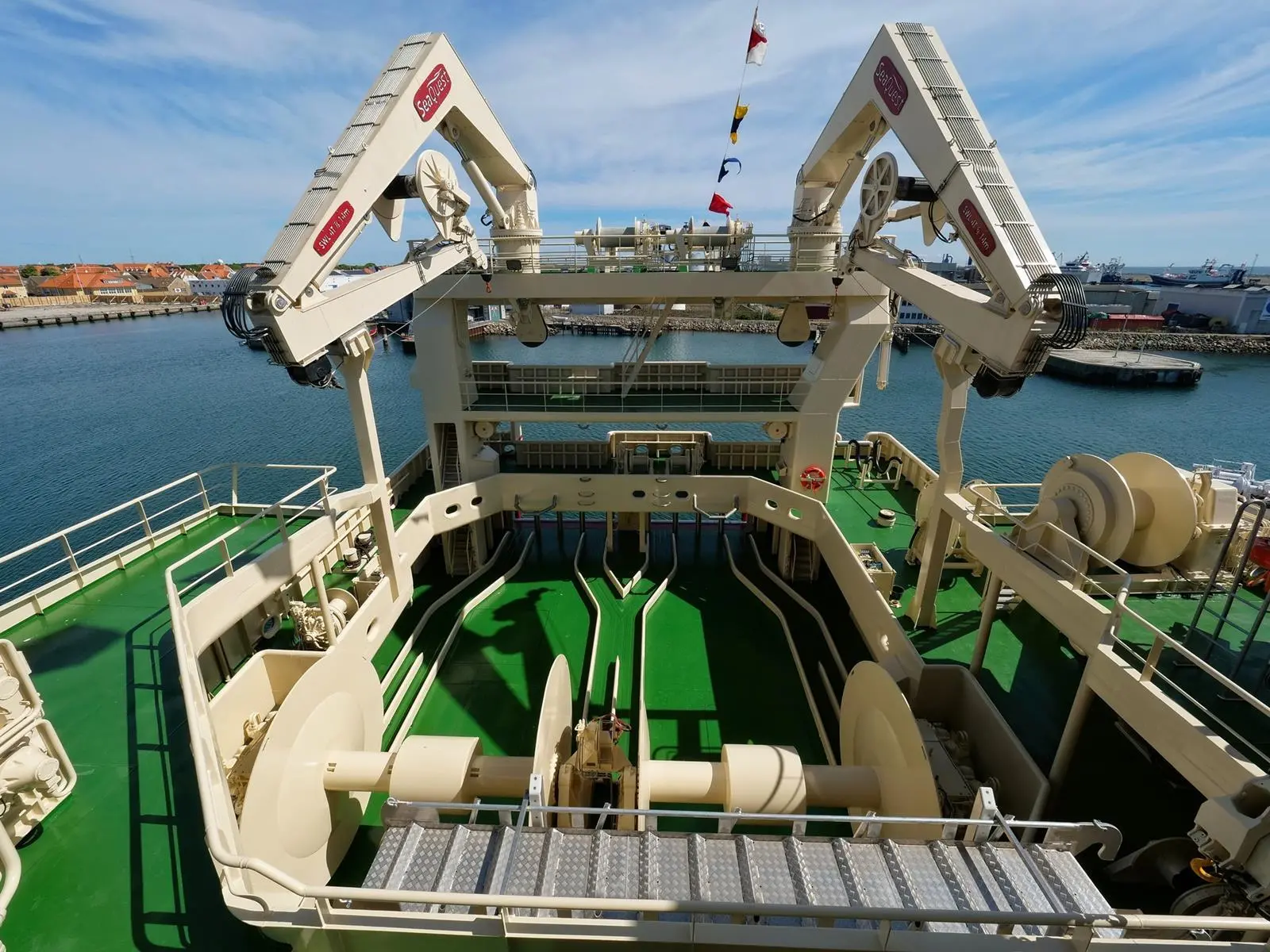
Altaire’s deck layout is from Karmøy Winch, with a pair of 91-tonne trawl winches managed by a Karmøy autotrawl, and 110-tonne net drums. The hydraulic Karmøy package includes a 71-tonne topline winch and a 57-tonne tail-end winch, as well as a pair of netsounder winches mounted on the aft gallows, a variety of smaller winches and the hydraulic hose and fish hose reels for the pair of 20-inch fish pumps supplied by SeaQuest Systems, which also supplied the foredeck crane and the deck cranes aft, with a net crane and a fish pump crane mounted on the aft gallows.
The 360° visibility wheelhouse is outfitted with a Furuno-UK Video wall control system that utilises five 55-inch and 22 32-inch Hatteland monitors. The fishfinders are a range of Simrad and Furuno equipment, with ST94 and FSV-25 low frequency sonars, MF-90 and FSV-85 medium frequency sonars and an SN90 bow scanner. The echo sounders are an ES80, plus FCS-38 and FSS3-BB and a Wassp 80kHz 3D sonar. The trawl-mounted electronics are a Simrad FS-70 trawl sonar and a Marport array of sensors. The current indicator is a Furuno CI68.
Plotters are a pair of MaxSea Time Zero sets, a 3D Olex and a Sodena unit, as well as a Furuno FMD-3200 ECDIS. The radars, GPS sets, GPS compasses and AIS are all Furuno equipment, while the AP-70 autopilot, and the three RGC-80 gyro compasses are from Simrad. Cobham Sailor supplied the 900 V-sat communications and SatöTV systems, as well as the A3 GMDSS setup and VHFs.
Crew comfort
Accommodation is outfitted to an exceptionally high standard by Maritime Montering, with six ensuite single cabins for crew and engineers at main deck level, along with the laundry, sauna and gym. At the shelterdeck level, there are six single crew cabins and a sick bay, as well as the steam room, changing room and a coffee bar. The superstructure at this level incorporates a large gear workshop in the starboard side.
Cabins for the skipper and mates are located in the upper boat deck, with four single cabins and a conference room. The main crew areas are at lower boat deck level, with the day room, mess area, galley, provision room and coffee bar. To minimise noise levels, the accommodation has been placed as far as practically possible from the propeller, in addition to other measures to ensure low noise in the crew’s living areas.
Altaire’s owners went to Wärtsilä for a full propulsion package, with the main engine driving a 4,200mm-diameter 4G1095 propeller via a two-step SCV 100/2-PDC68 reduction gearbox providing options of 138 and 116 propeller rpm.
In a power arrangement that has become standard with the long series of pelagic vessels designed and delivered by Karstensen, Altaire’s Wärtsilä 12V31 main engine serves as the primary power source for both propulsion and the hydraulic systems, working on the principle that when hauling and shooting, there’s a reduced requirement for propulsive power, and while towing the demand from the hydraulics is lower.
Under this setup, the 3300kW Marelli shaft generator can be disengaged from the from the switchboard while towing, leaving the two 1158kW Wärtsilä W16V14 gensets to meet the demands of the ship’s electrical network. The gensets are able to connect into main switchboard, controlled by the vessel’s DEIF Power-Management-System. Further on a bus-bar breaker is fitted in main switchboard, allowing aft thruster to be fed off shaft alternator and forward thrusters and vessel’s hotel load off from the gensets.
The 1400kW FU74 aft thruster and the 1470kW AR80 retractable thruster are supplied by Brunvoll. The high-lift flap rudder is from Kongsberg and the steering gear is a Kongsberg Tenfjord SR 72 unit.
The electrical power system is arranged for sliding frequency (60-50 Hz), by means of frequency converters for 400/440V and rotating frequency converter for 230V. This allows the main engine and propeller revs to be reduced by 17%.
The design incorporates a take-me-home option, with a clutch between the main engine and gearbox. A separate pony motor allows the shaft generator to start up as an electric motor, fed off the auxiliary engines. Up to 1500kW can be used for this diesel-electrical propulsion drive.
Related Articles
 VESSELS & SHIPYARDS
 VESSELS & SHIPYARDS
 NEW VESSELS