





Iran’s aqua growth plans
Iran’s new government has rolled out ambitious plans to boost domestic farmed fish production from last year’s level of 560,000 tonnes to 1.6 million tonnes by the end of the decade through diversification and the application of new technologies.
According to Morteza Afrasiabi, deputy head of the Iranian Fisheries Organisation’s aquaculture department, the strategy – which the government is calling “a fish industry transformation programme” – is very ambitious, but its targets are deemed realistic, as they are supported by scientific data.
Afrasiabi added that recent research estimates that under the proper management, the country has an opportunity to grow beyond 5 million tonnes of farmed fish production per year.
With more than 80 million people, Iran has the second-largest population in the Middle East after Egypt. It also has a coastline stretching 2,700 km. To the south, the country borders the Persian Gulf and the Oman Sea, and in the north, the Caspian Sea. However, it has struggled with economic problems in recent years – caused by the US sanctions and, more recently, the COVID-19 pandemic. Amongst other things, these have undermined the local population’s purchasing power and hindered its fish consumption, which is now estimated at 13 kg per capita.
To some extent, the planned aquaculture development is a forced measure for the Iranian authorities, as the available wild fish reserves are seemingly dwindling.
“Currently, we have 55% of our fish supply coming from the fishing sector and 45% from aquaculture. However, our aquatic reserves are declining sharply, and soon we will have these shares reversed,” Afrasiabi said.
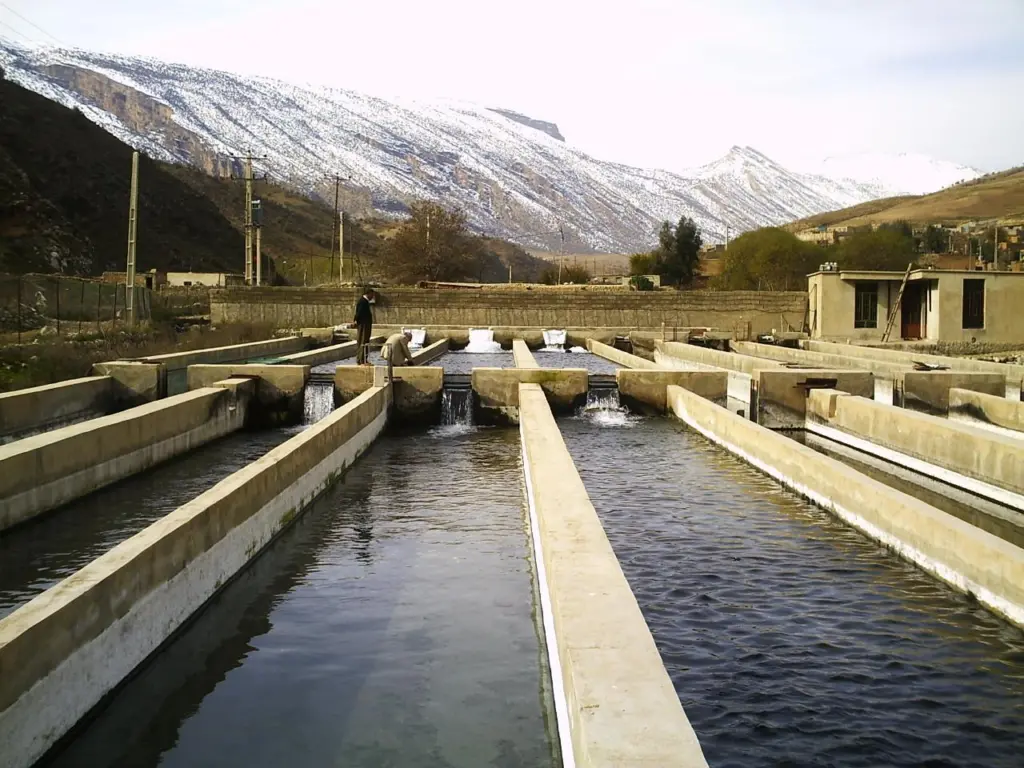
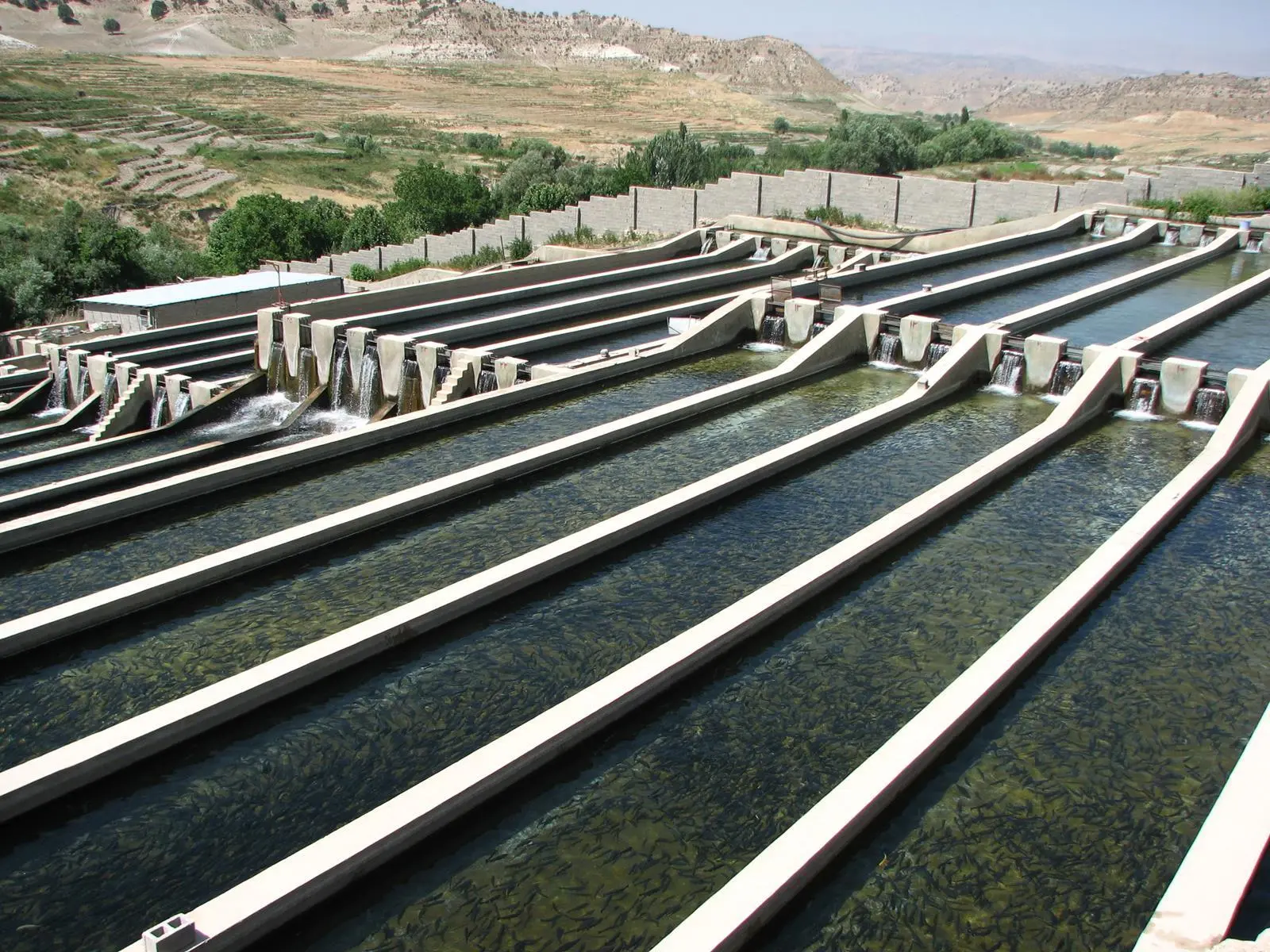
Most of Iran’s farmed fish production takes place in remote southern areas of the country, where food security is an issue due to the lack of infrastructure. Different types of aquaculture are practiced as a result of varying weather conditions, but rainbow trout (Oncorhynchus mykiss) and Chinese carp (Cyprinidae) are the most common species cultured.
The Iranian government has acknowledged that the available freshwater resources are currently being used close to their maximum possible potential, and Afrasiabi believes that in the future, most of the fish production growth is likely to be achieved through cage farming.
Government officials also think that while Iranian fish farmers have faced repeated droughts and general water shortages in some areas of the country, new technological approaches could help move the industry forward and boost its production performance.
Sanctions are the main impediment
But while developing cage aquaculture might be a good plan, local fish farmers have highlighted there are some obstacles that need to be overcome. For example, Hossein Yousefi, CEO of Niksa Company, estimates that currently up to 70% of cages used in fish farming in Iran are imported.
In 2020, the Ministry of Agricultural Jihad asked government to allocate $400 million to purchase cages to ramp up production in this segment by 200,000 tonnes. In the long run, this measure would provide the national budget with $800 million, as a significant portion of the grown fish was expected to be exported, the Ministry said in an explanatory note to the decree.
The Iranian Fisheries Organisation estimates that it takes 100 billion tomans to establish a fish farm with a designed production performance of 5,000 tonnes if investors manage to obtain foreign currency under a government-subsidised exchange rate. If no state aid is available, this figure rises to 250 billion tomans, which is described as “unbearable”.
The Fisheries Organisation said the industry has insufficient liquidity these days to secure such enormous financial resources, even if bank loans are available. At the open market exchange rate, that would equal $12 to $15 million.
Saifullah Haghighi, a spokesperson for the Iranian Fisheries Organisation, estimates that every 1,000 tonnes of designed production capacities in cage aquaculture requires around $2 million worth of imported equipment. And then there plus are the additional costs that come with launching a farm.
“The lack of investments in the private sector promises to hamper the cage aquaculture development plan,” Haghighi said. He added that neighbouring Turkey has put a lot of effort into developing cage aquaculture and has managed to reach 400,000 tonnes of annual production in this segment while Iran, with its longer coastline, only produces 15,000 tonnes of fish in cages per year.
This situation has caused some Iranian officials to call on the government to establish a new state-owned holding company to take over the country’s cage aquaculture.
Meanwhile, Iran currently uses three different exchange rates: the official subsidised rate, the market rate, and a rate controlled by the central bank available to importers and exporters of essential goods. The latter is known as the NIMA rate. The US sanctions introduced in 2018 have substantially reduced Iran’s dollar earnings since 2018, forcing the country to dip into its foreign currency reserves, which have dwindled since that time.
At the same time, Iran faces several impediments in buying foreign equipment. The main hurdle is paying for foreign equipment when the US banking sanction threatens foreign banks with third-party sanctions if they deal with Iran.
Equipment aside, some issues are being addressed. Nabiullah Khoonmirzaei, head of the Iranian Fisheries Organization, said that in the fish farming sector, the Iranian government has been making some progress with regards to overcoming the dependence on imported broodstock.
“Last year, import of salmon broodstock constituted only a third of the previous two years’ level, as most of our needs were met by domestic production. We still have salmon production on the agenda, and we hope to increase it [broodstock production] up to the level of self-sufficiency,” he said.
Diversification is key
In the coming years, Iran plans to focus on segments overlooked by fish farmers in previous years, with tilapia and shrimp offering two of the most promising directions.
“Tilapia fish has a good biological capacity as it can grow in brackish waters, in high density, and has low feed requirements,” Mehdi Shakoori, Director General of Freshwater Aquaculture, said.
In 2020, Iranian farmers produced just 550 tonnes of tilapia. As stated by Shakoori, this figure is expected to grow to 30,000 or 50,000 tonnes per year in the next five years.
On the other hand, Iranian farmer Issa Golshahi said the problem with tilapia is that in Iran, it is usually called “fish for poor”, which is a bad advertisement.
“Using this word for fish with the benefit of tilapia is very wrong and prevents people from looking into this [production segment],” Golshahi said, adding that strong growth in tilapia production could become a basis for a sharp increase in fish consumption in Iran.
Tilapia is also said to be the perfect fish for the Iranian fish farming sector, which experiences a shortage of high-quality feed. Golshahi said that tilapia needs only rather affordable plant-based feedstuff, while most other fish species require more expensive components of the animal origin.
Mohammad Pourkazemi, Head of the FAO Aquatic Genetics Management Advisory Group, commented that there was a lot of uncertainty about tilapia during the past few years, as this fish had been found destroying the ecosystem of Khuzestan waters.
“The discussion about tilapia is linked to the danger of invasive species, but the species of farmed tilapia that is licensed in Iran is Nile tilapia and is different from the invasive type that has penetrated from Iraqi waters to Khuzestan waters,” Pourkazemi said.
The picture is similar with shrimp which are also likely to become a booming segment in the coming years. Homayoun Hosseinzadeh Sahafi, Ministry of Agricultural Jihad, said that the Iranian shrimp production has nearly tripled over the past five years, reaching 80,000 tonnes last year. This figure is projected to jump to 150,000 tonnes in the next couple of years.
If boosting tilapia production is called to meet domestic demand, rising shrimp production is expected to secure additional export revenue for Iran. The country exports roughly 30,000 tonnes of shrimp for $150 million, constituting nearly one-third of the overall aquaculture exports. Most of the additional shrimp volumes are also expected to be exported.
Related Articles
 PROCESSING & REFRIGERATION
 PROCESSING & REFRIGERATION
 PROCESSING & REFRIGERATION