




Feed optimisation through digitalisation
Over the last few decades, IT has advanced significantly, with profound impacts on industries including aquaculture.
A new start-up is harnessing ways to optimise risk management and operational performance, as fish farms explore the integration of digital technologies, data analysis and algorithms for smarter, more sustainable operations. Given the growing importance of fish farming as a protein source, the need to boost production and supply the highest quality products has become all the more significant. This is in perfect sync with another impactful trend – industrial digitalisation.
Based in Singapore and Japan, Umitron Pte. Ltd. develops computerised sustainable aquaculture models using a range of technology including Internet-of-Things (IoT), satellite remote sensing and AI. With a focus on fish feeding, the data analytics firm monitors fish activity in farms and runs data through a proprietary algorithm to detect when fish are actually hungry. This optimises feeding, allowing farmers to offer the right amount of feed at the right time, and reduces environmental risks.
Founded on 21 April 2016 by Masahiko Yamada, Ken Fujiwara and Takuma Okamoto, Umitron’s mission is to “install sustainable aquaculture on Earth” by using technology to achieve stable and efficient fish production.
“Umitron’s founders wanted to solve problems for fish farmers by bringing modern day software and hardware computing technology to aquaculture,” said Andy Davison, Product Manager at Umitron. “With backgrounds in aerospace engineering and software programming, they were able to approach things with a fresh perspective.”
Growth in the aquaculture industry, as well as its continued maturity, convinced Umitron that fish farming could have huge potential. Interest in Umitron is rising, with enquiries from larger enterprises as well as small and mid-sized farms. Today, the company works in Latin America (Peru) and the Asia Pacific region (Japan) with species such as red sea bream and rainbow trout.
“We’ve been very lucky to find a number of customers and project partners who are enthusiastic about using our technology,” Andy said. “At the moment, a lot of our demand comes from word of mouth between local farmers in Japan, Singapore and abroad but we are getting interest from other companies too.”
With feed among the highest and most significant costs for fish farmers, reducing the dependency of aquaculture on fishmeal is key to aquaculture’s sustainable development. In addition to high costs, there are also risks to the environment, as excess feed can lead to problems such as eutrophication, an imbalance in marine ecosystems caused by high nutrient levels in the water column. Umitron’s technology and systems aim to reduce costs and risks in this particular area, and some farms in Japan are starting to see a difference.
Fish farmers in Ainan City, Ehime prefecture have been using Umitron CELL to manage day-to-day feeding, enabling them to reduce the need to go out in dangerous conditions to visit individual cages for observation or feeding. Fish can be remotely monitored and fed, while farmers can feed more precisely, better matching fish appetite with feed dispensed, thus improving overall feed use efficiency. This, in turn, reduces the risk of algal blooms and decreases costs by reducing labour requirements and wasted feed.
Being able to remotely check and dispense feed from the comfort of their own offices has been met with enthusiasm, Andy said, as farmers are beginning to realise how a wider use of Umitron devices can make their current operations more streamlined. He also points out the importance of data and AI in fish farms.
“AI allows farmers to completely automate their feeding decision-making processes,” he explained. “However, it is difficult for any human to blindly trust AI, or simply change their behaviour completely overnight. Farmers have years of experience and intuition that they rely on to inform their decision-making when it comes to fish feeding. Automated feeding gives the fish farmer another tool to use in combination with their own intuition to help improve their operations. Eventually AI feeding will become more common, and AI-powered fish appetite detection will take the guesswork out of fish feeding.”
One of the key challenges for Umitron was getting its IoT technology to work underwater by finding high quality, cost-effective cameras that could be submerged long-term. Work is now underway to waterproof cameras and the electronic parts of devices that are above water and exposed to high waves or heavy storms. With salt water being particularly corrosive, selecting the right materials is key. Reliable data connections and access to power are now relatively easy to come by thanks to the evolvement of solar technology and more cell providers that have expanded their services to reach billions of smart phone users.
“The real challenge for us at the moment is optimising how our systems work so that large amounts of data are not needed to control and monitor each device,” Andy said. “One of the ways in which we address this is by doing a lot of the data processing locally on the device itself, rather than in the cloud. This is similar to the technology used in satellites where data connections are sometimes slow and come at a premium. For offshore or lake-based farms where electric power isn’t available we rely on solar panels and a battery to power our devices. A power management system is also used to ensure that we are using the power we do have economically.”
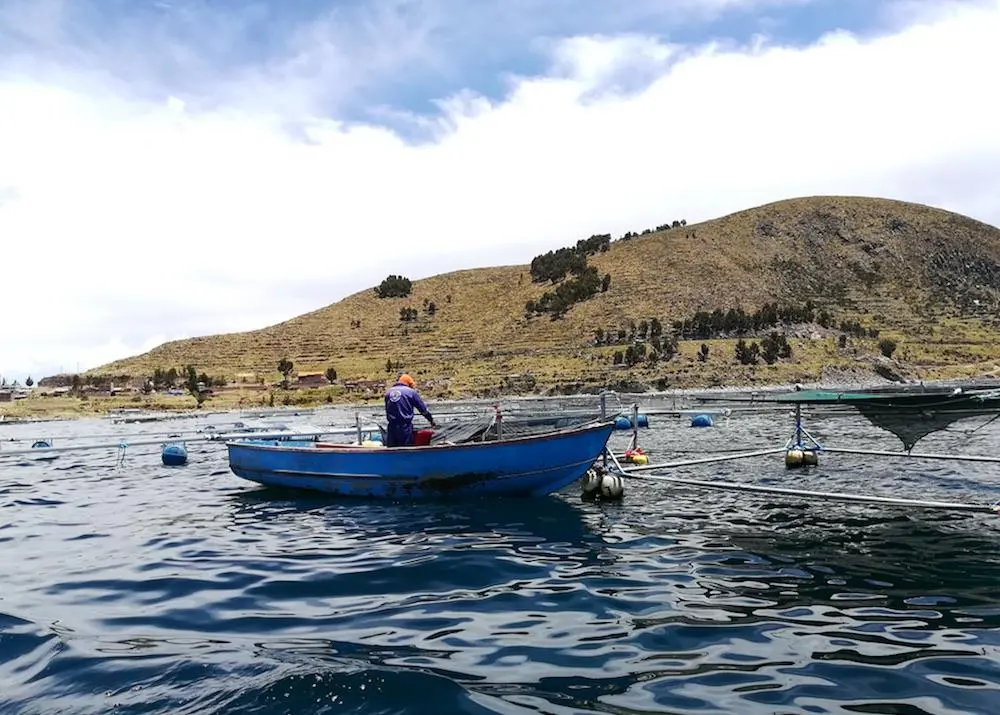
This year, more developments are underway for Umitron following a US$2 million grant from the IDB (Inter-American Development Bank) to improve aquaculture productivity in Peru’s Lake Titicaca. Umitron is partnering with Piscifactorias de los Andes (Piscis), a forward-thinking rainbow trout farming and processing company operating in Lake Titicaca. Farmers will be able to remotely monitor and control feeders, increase operational efficiency and reduce feed waste and any potential pollution from uneaten food. Another of the project’s objectives is to prepare Umitron’s technology for the Spanish-speaking market and test it in a new environment – the world’s highest navigable lake. As aquaculture enters a new age with technology like IoT, hopes are high for the Peru project.
“We hope that this is the first of many partnerships with public organisations like IDB who are interested in sustainable development goals and impact investing that improves local communities and the environment,” Andy said.
Cost and sustainability won’t be the only concerns for the aquaculture industry in future. Adopting new, innovative technology can also address other issues that farmers need more support for. Knowing that feed is not the only area in which Umitron can make a difference, Andy believes in the company’s need to be creative and come up with fresh ideas to sharpen its competitive edge. Two potential areas are data that can help provide insurance to aquaculture businesses and forecasting possible environmental effects on fish farming.
“Many farms are uninsured due a lack of insurance products or costly premiums. Overall, there is a lack of data for insurance providers to use in their risk assessments, so by providing that data, we can give insurance providers peace of mind and create affordable options for farmers to protect their assets and business from potential catastrophic events. Along those lines, we’re also starting to use satellite data to monitor and forecast events such as red tides. By combining satellite data with on-the-ground data gathering, we can begin to create an accurate model that can warn farmers when environmental conditions are changing for the worst or better.” he explained
“We’re hoping to continue finding customers and partners in Asia, South America and the rest of the world. We believe our technology can be used for a variety of different fish species and farming methods.”
Related Articles
 PROCESSING & REFRIGERATION
 PROCESSING & REFRIGERATION
 PROCESSING & REFRIGERATION