



What is expected to become Europe’s largest shrimp farm, with a projected 500 tonne annual production, is under construction in Ukraine. Aquafarm Tiligul is building the new facility and has already invested 200 million hryvnias (€6.40 million), with even larger investments yet to come in this ambitious venture.
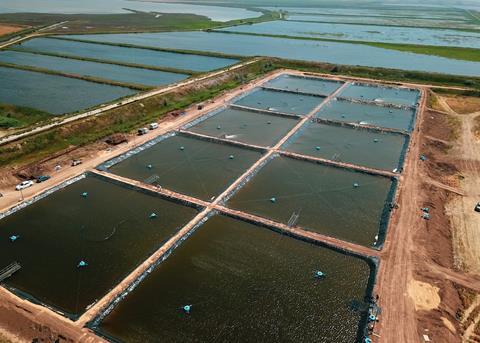
Aquafarm Tiligul aims initially to produce 500 tonnes of Pacific whiteleg, and hopes to increase production rates still further in the future, as well as developing plans to build facilities to breed sea bass, sea bream, barramundi and grouper, with a planned 1000 tonnes annual fish production. This expansion would represent a further investment of around €20 million.
“We are establishing an anchor project, which will give other companies an opportunity to be engaged in this business,” said Aquafarm Tiligul’s Lyobomir Gaidamaka, adding that the company also plans to establish an industrial park centred around aquaculture, attracting other companies to the region to form a synergy between their production capacities.
The new farm is planned also to include a production facility for 6000 tonnes of fish feed annually, processing capacities for shrimp, and a hatchery with surplus broodstock expected to be sold on the open market, to other aquaculture companies in Ukraine. Aquafarm Tiligul plans to become a trailblazer in Ukrainian aquaculture and provide a boost for the development to the country’s entire fish farming sector.
Major investment in Ukrainian aquaculture
Ukraine annually imports about 2400 tonnes of crustaceans per year, primarily krill and crayfish. The domestic market of king prawns is estimated at 200-300 tonnes per year. Currently these are not produced in Ukraine but only imported, according to Aquafarm Tiligul’s Lyobomir Gaidamaka, and a key pillar of this development is to export production.
“Aquafarm Tiligul is establishing vertically integrated production fully meeting its needs in raw materials,” Lyubomir Gaidamaka said. “The company is now working on certificating its products in accordance with European standards.”
Aquaculture in Ukraine has languished, despite having Eastern Europe’s strongest potential in this field, hampered by excessive regulations, providing fertile ground for corruption.
He stressed that the venture has already attracted the interest of local regulatory authorities, which, he claimed, is “traditional” in these cases.
“Unfortunately, there are a lot of problems. We had hardly started when the tweezers [local term describing officials willing to help with bureaucratic issues in exchange for small reward] arrived from the local regulatory authorities, who came along to check some claims at the request of an individual from the Odessa region. But our legal team knows very well how to put them in their place,” he said.
Aquafarm Tiligul even had to turn for support to the head of the Mykolaiv Regional State Administration, Vitaly Kim, and the chairman of the Mykolaiv Regional Council, Anna Zamazeeva.
Veterinary regulations are a longstanding problem for Ukrainian aquaculture producers. In 2020, a solitary producer of king prawns in Ukraine had to temporarily stop operation after the State Veterinary Service introduced enhanced controls for broodstock imported from Thailand.
Located in Zhmerinka, in the Vinitsia region, the farm was launched in 2018 at a cost of €2.5 million and operated successfully in recent years, according to director Gennady Melnik, although it has been entirely dependent on imported broodstock.
“The fry were airfreighted in bags with water. Previously, we were cleared direct through customs to prevent broodstock lossses,” he explained, adding that things changed when the Covid-19 epidemic began, prompting the company to suspend operation until better times.
Korean style
The concept of farming shrimp in Ukraine has been developed by local company Vismar Aqua, of which Lyubomir Gaidamaka is the director.
“The option of building a large farm for growing at least 100 tonnes of product per year, with its own hatchery, as well as a feed mill, is the only opportunity for any country to move this business off the ground and become commercially attractive for investors and a wide range of consumers,” he said, commenting that at least two or three such anchor projects must be launched in the country to breathe life into the industry, and high-quality, affordable broodstock, plus high-quality feed, are central to this.
“This needs to be close to a seawater source because the preparation of seawater is one of the expensive aspects of such farm, and this can significantly affect the production costs,” he said.
Vismar Aqua proposes to adopt the Korean model, under which the government financed the development of several standard shrimp farm projects operating on the bioflocculation principle.
“There are more than a hundred such farms throughout the country now. These are designed for seasonal production from April to the end of November. During this time, they manage to get two harvests. The farm runs for 7-8 months a year, and in the cold season, it operates simply to maintain required water parameters,” Lyubomir Gaidamaka said.
These farms generate a net profit of about $10 per kg and are popular among local investors. A similar approach, in theory, could be applied in Ukraine. In many cases, these farms could be operated even by a family or a few people.
This could be an significant social bonus for Ukraine, where during the Covid-19 pandemic, unemployment reached 10.5%, believed to be one of the highest in recent years.