





Driving factors behind decision-making
A research team has found that collecting data directly from fishermen can significantly improve understanding of the social drivers that lie behind fishing behaviour.
It is believed that this could help to better manage fleet movements across the globe when combined with environmental data. Using the Sri Lankan offshore fishing fleet as a case study, the team from the Zoological Society of London (ZSL)’s Institute of Zoology, University of Exeter and Oceanswell, a marine conservation and research organisation in Colombo, Sri Lanka, examined what prompts fishermen to venture to particular areas and why.
“The Sri Lankan fleet is especially interesting because of its far-ranging nature,” said Claire Collins of ZSL’s Institute of Zoology and the University of Exeter. “The fleet is semi-industrial and its boats are small to medium-sized. They are referred to as ‘multi-day’ vessels with seven to ten crew members. They occasionally go as far afield as Mauritius or the Seychelles and we wanted to understand why. Was it because of changes in the populations of target species such as declining fish in national and coastal waters? Or, were they after a particular species? In addition to this, the Sri Lankan fleet is sometimes suspected of illegal fishing beyond its own national Exclusive Economic Zones (EEZs). Fleets across this area of the Indian Ocean are perhaps not as regulated as they could be, we do not know enough about population of target species, and it’s an extremely busy region.”
Through informal interviews with 95 fishermen at two sites on the south and west coasts of Sri Lanka, the team formed a picture of the fleet’s spatial distribution and reasons for its non-compliance with ocean management policies. Oceanswell researchers, who conducted all data collection as well as helping to develop it, asked skippers to complete a mapping exercise in order to provide information on the economic importance of fishing areas and proportional contribution of species to catches. They then took part in a semi-structured interview, which collected information on their socio-demographics, vessel characteristics, fishing strategies and their perceptions of governance and management.
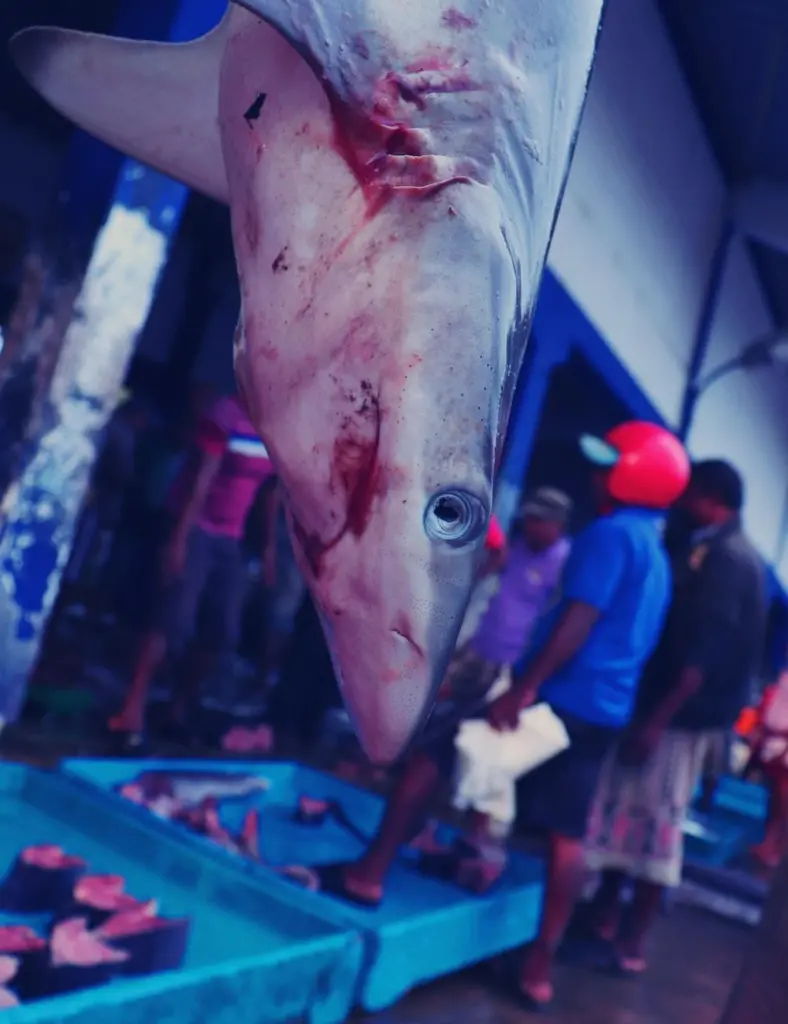
The team found that fishing effort was mainly concentrated in areas off southwest Sri Lanka towards the Maldivian EEZ. A range of targeting strategies and combinations of gear and species were found, including longline and gill nets, with some longline fishermen stating that they had longlines specifically adapted to target sharks (75% of fishermen said that sharks contributed to their annual income).
Distance to landing site was identified to be an important social variable driving decision-making, as were environmental variables, notably sea surface temperature, and target species. Tuna was the most common primary target species, followed by Carangidae, billfish and sharks. Findings suggested that perceptions of higher catch quantity and economic necessity may be driving fishermen to fish illegally. Economic factors including increased fuel prices and changes to market prices may also play a part, as do spatial management policies, confirming the role of political boundaries in decision-making. Vessel equipment also emerged as important, as the absence of advanced cold storage and ice that vessels rely on can determine the fishing area of choice.
Environmental factors are key in driving spatial patterns of fishing activity, and fishermen will often have a good knowledge of environmental signs to look out for. Therefore, combining environmental data with data on social drivers behind fishing decisions – such as social networks, traditions, fishing experience and expertise or the desire to make a profit – is vital to understand and predict fishing behaviour.
“Fishers have a lot of knowledge that we might not necessarily have, such as knowledge of breeding grounds, and obviously they want to go where the fish are but to do this they have to make those conscious decisions such as how long it might take to get to a particular site, how much is the journey going to cost, when they would need to get back for and so on, and this is why it is extremely important to actually speak to those who are making these decisions,” Claire Collins said.
“They are the ones who will be able to explain with certainty what factors are important to them and why. Then it’s a case of how these factors can be incorporated into the management of expanding fleets.”
New technologies, including Vessel Monitoring Systems (VMS), have also made it easier to characterise and track spatial behaviour and identify illegal fishing, while policies such as EEZs and MPAs are working to protect ocean diversity in light of issues such as overfishing and bycatch. However, the tools used by Claire Collins and her team are capable of obtaining valuable, complementary data to help understand fishermen’s perceptions of marine spaces and the social drivers behind their movements. Management policies like EEZs and MPAs are only effective if fishing fleets adhere to them, she said.
“Advancing technologies such as VMS are a great way of enhancing the surveillance of fisheries in a cost-effective and efficient way,” Claire Collins added.
“But we can’t fully rely on VMS because it might break down, fishers could actively turn it off, and fleets may be simply slow to adopt VMS across all vessels, especially for smaller vessels. By speaking directly to fishers, we can identify what is underlying their decisions and learn about the variation in behaviours within fleets. For the Sri Lankan fleet, some vessels only fish in national waters while for others, within their vessel company, or families, it is traditional to go further afield. It’s important to think about how this can be managed. One-size-fits-all is not the answer across fleets.”
Through their work, Claire Collins and her team have highlighted the importance of continued advancements in monitoring and managing fleets, and shown how data from fishermen can provide a nuanced, detailed understanding of fleet movements, which may be omitted by relying on VMS alone. Hopes are high that this will highlight the value of delving into fishermen’s motivations for deciding where to fish or carrying out illegal activity, making it possible for effective management solutions to be devised.
Calling for a nuanced approach to managing fishing fleets in future, Claire Collins and her team suggest increased data sharing on non-compliance, an investigation of what could hinder the ability of VMS to survey particular fleets, and management interventions that are adapted to local contexts. They will be continuing to further investigate the Sri Lankan offshore fishing fleet and learning more about how the fishers view VMS, any problems they have encountered when using it and the extent to which it provides benefits.
Related Articles
 PROCESSING & REFRIGERATION
 PROCESSING & REFRIGERATION
 PROCESSING & REFRIGERATION