




New research by two academics at the UK’s University of Swansea revealed jellyfish are not as lifeless as they seem and can actually “actively swim” against strong ocean currents.
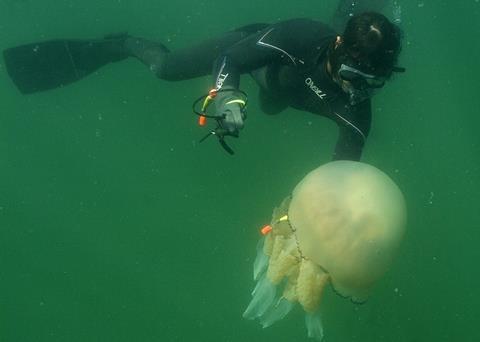
According to the new findings on free-ranging barrel-jellyfish, which have been published in the Cell Press journal Current Biology, some of the species are not just mere drifters and have the ability to detect the direction of ocean currents and to swim strongly against them.
“Detecting ocean currents without fixed visual reference points is thought to be close to impossible and is not seen, for example, in lots of migrating vertebrates including birds and turtles,” said Professor Graeme Hays, Swansea University Biosciences.
“Jellyfish are not just bags of jelly drifting passively in the oceans,” he added. “They are incredibly advanced in their orientation abilities.”
Professor Hays along with his Swansea University colleague Dr Sabrina Fossette tracked the movements of the jellyfish with GPS loggers and used GPS-tracked floats to record the current flows. They also directly observed the swimming direction of large numbers of jellyfish at the surface of the ocean.
The data revealed that jellyfish can actively swim at counter-current in response to drift. Their model of the jellyfishes’ behaviour and ocean currents helps to explain how jellyfish are able to form blooms including hundreds to millions of individuals for periods up to several months.
It’s not yet clear exactly how the jellyfish figure out which way to go. Dr Fossette and Professor Hays say it’s possible that the animals detect current shear across their body surface or they may indirectly assess the direction of drift using other cues, such as the Earth’s magnetic field or infrasound.
But, understanding the distribution of jellyfish in the open ocean may be practically useful for predicting and avoiding troublesome jellyfish blooms, they say, especially if it turns out that the findings in barrel-jellyfish apply to other species.
“Now that we have shown this remarkable behaviour by one species, we need to see how broadly it applies to other species of jellyfish,” Mr Hays added. “This will allow improved management of jellyfish blooms.”