



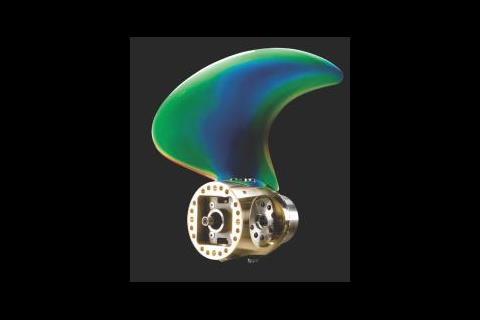
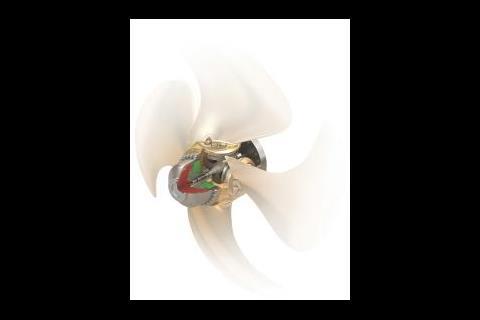
The new Kamewa CP-A hub for controllable pitch propellers has been developed from the established XF-5 design. Hubs for controllable pitch propellers are mature products and manufacturer Rolls-Royce says that the development has been made by evolution, not revolution.
However, by examining all the mechanical and hydrodynamic aspects of hub design using the latest tools and techniques, it has been possible to improve the power to weight ratio by about 20% without compromising its strength, with the added benefit of greater wearing surfaces for the blade bearings.
The operating principle of the XF-5 hub has been retained. This is a simple, compact and strong arrangement in which the pitch of the blades is set by a hydraulic piston connected to a crosshead in the hub which carries slide blocks riding on pins in the blade feet. Actuating oil is fed along twin tubes through the hollow-bored propeller shaft. A feedback mechanism ensures that the ordered blade pitch is achieved and the system gives full control of propeller pitch, providing ahead, neutral and astern thrust steplessly. A fully feathering version is also available. An associated low pressure oil system lubricates the hub mechanism and the bearing surfaces at the root of the blades. Seals at each blade foot prevent leakage of oil out, or sea water in, and the hub is maintained at a slight over-pressure.
As always with Rolls-Royce CP propellers, the propeller blades themselves bolt onto the hub and are individually designed to suit the vessel and its operating conditions. However, compared with the earlier design it has been possible to modify the shape of the blade root to give slightly more space between blades and an improved contour for the whole blade root/hub, reducing the risk of root cavitation and providing a small but significant increase in efficiency of about 1.5%.
The new hub is being offered in two main versions. The CP-A standard covers speeds up to about 30 knots and the CP-A/H is intended for faster vessels. They are suitable for the full range of applications, both commercial and naval, and the new hub will be offered in a wide range of sizes, covering powers above about 500kW with no defined upper limit. Thus the hub design will cover both the present and the anticipated future controllable pitch propeller market. Open water and nozzle propellers will be offered, the latter having a slight modification to the hub enabling the blades to be replaced individually without disturbing the hub or the nozzle. Both nickel aluminium bronze and stainless steel hubs and blades will be available, covering normal and Ice Class requirements. For applications with extreme environmental demands, a special version with double seals at each blade can be specified. These seals provide extra insurance against the possibility of oil leakage, and this arrangement also allows individual blades to be removed and replaced under water.
In parallel with the redesign of the hub itself, the hydraulic system has been updated. A new power pack with load sensing hydraulic pumps substantially reduces the amount of power required to operate the system, particularly in installations where propeller pitch changes are not frequent.The amount of oil in circulation is also reduced. Three types of oil distribution box continue to be offered, but the design has been revised to provide increased pitch setting accuracy and simpler servicing. First is the OD box riding on the propeller shaft. The second is the system where the OD box is mounted at the forward end of the gearbox. The third is applicable to Rolls-Royce single input-single output gearboxes and here the oil distribution system is integrated in the gearbox housing.
The control system for the new propeller is based on the Rolls-Royce common control platform, with a bus connection between the pitch setting system and the bridge levers and displays. Touch screens at the bridge stations provide the operator with a clear view of system status, and the screens themselves use bonded technology to give good visibility in bright sunlight. The propeller controls are based on the latest Rolls-Royce human/machine interface developments and the system is easily interfaced with other Rolls-Royce propulsion equipment, DP systems and proprietary equipment.