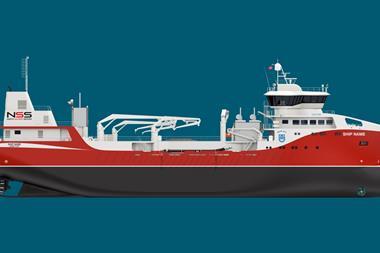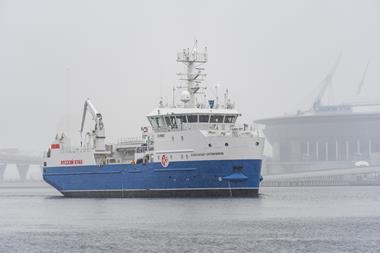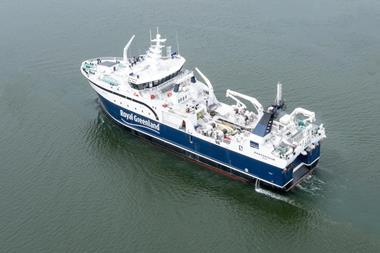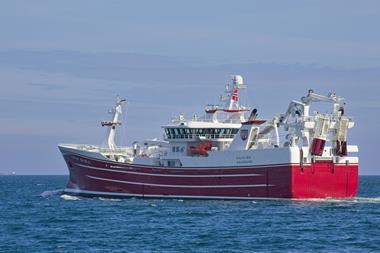




Maaskant Shipyards has completed a seiner for Dutch owner, v.o.f. Visserijbedrijf W. Melissant en Zonen.
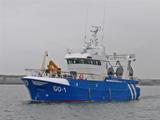
The innovative double-deck Wouter Adriaantje is a fishing vessel equipped for seining and fitted with a unique fish processing plant featuring a flo-ice system.
This vessel is the third new building of its kind built by Maaskant Shipyards in The Netherlands fitted with this type of fish rigging. The specific fishing technique is distinguished by its low fuel oil consumption costs due to the relative low propulsive power.
Deck machinery
The seining winches, nett drum winches and cargo winches are made Osey-VCU Urk. The winches are driven by Intermot hydraulic motors and Abex Dension hydraulic pumps.
Two seining winches are situated on the main deck in a 'falls configuration'. Each winch carries 4,000m of 40mm diameter cable. The warp line sheave guides are fitted at such a height that one can easily continue his activities on the working deck below the seining lines.
A sheave guide construction of both seining blocks has been fitted below the net drum foundation. During fishing the drums can be directed to either port or starboard, thus enabling the skipper to maintain his course easily.
The hydraulics are fitted with both tensioning meters and line length meters, from Marelec. The hauling speed can be remotely read in the wheelhouse from a Marelec control console. On top of the open aft deck, two single net drums are situated for the storage of the seine net. The aft deck also carries an auxiliary winch.
Fish processing
The closed forecastle accommodates a rinsing drum for efficiently processing round fish. The installation, made by Machinefabriek van Rijn, has been designed to rinse the round fish very carefully. After rinsing, the fish is discharged to a chute. The fish chute leads to the sorting hold, where the catch is weighed on a Marelec W50 weigher, complete with ticket printer, and packed immediately into small boxes, which will be filled up with flo-ice. The flo-ice is produced by a Promac flo-ice plant. The complete fish hold is fitted with insulation by Hertel, wooden sides and ceiling finished with polyester by VABO/IJtama.
Fish catch is dumped through a hydraulically controlled hatch into a special fish catch compartment. An elevator belt transports the fish onto a sorting/stripping belt. From there the fish is conveyed to one of the four fish chutes through the four compartment rinsing machine.
The Marelec B50 software installed in the ship’s computer on the navigation bridge automatically collects all fish catch data.
Engine room
The prime mover of Wouter Adriaantje consists of a Caterpillar C32 TTA Alerc, 709 kW/964 hp. At full power the marine diesel engine gives the fishing vessel a free sailing speed of approximately 10 knots. The main engine is fitted with a Reintjes WAF 562 reversing gearbox featuring a reduction ration of 1:5,947. A Vulkan and Centa Nederland elastic coupling is fitted between the main engine and gearbox. The main engine drives a four-blade 2300mm diameter Hundested controllable pitch propeller. Manoeuvring capacity is enhanced by the fitting of a Jastram bow thruster unit directly driven by a Habeco hydraulic motor of 111 hp. The forward end of the main engine is with a Mekanord drive system/gearbox.
Electric power is derived from John Deere 6088 HFU 79 generator sets, delivered by Dolderman. Each set consists of a 13 kW/190hp main diesel engine fitted with a 140kVA Stamford UMC 274 alternator. The ship’s electric system has been installed by Elektro Westhoeve. Engine room auxiliary systems include: Desmi K & R pumps, a P.H. fuel oil filter separator unit, Kärcher high-pressure cleaners and an Ambi rudder stock grease pump, Ambi also delivered an electric greasing pump suitable for 25 litre drums, complete with a 25m long air line connection kit and handheld greasing gun.
Wheelhouse
The navigation bridge provides a clear view to the vessel’s surroundings and on the working decks. Camera’s fitted in the seine net winch room and on the aft deck give the skipper a perfect view of the dead angles. The navigation equipment, delivered by SAM Electronics, has been double-executed to enable the skipper to navigate both in front and back of the wheelhouse.
Topics
Related Companies
- Previous
- Next