


Back in February 2017, Maruha Nichiro launched a model research project studying inland cherry salmon aquaculture, with a collaborative project between Maruha Nichiro and partners in industry, government, and academia. This was the first inland aquaculture project in Japan to be certified by the Aquaculture Stewardship Council (ASC) for sustainable and responsible salmon production.
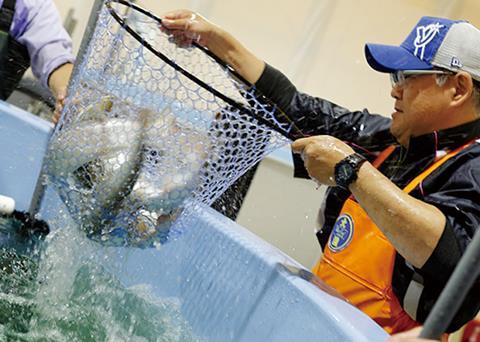
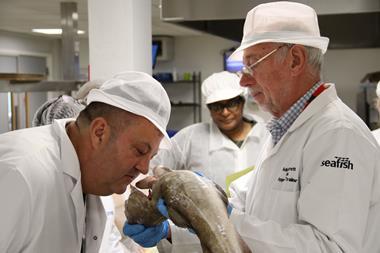
The project’s first full harvest was in May 2019, with high-quality fish weighing around 2kg. A selection sent to upscale restaurants in Singapore and Japan resulted in a universal consensus that the project’s cherry salmon was delicious. Some tasters could not even tell it apart from the naturally caught alternative.
In May this year, the harvest included fish weighing 3.50kg, , and the project’s researchers are now working to improve production efficiency by culturing salmon in greater density over shorter periods. Although this initiative will run for the predetermined experimental period, the technologies cultivated may allow aquaculture of cherry salmon and many other kinds of fish in locations all over Japan and around the world.
In the future, Maruha Nichiro is confident of finding a path to commercialisation that respects both environmental and local community concerns.
Maruha Nichiro has a proven track record in seawater aquaculture research and commercialisation, but challenges such as the limited number of suitable marine areas will make exploring inland aquaculture imperative for meeting its commitments.
The cherry salmon initiative began with a submission to the Ministry of Agriculture, Forestry and Fisheries as a proposed model R&D project. The ministry recognised the potential of a public-private-academic partnership that would promote Internet of Things (IoT) innovation while potentially creating a new resource for export. The project was quickly underway with government support.
The key to the project’s success has been cooperation between industry, government, and academia. As an example, the IoT technology controlling water temperature and quality, and other parameters in the project’s sensor-equipped tanks.
This technology served as a platform for a range of related initiatives: verifying the effectiveness of other private-sector technology, gathering data for public institutions studying optimal aquaculture conditions, and fusing the project’s infrastructure with zero-emissions theory and technology developed by academic researchers.
In effect, the project has functioned as an experiment in zero-emissions circulating inland aquaculture system, promising benefits both for environmental conservation and inland aquaculture itself. With each side of the collaborative triangle bringing its own specialist knowledge and experience, the project as a whole was able to explore and test more ideas, and on a greater scale, than any participant could have on its own.