



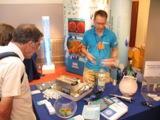
Making sound waves
Among those laying out their wares at the 2009 Summer Science Exhibition in London were ultrasound specialists Dr Andy Cobley and Dr Larysa Paniwnyk from the Sonochemistry Department, Faculty of Health and Life Sciences, at Coventry University. The department’s origins(1) date back to 1970's work on cavitation bubbles. Today the sonochemists are using 'power' ultrasound waves through water (as opposed to low-power, high frequency waves for ultrasound scans in medicine for example) to form bubbles. These continue to expand until they collapse in an explosion at up to 1,000 atmospheres pressure and produce a microjet of liquid travelling at up to 720kph at a temperature of up to 4,726oC.
We know that ultrasound cleaning for anti-fouling is available in the market, and Dr Cobley explained that the pressure can also be used to smooth out metals at the micro level as well as for plating. This could have hull streamlining implications for fuel savings.
Another area they are happy to discuss is stripping flesh off fishbones and shellfish for production perhaps of fish paté, mousse and soups. This could reduce machinery-cleaning problems. Dr Cobley also says that ultrasound can be a good emulsifier of oil and water. This might have an application in fishmeal pellet production. World Fishing raised the issue of using compact ultrasound equipment onboard to strip flesh to make cooked, reformed products and perhaps pulverise bone and shell for resale as fertiliser use.
Dr Paniwnyk told WF they are also collaborating with colleagues in Nanqing, China. Trials have been done to remove toxic algae from ponds but so far the impact area remains small and needs scaling up. There have been suggestions of using trawlers in the Baltic to take in contaminated water and ultrasound it to clean up certain areas but “Some of the problems are so massive” she said. That could be a nice little ‘throughput’ earner while pulling a trawl. Dr Paniwnyk is also looking at processes to extract oils (from rosemary and juice from blueberries and is ready to discuss fish) as well as drying, mixing and preserving in food preparation. They are also looking at using power ultrasound to destroy cancer cells and that takes us nicely on to:
Zebra fish
WF has regularly reported cases of high value ‘neutraceuticals’ (medicinal and “health” products derived from fish(2)). The fish industry may find it pays to think about direct medical applications. Dr Steve Renshaw is a hospital consultant in respiratory and inflammatory diseases who works closely with biologists at the Medical Research Council’s Centre for Developmental and Biomedical Genetics at the University of Sheffield(3). “We use the [zebra] fish to model human diseases or physiological processes that are common between humans and fish…to understand why we get diseases and find new treatments,” he said. That includes bone, nerve and heart and artery diseases.
They inject a fluorescent protein 'transgene”' from a jellyfish into a zebra fish embryo which is largely transparent. They can then watch the movement of cells, including cancer cells.
Although the breeding process is not his direct area of work, it seems that there could be common interest for the farmed fish sector in the gene process. Putting to one side the general debate over the pros and cons of genetically modified organisms (GMOs), most breeding is about taking advantage of evolutionary benefits appearing or triggered in any animal or plant. The breeding of tropical fish, under scientific supervision, by Kerala fishermen in the off-season, to sell as ornamentals for extra income, might mean they could also do some paid, basic monitoring work and link into the booming Indian bio-industry. Interestingly the Sheffield team are feeding the fresh water zebra with salt water shrimp and the fish enjoy it. Dr Renshaw says they have collaborations with some 40 labs around the world.
Flesh quality in fish and growth are key issues for the seafood industry. Dr Renshaw’s interest in inflammation of tissues suggests another crossover area for collaboration with the processing industry and onboard “events” from stings and toxic events handling unknown creatures from the depths. The fluorescence added to the zebra fish, “...allows us to see exactly how inflammation is initiated at the cellular level. We can see the cells moving into a site of inflammation, what they are doing while they are there, eating bacteria… and taking up damaged tissues,” he says.
Solar and sonar pinging
To finish off our little tour of Summer Science, which was hosted by the Royal Society, great strides have been made in recent years to produce more efficient solar photovoltaic (PV) panels. Imperial College’s Grantham Institute for Climate Change is developing multi-layered cells with metals such as gallium. These are very expensive - the European Space Agency has been developing this kind of panel for its satellites. However, the message is clear that PV panels benefit from plenty of light and vessels at sea have plenty of that. The issue is getting marinised applications for more use onboard, perhaps for direct electrical power as well as for use for heating water and cooling. This could save fuel when maintaining slurry ice in holds using solar panels to power extractor fans, or for charging batteries for emergency systems and lighting. Thermal (liquids or water with antifreeze in pipes) can also provide hot water for crew and gutting rooms at very low cost. Further, China, which is a world leader in using and producing PV and thermal systems, has a glut of stock because of the credit crunch, so prices are falling dramatically. What is needed now is economical, working systems for use onboard and it may be time for some DIY testing. It does not need a lot of imagination – just action.
Researchers at the University of Southampton and the National Oceanography Centre have begun working with some oil and gas companies to ‘borrow’ their remotely-operated vehicles for deep-sea species search and to do some limited mapping.
But perhaps the real area to watch is their initial research on how dolphins use sonar for location. It is early days, but if they can work out whether a dolphin, having echo-located a shoal is then able to ‘know’ whether the fish are of a particular species or perhaps too juvenile to be worth the effort or too big, then fishermen and stock management officials who want high-value, targeted trawls will be beating a path to their door.
(1) Contact via http://www.coventry.ac.uk/researchnet/d/390
(2) http://worldfishing.net/new_horizons/new_horizon.ehtml?o=1352
(3) http://www.fishforscience.com/