




More than 1,500 tonnes of the ornate or flower spiny lobster, Panulitus ornatus, are farmed, or ranched, each year in sea cages off the coast of Vietnam, according to FAO. Juvenile lobsters are caught in the wild then fattened in basic wooden cages in shallow waters off the beach.
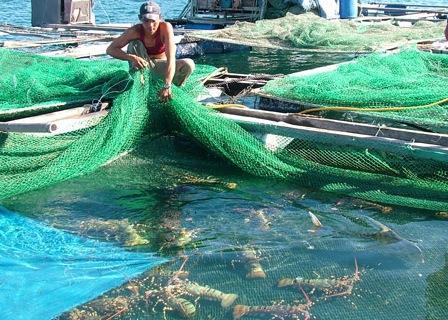
P ornatus is well suited to captivity, FAO says. Fed on trash fish, growth and survival rates are excellent and the industry is very profitable. So much so, that the Vietnamese Ministry of Agriculture and Rural Development (MARD) is intending it to become a key economic activity in the central region of the country.
The ministry plans to increase the farming area in this region to about 1 million cubic metres and the output to 1,940 tonnes by 2020.
The farming of P ornatus in the south-central provinces of Vietnam has been expanding for more than 15 years, according to Vietnam News. In Khánh Hoà Province, more than 23,300 cages are now used for fattening the spiny lobster accounting for 40% of the country’s total.
The practice of catching juvenile lobsters and holding them in cages until they put on weight developed in the late 1970s and early 1980s. It was driven by demand in China where large (weighing more than 1kg each) P ornatus are much sought after as centrepieces for celebratory banquets.
The Chinese are reputed to pay up to $200 each for live large lobsters air freighted into the country.
Appeal
P ornatus has a brightly coloured shell so has high visual appeal when served as a sashimi product. The firm flesh is also said to be suitable for serving in this way.
There had been a small lobster fishery operating in Vietnam where divers supplied the local market. Less than 100 tonnes of various species were caught, FAO said, and demand for P ornatus was moderate because its eating quality was not judged as highly as the others.
However, when demand from China grew rapidly this led to increased fishing effort throughout the South China Sea. In Vietnam, larger vessels equipped with trawl nets operated further offshore and catches of P ornatus increased to more than700 tonnes
But by the 1990s, unregulated fishing had led to dwindling catches of smaller lobsters, too small, in fact, to attract good prices in China. So began the practice of holding the smaller lobsters to fatten them to the preferred market size. By 2004, FAO says, more than 30,000 net cages had been set up along the south central coastline of Vietnam producing more than 2,000 tonnes of farmed lobsters, primarily P ornatus.
The volume of small lobsters for growing in cages dropped, although the number increased as the lobsters became smaller and smaller in size. Since 1996 the bulk of lobsters marketed from Vietnam have been farmed from an initial capture size of less than 5g each.
Although the development of spiny lobster culture has been actively pursued for many decades, according to FAO, the only significant established lobster aquaculture industry established is in Vietnam.