


Using light to attract or repel fish looked to be an innovative strategy, until Dan Watson looked into it more closely as part of the development of the Pisces selectivity device.
This is a potential contribution to selectivity and UK-based start-up company SafetyNet Technologies has already won a slew of awards, from Pitch@Palace to the James Dyson Award, Hello Tomorrow and The Observer Ethical Business Award, and there is support behind SafetyNet Technologies from Youngs Seafood, the James Dyson Award, Richard Branson and Eric & Wendy Schmidt.
SafetyNet have completed their proof of concept and are now ready to expand into batch production, and new trials are already in progress with the latest version of the concept to use light to boost selectivity.
It was while studying at university in Glasgow that Dan Watson first became aware of some of the problems facing the UK fishing industry, notably with news of Scottish vessels being arrested in Norwegian waters for infringing regulations on by-catch. Intrigued by the industry’s problems, he began working on ways to use light to make trawl gear more selective became his final year project for his degree in mechanical engineering and product design.
“We wanted to examine what could be put in a trawl that could change fish behaviour, either to attract or repel,” he explained.
“I’ve been working on SafetyNet for eight years and we’ve made some really exciting progress and learned a lot during that time. We’ve worked hard because we see a real need for this technology, but we couldn’t have done it without our supporters,” he said. “Now we’re making the effort to bridge the gap between proof of concept and a device that can be used by many more people to accelerate the science and begin having a widespread positive impact.”
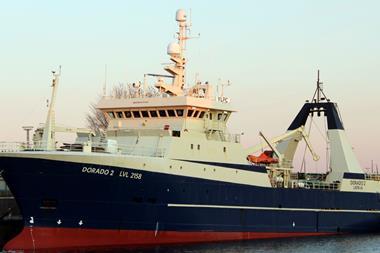
The initial result of Dan Watson’s efforts at Glasgow University was the Escape Ring, which was tested successfully on board a UK nephrops twin-rigger in a project supported by Youngs Seafood. These devices were fitted to one codend, illuminating an escape route for the unwanted whitefish, while the target species were retained, with encouraging results.
“The results of this research are very encouraging and we now hope that the industry, Government and other organisations will come together to support further trials,” commented David Parker, Head of Corporate Social Responsibility at Youngs Seafood, who took an active part in the at-sea testing of the original Escape Ring. “Having been out on the trawler during the research and having seen the technology in action, I believe this innovation could have a positive impact on the industry and the future of fishing.”
“To start with we spent a lot of time in workshops working on prototypes with no money,” Dan Watson recalled, adding that the aim was to produce an adaptable source of light that would function under harsh conditions.
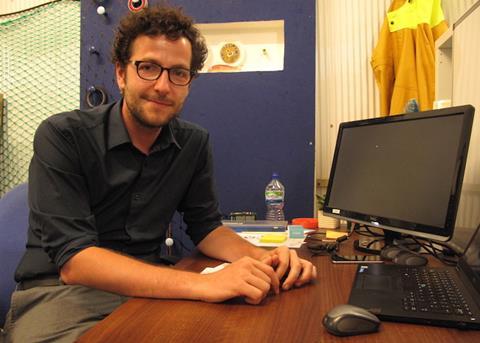
Today the company has grown into SafetyNet Technologies, occupying a space among a group of innovative companies not far from central London, but still operates on a part-time basis while it establishes itself, with its main activity in building bespoke devices. Dan Watson splits his time between SafetyNet Technologies and a couple of days a week working in the aerospace industry, but it’s obvious where his real passion lies.
The development has taken the Pisces device into new territory, mainly with the realisation that the possibilities of the light source are more of a concern than the geometry of the gear. Pisces is programmable for a variety of light frequencies, colours and flash sequences, and much of the development has gone into making this usable as well as robust, such as developing a baseplate charger that does away with the need for batteries to be changed at intervals.
“We’re looking at the usability,” he said. This includes an integral GPS that registers the device’s location, allowing it to adjust itself for the species in that region, or the user can enter the required species to avoid, and Pisces chooses the right mix of light emission to suit those requirements.
“It needs to be able to have a week of constant use on one charge, and it needs to be programmable for different depths,” Dan Watson said, commenting that the vast number of possible combinations of colour, frequency and flashes makes programming the device for specific species something that should ideally be boiled down to a set of choices based on species to be avoided.
He said that as part of the efforts put into this work, he discovered that there has been a great deal of work carried out into the effects of light on fish behaviour over the years – but much of this work had been done in isolation
“There was an awesome amount of work done in the 1970s,” he said. “We were surprised at just how much work had been done, such as the work done by John Wang in Hawaii to deter turtles from approaching fishing gear, and we were keen to aggregate all those experimental outcomes.”
He added that researchers in Oregon placed light devices on the footrope of a trawl, successfully reducing by-catch by up to 90%, the thinking being that the fish species can see and avoid the illuminated footrope more easily while the shrimp continue to make their way into the trawl gear.
Dan Watson said that they have worked on making Pisces as durable as possible, with the casing made of a superstrong polymer, similar to the material used for modern car headlights, resistant to abrasion and UV light, and an additional factor is the emphasis placed on making this into an enduring piece of equipment.
“We don’t want this to be disposable – we don’t want it to become another pollutant,” he explained. “We work to the GGGI guidelines on disposal of fishing gear.”
A key part of the plan is to make each Pisces returnable under a service agreement in which the user would then get a replacement Pisces while the returned unit would be serviced, refurbished and updated before going back into service.
“It’s important that they’re returnable, and that there’s an incentive to return the devices for servicing and upgrading – otherwise someone in China will be making these in a few weeks and will undercut us – so we aim to provide service as well as the hardware on a subscription basis that spreads costs for the user and ensures they always have serviced and up to date units on board.”
“We are taking part in a trial with the Pisces devices on scallop boats in the Isle of Man to reduce groundfish by-catches, working with Mike Kaiser of Bangor University, and people are lining up to try these out,” he said, commenting that the intention is to be able to supply each vessel with a set of ten Pisces units.
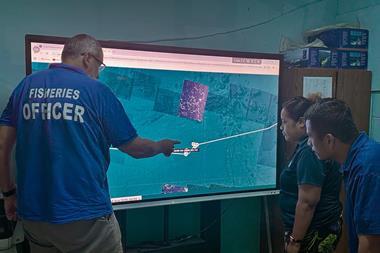
“We’re also talking to the Indonesian government about testing them there, and there’s a test project coming up on North America. There are clear opportunities to use light, and this could be super-effective for anything from turtles and seabirds to crustaceans,” Dan Watson said.
“We have created a useful tool here, but a lot of experimentation is needed to find out exactly where it fits.”