


Andfjord Salmon expansion in full swing
Land-based aquaculture company Andfjord Salmon is rapidly advancing with the expansion of its facility at Kvalnes, Andøya, Norway, with the company reporting that the summer months saw successful preparatory efforts and the deployment of personnel and equipment to set the stage for the next phase of construction.
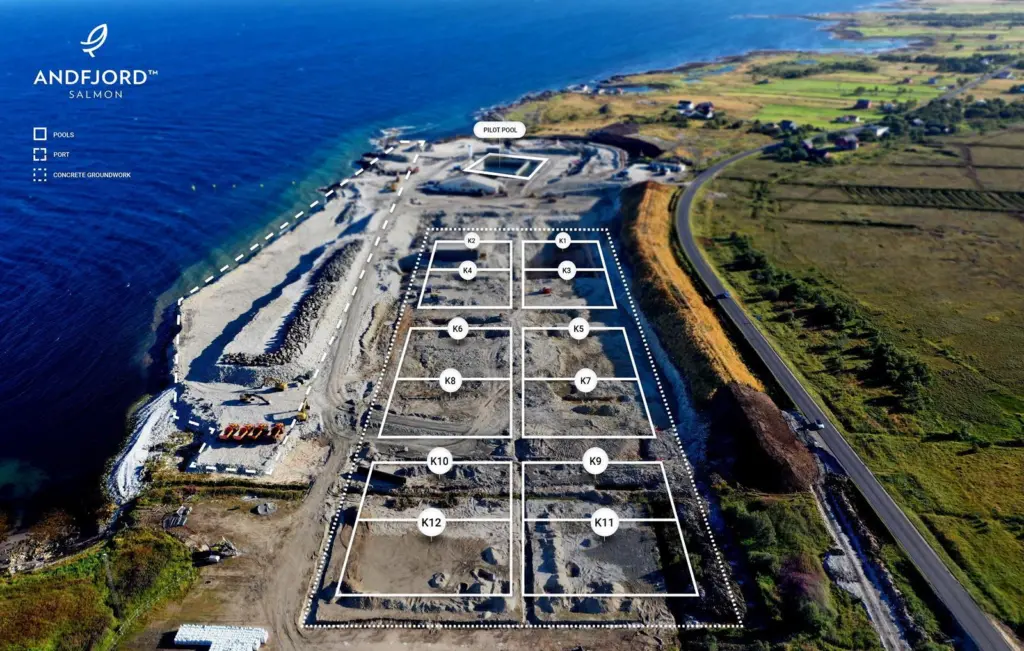
In mid-June, Andfjord Salmon unveiled the specifics of its expansion plan at Kvalnes, targeting a total production capacity of 40,000 tonnes (HOG) through a gradual increase between 2025 and 2030. An initial volume of 8,000 tonnes (HOG) is anticipated for 2025.
The company has confirmed that contractors have done extensive groundwork spanning several hundred metres, with the work involving injecting concrete to stabilise the sections surrounding the 12 pools that constitute the upcoming construction phase at Kvalnes.
This preparatory work will help speed up blasting and excavation, contributing to an economically efficient development process, it said.
“Our approach essentially involves constructing an ocean-like fish enclosure on land. We leverage bedrock and topography to ensure a development that is both predictable and expeditious. This integration of land-based and ocean-based fish farming is a distinctive aspect of our approach here at Andøya,” Andfjord Salmon CEO Martin Rasmussen said.
During the successful first harvest in late June and early July, lead contractor AF Hæhre-Contur began mobilising equipment and personnel along with subcontractors. Simultaneously it prepared areas designated for machinery, equipment, and tools, complementing the ongoing groundwork. These areas include workshops, tunnel operations, equipment maintenance and cleaning stations.
“By timely executing our first harvest as scheduled in June/July, we substantially mitigated project execution risks for our expansion. Our primary objective is to increase production capacity to 8,000 tonnes by 2025, accompanied by increased revenues and cash flow. I’m truly impressed by the swift progress achieved thus far,” Rasmussen said.
Office barracks have been established at Kvalnes for the project administration, and a site has been prepared for concrete production. In addition, Andfjord Salmon’s Breivik site is being prepared to receive accommodation barracks.
Extensive preparation work was carried out at Kvalnes prior to the first release of smolt last year in order to prepare the area for the upcoming construction phase.
Last week, Kvalnes received the machinery, drilling equipment, dumper trucks, and wheel loaders necessary for excavating the initial twelve pool pits and transporting materials to the port area. A mass balance approach is being adopted, whereby excavated masses from pool pits and waterways will be utilised for port and quay development.
Andfjord Salmon Project Director Jostein Nilssen said: “The machinery is already being used to remove and transport excavated masses to the port area. The efforts undertaken in 2021 and 2022 are yielding remarkable efficiency gains at present.”
In addition to the port infrastructure, Andfjord Salmon will establish waterways to support the production of 40,000 tonnes of salmon at Kvalnes. The plan is to commence waterway pre-cutting, followed by tunnelling activities, in September.
Related Articles
 AQUACULTURE
 AQUACULTURE
 AQUACULTURE