


Japan
Emergency aid for Japanese fishermen – The Japanese government Fisheries Agency announced on 28 July a package of emergency measures totalling Yen 74.5 billion (US$752 million) to alleviate the impact of soaring fuel prices on Japanese fishermen.

The package was announced following ministerial meetings concerned at the impact of high fuel prices on the fishing industry which had prompted a widely publicised one day strike by fishermen earlier in July that captured the nation’s attention.
The government’s main support involves the payment of a subsidy covering 90% of the cost of fuel price increases to fishermen’s organisations that participate in a government programme to reduce the amount of fuel they consume by more than 10%.
The support package also includes increased interest free loans and other financial assistance to fishermen who have been forced to suspend their fishing operations or reduce the number of fishing vessels they operated due to high fuel prices. Funding for the support package will be allocated from the government’s current budget for the current financial year ending 31 March 2009, the Fisheries Agency announced.
“Japanese fishermen are saying they are not well supported. On July 15 there was a one day strike. This is very new. There has been no demonstration on such a scale for the past 15 years,” commented Masashi Nishimura, international section manager in Japan Fisheries Association’s operations division. “This time there was a real strike before the protest march. This means the situation is very bad with low fish prices and multiple problems. Also, there an influx of foreign seafood in the Japanese market. But more than anything we are suffering from rising fuel prices.”
Although fuel prices are fishermen’s major complaint, Japan’s fishing industry faces a number of problems that require various strategies to tackle them. Although the nation’s total fishery production has dropped by half from a peak of 12.8 million tons in 1984 to about 6 million tons a year at present, actual fish consumption rose from 1984 to 2001 due to the growth of lower priced fishery imports.
The increase in low priced fishery imports resulted in per capita daily consumption of fishery products growing from 95g in 1980 to 110g in 2001. However, per capita fish product consumption has since fallen to about 94g per day equivalent to 34kg a year.
Japan Fisheries Association is concerned that the younger generation may change their dietary pattern with greater exposure to foreign food and because young housewives are less skilled in fish preparation than their mothers. Surveys of school lunches reveal that fish dishes are most commonly liked by children compared with other dishes.
Another factor is cost. Prior to the mid-1970s, the average price of fish in Japan was about half that of meat. Since 1990 there has been no gap between fish and meat prices. Because meat dishes are more filling than fish, this may be leading more people to view fish as an expensive option.
If the present trend continues, the government forecasts that daily per capita fishery product consumption will decline to 87g in 2017 equivalent to 32kg a year, the same level of fishery product consumption in Japan in 1970, before the economic boom period began.
Although the fisheries industry is concerned that the younger generation are eating more meat, evidence suggests that tuna dishes, particularly sushi, remain popular with all age groups.
“Fast food sushi demand is strong as it is cheaper. Children still like fish,” Nishimura commented. “We are concerned they will like meat and change their food preference. Children like sushi especially with tuna and salmon roe, more than cooked fish. Also, cooked fish is more difficult for them to eat with chopsticks than sushi.”
“There are changes in eating style but not a change in our fish eating culture. We still eat fish. More prepared fish meals are being bought. Young housewives do not know how to prepare whole fish.”
Established in 1882, Japan Fisheries Association (JFA) is involved in a variety of activities including the promotion of fisheries. The association is the umbrella organisation for Japanese fisheries and its members include associations and trade groups representing all interests associated with fisheries from coastal fishermen to big fishing companies.
“A lot of our association members specialise in different sectors such as tuna longlining, purse seining, squid fishing, coastal fisheries, whaling and others. Many fishing companies are medium size while the largest are traders and processors. Our members include cooperatives and family companies,” Nishimura explained, noting that fishery processing and logistics companies also are JFA members along with fish farmers, fishing boat builders, fishing gear companies and others.
Reform is needed in fishery processing and distribution, the government believes, to solve some of the fisheries sector’s problems. The fishery processing sector which produces steamed fish paste, fish sausages and canned fish is the largest buyer of Japan’s fish catch and an important part of the local economy in Japan’s coastal regions.
Aware that growing fishery imports are reducing employment in the domestic fisheries sector, the Fisheries Agency is keen to see fish processors increase their use of local fishery products to develop new processed products and to create more efficient distribution networks to reduce the retail price of fish.
Whether fishery processors can be persuaded to use more local fish products remains to be seen. Japan’s fishery industry already has entered a period of consolidation as major fishery companies prepare for tougher market conditions in the future.
Consolidation has started among the biggest players and is expected to affect many more in the industry. In December 2006 Maruha Group, Japan’s largest fishery company, merged with third ranked Nichiro Corporation to form Maruha-Nichiro Corporation which is double the size of currently second ranked Nippon Suisan.
Prompted by the impact of high oil prices on fishing costs and the expectation that Japan’s seafood market is unlikely to grow in future, the merger is expected to be a long term success as the companies have combined their different fishing businesses – Nichiro being a major salmon supplier, handling Alaskan salmon and crab imported from Chile and Alaska; and Maruha specialising in shrimp farmed in Southeast Asia and tuna farming in the Mediterranean.
Changes in fisheries distribution also are needed, the Fisheries Agency believes, to reduce fish prices and to increase public awareness of fishery products, particularly among younger people. The current distribution chain often involves three wholesalers after fishermen land their catch. The Agency wants local governments in areas with fishing ports to encourage the growth of local small scale fish distribution and retailing to reduce fish prices and encourage fishery consumption.
“Distribution of fish is complicated. Big companies process fish in Japan and overseas. Some medium companies process themselves and others sell to the market. Usually there is quite a long supply chain,” Nishimura explained. “Big retailers have a lot of power. They operate fish shop corners in department stores and supermarkets. There used to be a lot of fish retailers but the number decreased as supermarket shopping grew. The traditional fishmonger has a conversation with his customers.”
The Fisheries Agency is encouraging efforts to train a new generation of fishmongers who can advise housewives on how to prepare fish when making their purchases.
“There is a fishmonger programme to bring this tradition back. Another organisation gives certificates to knowledgeable fishmongers to promote a fish eating culture,” Nishimura said. “Small fish retailers had this function before. Vegetable farming and meat industry associations have similar programmes for greengrocers and butchers.”
Meanwhile, government support also is being given to help modernise the nation’s ageing fishing fleet and to training a new generation of fishermen. This support appears to have helped halt the decline in fisheries production in recent years.
From a peak self sufficiency rate of 113% in 1964 when Japan was a net fishery exporter, the nation’s level of self sufficiency in fisheries steadily declined over the past four decades to about 57% today with 43% of fishery supplies for human consumption now being imported.
In spite of the decline in the annual catch and the growth of fishery imports, Japan still has the world’s second largest per capita fishery production supply after Iceland at 67.4kg per year, according to the United Nations Food and Agriculture Organisation.
Japan is the world’s third largest fishery producer with a total annual catch of around 6 million tons after first placed China and second placed Peru.
Offshore fisheries production totalling about 2.5 million tons annually accounts for 42% of Japan’s total fishing catch, followed by coastal fisheries production of about 1.6 million tons which represents a further 24% of production. Marine aquaculture totalling 1.25 million tons and the 600,000t distant water fisheries catch make up most of the balance.
Major species caught include common mackerel with about 250,000t caught annually along with about 200,000t of saury, 215,000 tons of skipjack tuna, 230,000t of Japanese anchovy, 125,000t of jack mackerel and 145,000t of Alaska pollack.
Meanwhile, the fishing industry continues to suffer a long term decline in labour.
During the past decade the number of fishermen in Japan has fallen by 25% to 210,000 at present. The average age of fishermen increases each year due to the continuing reduction in the number of younger fishermen aged from 25 to 39 who leave fishing for land-based employment.
In fact, 36% of all fishermen in Japan are aged over 65. Most use pension income to cover revenue shortages from fishing.
With new recruits to the fishing industry numbering only about 1,200 a year, the Fisheries Agency is publicising job information to try and increase recruitment. In addition to coastal communities, young people in urban areas are being targeted and offered a six month on-the-job training programme.
“Successors are an issue as fishing is seen as old fashioned. In Japan fisheries are seen as part of the culture but fishermen do not have a good position in society,” Nishimura commented. “The saying ‘dangerous, filthy and hard’ applies to primary industry jobs such as construction, fishing, mining and others.”
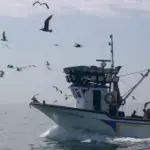
Meanwhile, higher fuel prices and declining profits from fishing have affected investment in Japan’s fishing fleet during the past decade. Most fishing boats are over 20 years old. To assist in modernising the fishing fleet the Fisheries Agency is implementing a package of measures aimed at restructuring fishing vessel operations and assisting the purchase of energy-saving, labour-saving vessels.
Currently 217,000 fishing vessels are in use of which 91,000 are fitted with outboard motors, and 95,000 are less than 5t. The number of vessels in the range of 5 to 20t is 24,500 while 570 vessels are sized 20 to 100t.
Among larger vessels the fishing fleet includes 1,230 vessels from 100 to 500t and 13 vessels sized 500t and over.