




Isle of Man hydrodredge sea trials complete
Sea trials to test a low impact ‘hydrodredge’ which uses a cup arrangement instead of scallop teeth to extract shellfish from the sea bed were completed last year by researchers at School of Ocean Sciences, Bangor University, Wales, and a report of their findings has now been published.
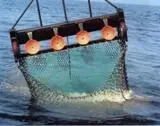
The project, part financed by the Seafish Industry project fund and the Isle of Man’s Department of Agriculture Fisheries and Forestry, has been investigating the potential for this type of gear to exert less damage on the seabed and marine benthos.
The cup arrangement on the hydrodredge works by deflecting water downward in a turbulent wave sufficient to lift scallops from the seabed and into the trailing net or chain bag.
The system was originally designed at the Massachusetts Institute of Technology for the New England giant scallop fishery (Placopeten magellanicus). A prototype of the gear underwent a preliminary investigation in the Isle of Man King Scallop fishery in April 2007, with the results being encouraging enough to lead to a more thorough evaluation in August 2007.
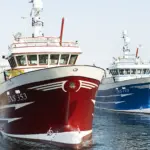
These took place around the Isle of Man using the commercial scallop vessel, FV De Bounty (CT73). During the trials, the hydrodredge was fished on one beam, with three 75cm wide Newhaven dredges being fished simultaneously on the other. A series of comparative tows then took place over different fishing grounds (smooth, medium and hard) and at different speeds (2.5 knots and 4.0 knots).
The study found that the hydrodredge significantly reduced the proportion of dead scallops and bycatch compared with the Newhaven dredge. However, there was no difference between the gears in the incidence of non fatal damage to captured organisms.
The project also found that the hydrodredge was significantly less efficient at lifting out heavily embedded king scallops than the equivalent Newhaven dredges, catching between 60 and 90% fewer scallops – a much lower rate than the preliminary trials suggested in the US.
The US trials however were targeting P. magellanicus – a species that is more active and lives directly on, rather than recessed into the seabed. This type of surface living behaviour is shown in UK waters by the queen scallop. The hydrodredge could, therefore, offer exciting potential for targeting queen scallops and other similar species whilst at the same time reducing the environmental impact on the benthos. On this basis, project researchers believe the hydrodredge merits further investigative trials focusing on shellfish species such as these.
Related Articles
 FISHING TECHNOLOGY
 NEW VESSELS
 FISHING TECHNOLOGY